

Issue 206
2023: A look ahead


Well hello there, 2023! We’ve made great strides in the past year, gotten our hands wet in the lab (Jessica at least 😉), built data systems, and even delivered phages for patients. This year we aim to do a whole lot more of that! This week, we’re also re-launching the Instill experimental community forum, so come check it out.

Sponsor
Sponsor

From A-Z of phage development, the 5th Bacteriophage Therapy Summit is the definitive commercial-orientated conference to accelerate phage-based applications for organizations pioneering with phage pipelines.
Explore advancements in clinical trial design to push medicinal phage therapies to the clinic, CRISPR-based gene editing to improve functionality, the rise of lytic technologies, and alternative potential for phage technologies beyond human health. This is the conference of the year for biopharma, clinicians and consumer product developers to harness the safety and efficacy of phages.
Download the full Event Guide here This event takes place February 21 - 23, 2023
Community digest1alert5updates8jobs2posts
Phage alert
Urgent need for Pseudomonas aeruginosa phages for a patient in the USA
We are urgently seeking Pseudomonas aeruginosa phages for a patient in the USA.
Ways to help at this stage:
- By sending your phages for testing on the patient's strains
- By receiving one or more of the patient's strains and testing your phages
- By receiving the strain(s) and using it/them to search for new phages
- By offering to prepare phages supplied by others to clinical grade
- By helping spread the word about this request
- By providing us with names/email addresses of labs you think we should contact
Please email staff@phage.directory if you can help in any way, or if you would like further details/clarification.
Let’s make a difference, Phage Directory
Updates
Technophage, a phage biotech company in Portugal, successfully completed its Phase I/IIa Clinical Trial of TP-102, a phage cocktail for infected diabetic foot ulcers.
The Antibacterial Resistance Leadership Group will begin a phase 1b/2, multicenter, randomized, double-blind, placebo-controlled trial to examine safety and microbiological activity of phage therapy in persons with cystic fibrosis colonized with Pseudomonas aeruginosa.
From 2018 to 2022, IPATH initiated phage hunts for 265 patients, but 25% couldn't proceed due to lack of phages. IPATH has now partnered with Korean phage company MicrobiotiX; IPATH will screen and send sample isolates to MicrobiotiX, who will screen and send phages back to IPATH.
Cole Matrishin (University at Buffalo) and colleagues published a new preprint on how phages are unrecognized players in oral pathogen Porphyromonas gingivalis ecology, contributing to strain-level diversity and the species pangenome. They demonstrate that prophages harbored by a model strain of the pathogen are active, producing extracellular viral particles.
In a new GARDP antimicrobial viewpoint piece, Jon Iredell and Jessica Sacher of Phage Australia discuss ways to improve the economics of personalized phage therapy as part of a clinical service, including increasing the number of patients who benefit from each phage batch, establishing safety through endpoint rather than full process controls, and exploring new payment models like value-based pricing.
Jobs
The Department of Biology at the University of Copenhagen is looking to fill a PhD fellowship in bacteriophage-pathogen interactions and the potential of using phages to control fish pathogenic bacteria in the production of fish in aquaculture.
The School of Pharmacy and Biomolecular Sciences at the Liverpool John Moores University is hiring a Research Fellow to work on developing large serine integrases as tools for constructing and manipulating genetic circuits for use in synthetic cells.
Felix Biotechnology is looking for candidates with backgrounds in ML/AI to join their team in developing tools to help patients prevent deaths and create a better future. They specialize in collecting data quickly and cheaply, mapping viral genotypes to phenotypes, and printing and booting that code into self-replicating biological nano-robots.
The Pavel Plevka Research Group at Central European Institute of Technology (CEITEC MU) is seeking a postdoctoral scientist to use cryo-electron microscopy and tomography to determine three-dimensional structures of viruses and phages.
Vesale Bioscience is looking for a Production Supervisor to develop, organize and optimize the production of bacteriophages for treating antibiotic-resistant bacterial infections in a hospital environment. The Production Supervisor will work with teams from Vesale Bioscience and the Queen Astrid Military Hospital to transfer production activities to a new site.
The Institute for Parasitology at the Vetsuisse and Medical Faculty is seeking a postdoc to study responses of mosquitoes to skin bacterial and host volatile organic compounds by video tracking, to identify key microbial compounds that mediate the attraction of mosquitoes and create in-vitro skin bacteria community models to test selectively inhibiting skin bacteria with phage lysins.
The Niels Bohr Institute at the University of Copenhagen is looking for a scientist to explore questions at the interface between physics and biology. The project is part of the research project “Universal Growth Laws of Viruses of Bacteria”, led by Associate Professor Namiko Mitarai and financed by NERD Program, Novo Nordisk Foundation.
The Helmholtz Centre for Infection Research (HZI) is looking for independent Helmholtz Junior Research Group Leaders in the field of infectious disease research.
Community board
The Ibadan Bacteriophage Research Team, an undergraduate SEA-PHAGES team at the University of Ibadan, Nigeria, announces the launch of the 2nd edition of the team’s journal issue, PHAMILIA. This is the very first undergraduate research journal focused on bacteriophage biology. It showcases publications on diverse subjects of bacteriophage biology, from the team and other guest writers. To download: https://ibadanphageresearchteam.org/
Exciting day 🤩 Our newly born GIVoM - Gruppo Italiano Virus of Microbes met for the first time! Italians – in the country and abroad 🇮🇹 - working in this field 🧫🦠🧬 will gather every month to share our research and support each other.❗️PM if you want to know more about this! - via Michela Gambino on LinkedIn
Hey look, how is it already 2023?? Time goes pretty fast when you’re having fun and doing a whole lot of awesome phage stuff — like building an entire phage therapy system from zero to bedside in less than a year!
In our “look ahead” issue last year, we said we would build the Operating System for Phage Therapy. And we did that — we prototyped data systems and lab protocols into a fully functional phage therapy operating system that lets us do phage library management, phage matching, production, and monitoring. This engine was enough to provide therapeutic phages for a few patients! This year, we’ll take what we learned last year to make our phage therapy operating system cheaper, better, faster!
Building out the Phage Therapy Operating System at Phage Australia
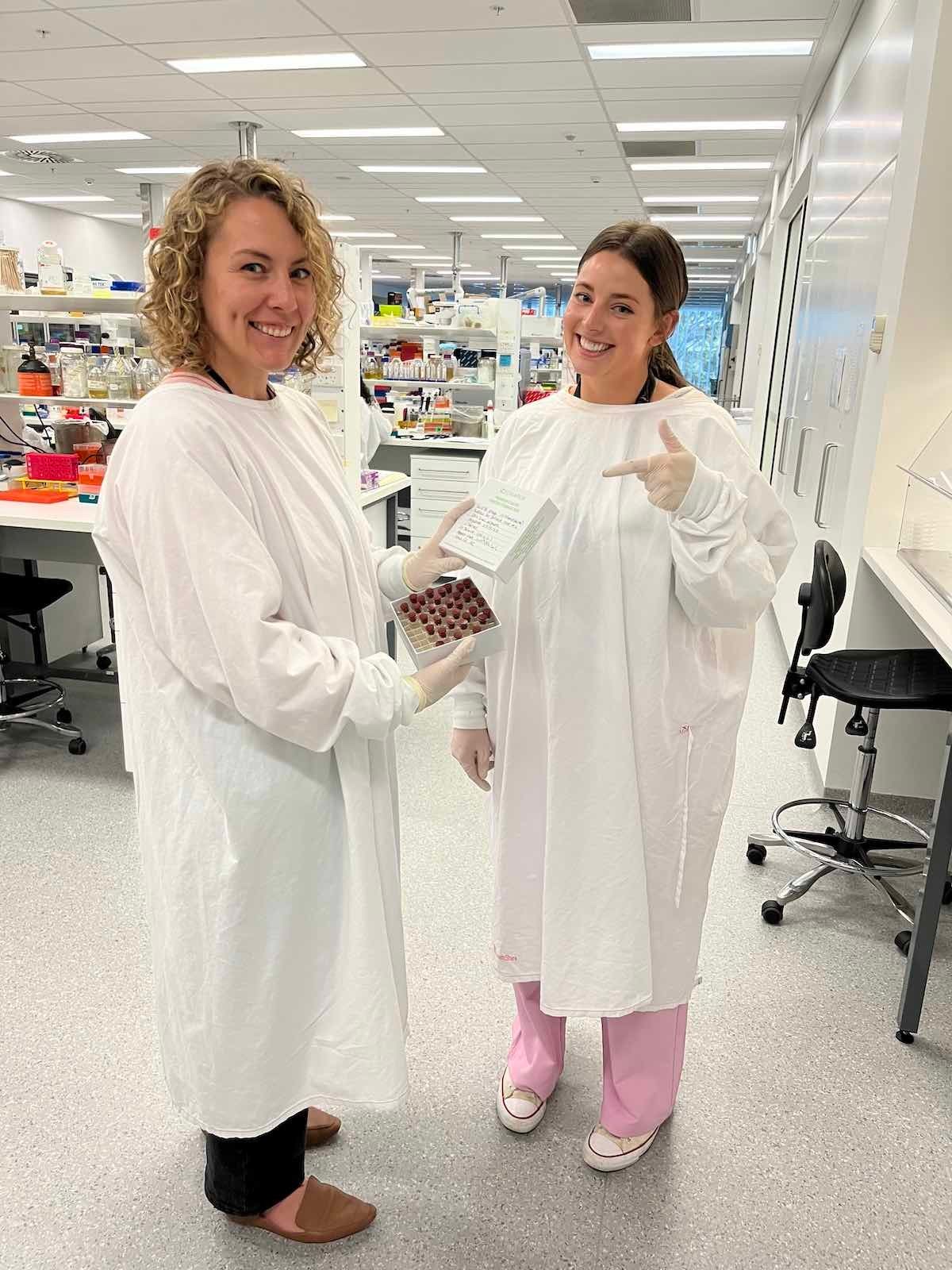
Jess and Steph with their first batch of patient-ready phage
Last year we built and launched the beta version of the operating system. We used lots of simple tools like Notion, Airtable and Google Sheets to put together our “operating system”, which essentially “is a collection of SOPs, methods, and digital tools like apps, databases, APIs, and data dashboards to aid us in the data collection and decision-making”. We’ve learned a lot along the way, and we’re close to out-growing some of these systems. We’re also ready to start exploring the lab automation process!
This year we’ll focus on building out and uniting our data collection systems under one roof (”Phage Atlas”). This will let us dig deeper into the data! We’ll also be battle-testing and publishing our wet lab protocols, and hopefully even some case reports.
Hopefully this is the year we’ll dabble in lab automation, with tools like Opentrons!
Either way, there will be many trials and tribulations, much learning, and many more articles from both Jessica and me (Jan) in Capsid this year. Jessica will get deeper in the wet lab, and I’ll get much more nerdy with data systems and database stuff. I’ll probably even share some of our code and systems, and perhaps even open up access to those who are interested!
This year, Jessica is excited to up upgrade the operating system with more robust documentation, protocols, and automation. I’m excited to work on connecting the wet lab, genomics, report generation, and patient monitoring data tools. This way we can get better at giving people accurate estimates (for how long phage-making would take, and how much it would cost, for a given patient or set of patients). Plus, we’ll have an easier time scaling up the work as well, which will allow us to treat more patients and collect better data!
Experiments with Phage Directory
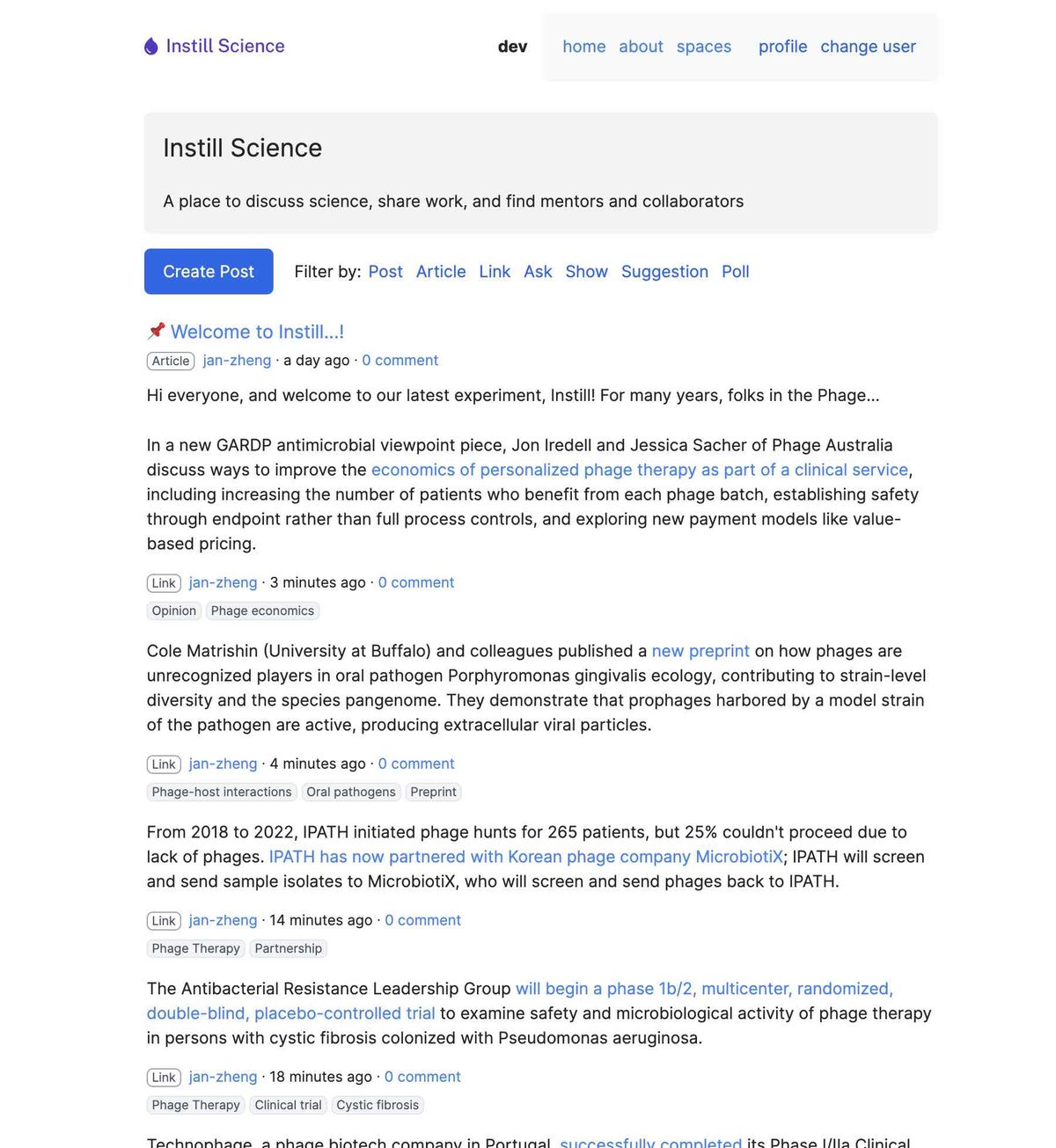
As we’re super busy being heads down working on our core phage project, we won’t have a lot of time to run community events. However, we have something exciting to share!
You might have noticed something different on the Phage Directory homepage recently. This is Instill, our running experimental community project (Thanks to everyone who participated in the peer mentorship and peer review experiment!). We learned a ton, and have gotten lots of feedback.
One thing people have asked for is a more general “forum” where people can just ask questions, find collaborators, and such… that isn’t Slack. Messages disappear in Slack. Knowledge is lost. It’s a pain to find anything, and it’s devolved into a mess. So, I’m pretty excited to try this new tool out, and see how it fares as a community x knowledge base type of tool.
This is the latest re-launch of Instill, as a micro-community forum platform.
Eventually this will be the place to post community board posts, jobs, and share and discuss any cool news and papers you’ve found. We plan to create various channels like “#find-a-collaborator”, “#ask-and-answer” over the next few months. We also want to create more dedicated threads about hyper-specific phage topics — for example what topics you might discuss in a Biobank Working Group. We have so many ideas!
Experiments with Capsid & Tail
This year, we’re also eager to try a few more formats for Capsid, from short, 5-question interviews to quick review papers of certain niche phage topics. Many of these will come from our own chatting with phage researchers, or digging deep into certain topics for our Phage Australia needs.
We’ll also play around with integrating and connecting the newsletter more closely with Instill posts. For example, add a “comment” link to certain posts in Capsid, that point to their Instill post counterparts, etc.
2023: A year of experiments and tons of learning
This is another year where we’re very much heads down in both the lab and in our laptops. Coming out of the year, we want to have a solid “Operating System” set up, with robust documentation, systems, and some initial attempts at automation. By the end of the year, we almost want our system to become sort of “a kit” for anyone to adopt and use. That would be a sweet reach goal for the end of the year — for another lab to replicate some of our success, purely from reading our documentation and using our systems.
The larger phage community is doing more than ever, with Viruses of Microbes doing another conference (in Georgia, no less!) this year, and hints and rumors of Evergreen potentially happening again (sorry folks, I have NO inside information… being in Australia makes gossip hard to come by 🥲).
Hopefully we’ll also kick off some other community projects like the Biobank Working Group and other small ideas we’ve had bubbling for a long time!
Also — you might also have noticed that I (Jan) have taken up Capsid & Tail writing and planning duties, because Jessica is so busy in the lab every week. This means that C&T will take on a more casual tone this year, and with lots more technical and data engineering posts to look forward to!
Also on our agenda is petting / holding a koala bear. And seeing a wild kangaroo!
Here’s to a year of learning, experimenting, doing great work, and having fun!
With 🥂, — Jan & Jessica, Phage Directory <>={
Jan Zheng, MHCI
I'm Jan, the other half of Phage Directory, and co-write Capsid & Tail.
Previously, I did data work at Phage Australia / Westmead Institute, where I built the biobank databases, data systems, and bioinformatics workflows for the clinical trial
I have a background in computer science and human-computer interaction, and I'm currently full-time at building the agentic layer for science at Nvidia.

Jessica Sacher, PhD
I'm a co-founder of Phage Directory and have a PhD in Microbiology from the University of Alberta (I studied Campylobacter phage biology). For Phage Directory, I help physicians find phages for their patients, and I'm always trying to find new ways to help the phage field grow (especially through connecting people and highlighting awesome stuff I see happening in the field).
I spent 2022-2024 as a postdoc in Jon Iredell's group at Westmead Institute for Medical Research in Sydney, Australia, helping get Phage Australia off the ground. I helped set up workflows for phage sourcing, biobanking, diagnostics, production, purification and QC of therapeutic phage batches, and helped build data collection systems to track everything we did. We treated more than a dozen patients in our first year, and I'm so proud of that!
As of 2024, I joined the Bollyky lab at Stanford University as a Staff Scientist, where I'm focused on phage engineering and delivery (to both microbial and human cells) and hydrogel-embedded phage cocktail development for wounds!