

Issue 306
Does every scientist need an AI co-scientist?

"It was right in front of us the whole time." Imperial College London professors José Penadés & Tiago Costa challenged Google's new 'AI co-scientist' with a phage PICI question they'd just solved after years of work. Given their unpublished data, AI quickly identified the key experiments that would have saved them years.
Sponsor
Sponsor
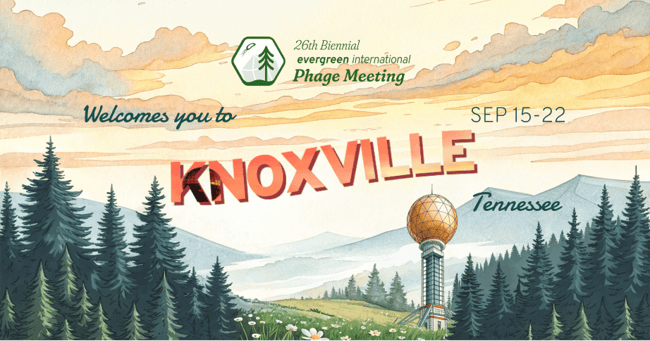
Evergreen 2025 is happening, and for the first time in its 50-year history, we're taking it on the road!
Register for the 26th Biennial Evergreen International Phage Meeting, which will be held August 3-8, 2025, at the University of Tennessee, Knoxville!
Hosted by the Phagebiotics Research Foundation, the Denes Lab, and UTK colleagues, this event aims to bring the magic of Evergreen to a new location.
Follow @Evergreen_Phage on X for updates, or stay tuned here — Jan and Jess are excited to help out again this year!
Community digest5updates3jobs1post
Updates
Qeen Biotechnologies (in partnership with Cellexus, CPI, University of Exeter, NRC Canada, and Unity Health Toronto) was awarded a $2M CAD grant through the Canada–UK: Biomanufacturing of Biologics and Advanced Therapies program to develop a scalable GMP manufacturing platform for phage therapies.
Michael Shamash (McGill University) and colleagues published a new preprint on improving gut virome comparisons, showing that incorporating predicted phage host information enhances the analysis and comparison of gut viromes across different studies.
Amandine Maurin (University of Montpellier) and colleagues published a new paper on convergent evolution in a Salmonella phage, showing expanded host range and increased virulence evolved through parallel mutations, particularly in genes for nucleases, dUTPase, and caudal proteins.
Giuseppina Mariano, Justin Deme (University of Glasgow & National Cancer Institute) and colleagues published a new paper on structural and mechanistic insights into Zorya phage defense systems, showing ZorAB forms an ion-driven motor complex that recruits nuclease effectors to damage host DNA and provide population-wide immunity against phages.
Nanami Kubota (University of Pittsburgh) and colleagues published a new preprint on filamentous phage exploitation of bacteria, showing that mutant Pf phages can drive P. aeruginosa populations to lower fitness through superinfection and miniphage invasion.
Jobs
We are seeking a highly motivated Postdoc candidate to join the Phage Lab in Frankfurt, Germany, for a joint research proposal. Applicants should have a Ph.D. or equivalent, or be close to completion, with a strong publication record, excellent organizational and teaching skills, and several years of experience working in a phage lab. The candidates should also be currently based outside Germany and have the ability to work well in an international, intercultural, English-speaking team. Contact: Silvia Würstle.
Eligo Bioscience in Paris is hiring a Senior In Vivo Scientist - Microbiologist, to study host-microbiome interactions and support preclinical development of microbiome therapeutics using in vivo, ex vivo, and in vitro models.
PhD position: Phage pharmacokinetics at UiT The Arctic University of Tromsø, Vascular Biology Research Group in Tromsø, Norway
This PhD project aims to explore the pharmacokinetics and biodistribution of phages using clinically relevant mouse models and primary human cell cultures. Specifically, the study will investigate the role of the liver's scavenger system, including Kupffer cells (KCs) and liver sinusoidal endothelial cells (LSECs), which are known to play a significant role in the clearance of bloodborne pathogens and nanoparticles.
For more info, please contact: anett.k.larsen@uit.no
Community board
Has anybody got borrelial phage φBB-1? We'd also need a recommendation for correct concentration, dosage and administration. Thank you all! — Barbara Brenner
This week, we’ve got a great story for you — both from a phage biology perspective, and a ‘should we use AI for science?’ perspective. This is a story that was covered last month by Forbes, BBC, and several other news outlets, mainly because of how exciting it is for Google, who created a new AI tool for scientists, and for everyone who cares about AI/wonders if it’s worth the hype.
I was super excited when I saw this story (because I am always excited if we scientists get new tools to help us go faster), but also because this mainstream news-worthy story was actually involving a researcher I knew and had followed for years! It was a phage story! So I had to reach out to José and see if he’d let us interview him on Podovirus.
Excitingly, even though he’d been exhaustedly fielding media calls all month, he was happy to have a chance to talk to our community of phage scientists, to get into the nitty gritty of the science, and discuss the reality, his own skepticism, the humbling experience of working with an AI who saw something he didn’t, and what it all could mean for science. He and his colleague Tiago have published all of this, from the biology to experiment they did to test the AI tool (links below!), but first, here’s their candid conversation (and here on YouTube) — we hope you enjoy!
— Jessica
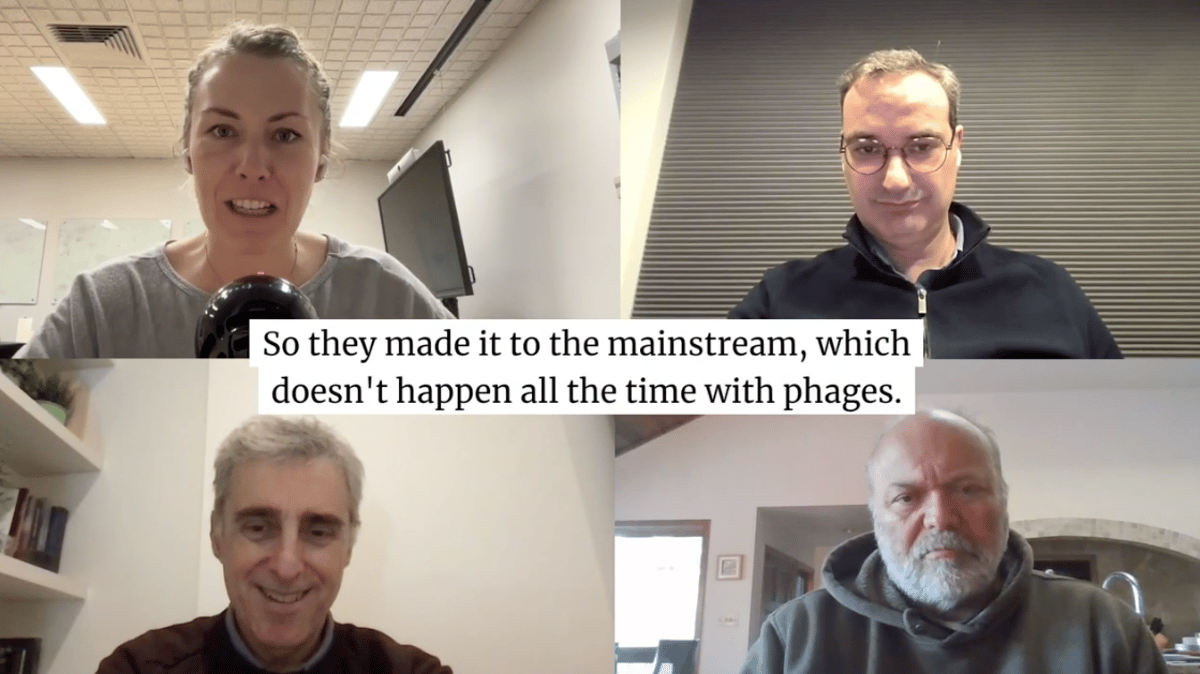
When Imperial College London professor José Penadés and his lab discovered that phage satellite entities called capsid-forming PICIs (Phage-Inducible Chromosomal Islands) could swap tails to infect different bacterial species, his lab had solved a puzzle that had eluded them for years.
Just before he was ready to publish, however, his collaborator Tiago Costa (another Imperial College Professor) told him about a new AI tool (Google’s ‘AI co-scientist’) he was testing. Tiago was really impressed with the hypotheses it was generating, and this piqued José’s interest.
The two developed a plan. Instead of waiting years to prove whether the AI was right or wrong about the experiments it was proposing for Tiago’s project, could they test the system in reverse? Could they instead first show the AI all of José’s lab’s unpublished data about PICIs, which they’d only finally figured out how to interpret, and see if it could get the same answer?
To their surprise, delight (and no doubt a bit of dismay), the AI quickly came up with the key experiments it had taken them years to consider doing.
Why? According to José and Tiago, it has to do with their own scientific biases, which made them not contemplate some ‘obvious’ explanations for the patterns they were seeing.
On the newest episode of Podovirus Podcast, Joe and I spoke with José and Tiago about the entire process — from the fascinating PICI biology question they were mystified by (and finally solved), to the experiment they did to test the AI, how it humbled and inspired them, and how they now think about how to use AI for science. Lastly, we dig into what this all means for us human scientists. What scientific biases might we each be bringing to the table? When is ‘beginner’s mind’ exactly what we need to make sense of our data? Can we use AI to help us find the patterns in our work that might be lying in plain sight?
Highlights from our conversation:
- José's team discovered that capsid-forming phage-inducible chromosomal islands (cf-PICIs) can exist as "tailless capsids"; and that—contrary to prevailing assumptions in phage biology—these tailless cf-PICIs acquire tails after assembly and cell lysis by binding to free tails from different phages
- This modular "mix and match" capability allows PICIs to dramatically expand their host range by pairing with tails that target different bacterial species or genera
- When presented with the same question, a bunch of unpublished observations, but none of the conclusions, Google's AI Co-Scientist tool suggested the correct mechanism (along with a set of testable hypotheses to prove it)
- The researchers estimate that using this AI tool sooner could have reduced their failed experiments (and unneeded rabbit holes) from ~90% to 50%, potentially saving years of work
- The discovery itself has significant implications for phage therapy, as it suggests a new way synthetic phages with customizable and much broader host ranges could be engineered. Finally, after years of work, they have the mechanism (and now they also have an AI tool to hopefully help them crack their next biological mystery a lot faster!)
A few snippets from the episode…
On how scientific bias delayed their discovery:
José: "We were biased. That's the problem we had. For many years, I always thought—and all phage biology people think—that after infection, what you have are infective particles with the capsid and the tail. We didn't understand why we had PICIs that could be induced but didn't get transferred... We were so biased we couldn't see what was actually happening."
"We have been thinking a lot, okay, how this machine got the right answer. Okay. And it's very frustrating. It's very frustrating because we have the answer there and we didn't see it.”
On the AI's unbiased approach:
José: "Google [AI co-scientist] didn't understand what's happening here, but made the most simple connection. If you are in many different species, and to go to these species you need a tail, you are binding to different tails. That's it... We all knew that the tail determines tropism. It was obvious, but someone needed to tell us."
On adapters and connectors determining specificity:
Tiago: "The tropism will be always determined by the tip of the tail... But the neck region, where the port or the adapter and the connectors are, will have some role in determining that tropism... by generating a promiscuous or a very specific structure that binds only one or several phage tails."
What's next:
José and Tiago are now investigating whether regular phages (not just PICIs) can also exchange tails in natural environments. They're developing IP around synthetic phage particles with customizable host ranges, which could potentially overcome one of phage therapy's biggest limitations—narrow host specificity. Additionally, their labs are continuing to work with Google to test the co-scientist on new research questions, comparing AI-driven hypotheses with experimental results.
Listen to (or watch!) the full episode:
Learn more:
- Google's Co-Scientist preprint - Details on how the AI system generates and ranks competing hypotheses
- Penadés & Costa's preprint on PICI mobility - The research paper detailing the novel mechanism of PICI transfer
- The team's evaluation of Co-Scientist - Their analysis of the AI system's performance on phage biology questions (and comparison to other AI systems like ChatGPT)
- Want to learn more about phage satellites? Check out this new Nature Reviews Microbiology by José's team
- José's lab: https://profiles.imperial.ac.uk/j.penades/about
- Tiago's lab: https://profiles.imperial.ac.uk/t.costa

Jessica Sacher, PhD
I'm a co-founder of Phage Directory and have a PhD in Microbiology from the University of Alberta (I studied Campylobacter phage biology). For Phage Directory, I help physicians find phages for their patients, and I'm always trying to find new ways to help the phage field grow (especially through connecting people and highlighting awesome stuff I see happening in the field).
I spent 2022-2024 as a postdoc in Jon Iredell's group at Westmead Institute for Medical Research in Sydney, Australia, helping get Phage Australia off the ground. I helped set up workflows for phage sourcing, biobanking, diagnostics, production, purification and QC of therapeutic phage batches, and helped build data collection systems to track everything we did. We treated more than a dozen patients in our first year, and I'm so proud of that!
As of 2024, I joined the Bollyky lab at Stanford University as a Staff Scientist, where I'm focused on phage engineering and delivery (to both microbial and human cells) and hydrogel-embedded phage cocktail development for wounds!