This month, Jan and I were asked to talk to a bunch of grade 7 and 8 kids in the small, rural town of Olds, Alberta, Canada. We talked about phages, phage therapy, and Phage Directory.
This week, we wanted to share a bit about the experience and the resources we used (a slideshow (PPT|PDF), a few great videos, a stuffed phage, and a hand-knit bacterial cell made by the talented Dr. Leen Labeeuw. We also wanted to encourage some of you to do the same in the new year!
Middle school kids want to hear about phages!
To be honest, we didn’t really know what we were doing, going into this, and both of us had essentially forgotten what it felt like to be in grade 7 or 8. However, it turned out great, and the kids peppered us with questions, many of which would have actually been perfectly acceptable for graduate students to ask at a seminar.
We got questions like: “Has anyone tried phage therapy in plants?”, “Will the phages attack the good bacteria in your body too?”, and “After you’ve had phage therapy, what happens to the phages? Do they stay in your body and help kill bacteria that infect you later?”. We also got a few questions no one had yet asked us, like “Are there phages in swimming pools?” and “Can you take a phage out of a person after it’s been used in phage therapy, and then use it on someone else?”.
We didn’t know what the kids would know when we got there, but we asked them, and they had a lot to say. Some of these kids had heard about antibiotic resistance. Most didn’t know anyone who’d had a resistant infection, but some did. Most hadn’t heard about phages, but the dozens of questions we got throughout the day told us they were absolutely interested in hearing about them, and brimming with ideas on how to use them to fix problems.
Our challenge for 2019
We want to extend a call to all phage biologists, whether you work in a lab or a company, whether you’ve been around a while or are new to the phage field…
Would you consider talking to a classroom (or even a group of adults!) about phages in 2019? If you’re up for the challenge, let us know by filling out this quick pledge form.
To help hold us all accountable (we also plan to talk to more classrooms in 2019!), we’ll check in with everyone who pledges throughout the year.
After you've given your talk, please email or tweet us your stories/testimonials from students and teachers! We’d love to share them with the community. If we feel extra inspired by your story, we'll send you a Phage Directory T-shirt!
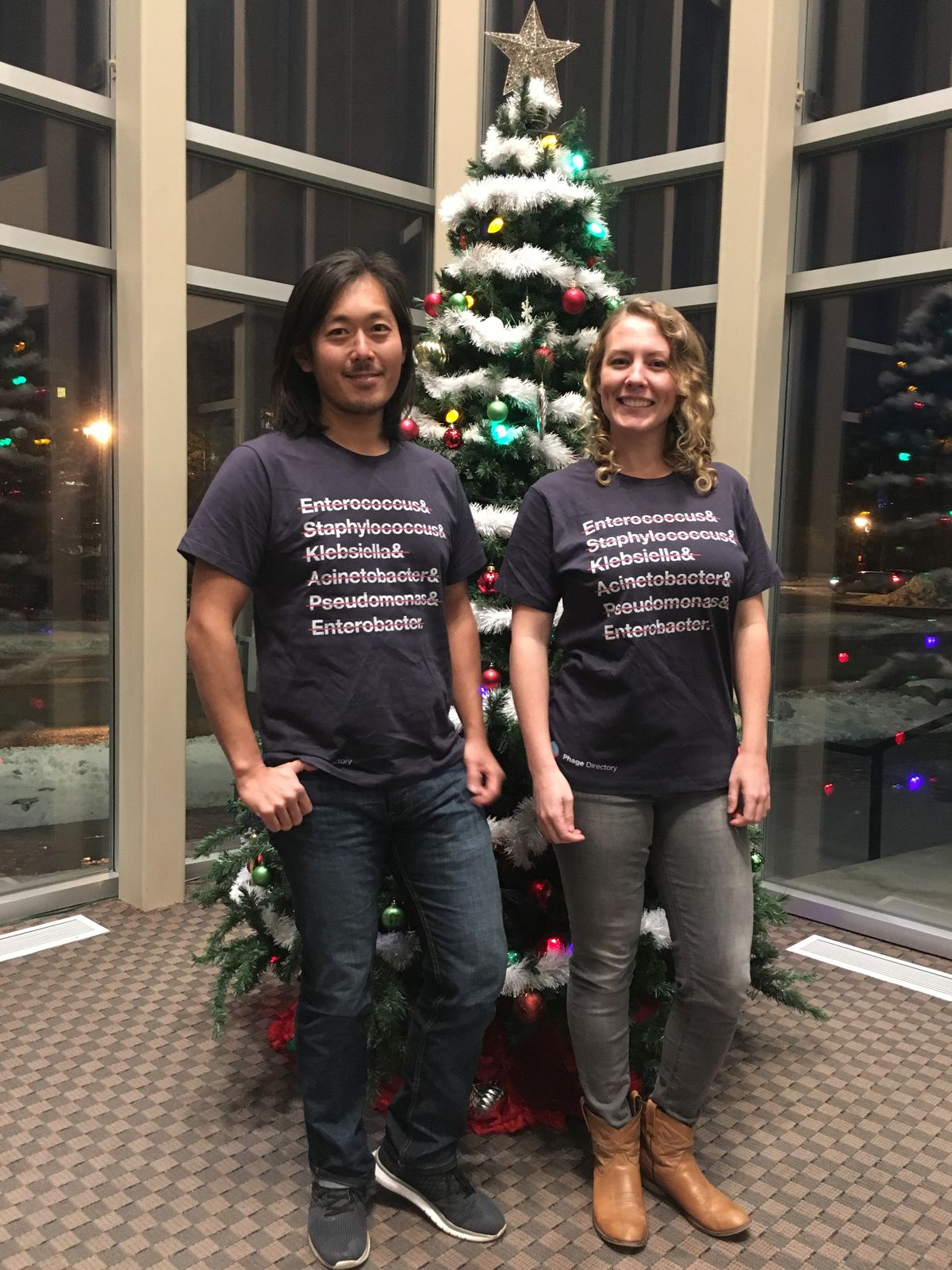 Photo credit: Julian Sacher.
Why you should do it
It seems like a small thing, and we almost didn’t do it (with so many other pressing issues to take care of, it can be hard to schedule in something that is both purely optional AND a little nerve-wracking). But it was surprisingly fun, incredibly rewarding, and we think it really could make a difference for kids to start hearing more about these concepts. Plus, the kids (and teachers) loved it! To illustrate this, here's a testimonial from the teacher who hosted us:
"The students are STILL talking about it and they are asking questions about it. The students in my room have been very curious about phages. Upon talking with my colleagues they have said the same thing. The kids were fascinated and they want to help you search for answers. They loved the “science-fiction” type explanation and the videos and the applications and implication for extremely sick people. The easy to understand video explanation was fresh and current and relevant. It was extremely well done. They were engaged the entire time and they didn’t stray far off the conversation. Without a doubt in my mind you could have dropped a pin in my classroom (with 81 students) and heard it."
As representatives of our growing global phage community, we’d love it if you took part, and we’d love to hear and share your thoughts on what goes really well (and what doesn’t)!
Choosing a school
We went to Deer Meadow School in Olds, Alberta, Canada because we were invited by Sandi Hoppins (@SandiHoppins), a teacher who works there. Sandi was incredibly supportive, made sure we had access to powerpoint and a projector, and had alerted the kids and several other teachers of our arrival. In addition to her own class, she managed to round up several classes worth of students into each classroom (apparently we spoke to 135 kids in total!). She set it up so we would speak to two groups of students (and doing the presentation twice in a row was actually really great practice!).
We suggest that to set this up, you reach out to local schools and ask to be connected with a science teacher, then explain a bit about what you do. It may be best to go through a friend or family member who knows someone who teaches at the school. Of course if you’re a parent of a child in school, you’d already have these connections.
If you have trouble finding a school or group that will host you, or you’d rather do this from the comfort of your home, office, or lab, you can check out Skype a Scientist (sign up form here), an organization connecting scientists with teachers to facilitate talks like these.
Importantly, feel free to use and distribute these resources:
This is our last issue before Christmas. Even if you don’t end up finding a classroom to teach about phages, maybe you can share these slides or videos with your family members (when they inevitably ask you what it is you study/do for the umpteenth time…).
Thanks for reading! We wish you a warm, joyful holiday season and a very happy new year!! See you in January!
– Jessica and Jan <>={



