

Issue 7
Special issue: An update on our current phage crowdsourcing campaign

To provide a window into what happens during a phage hunt, we're devoting this issue to showing some of what's happened over the last three weeks. We've put together an infographic to help illustrate how labs across the globe have come together in support of this cause.
Community digest5updates
Updates
The European Research Council just released the results of its Consolidator Grants 2018 competition, and two prominent phage research labs have been funded! Many congratulations to the labs of Rob Lavigne of KU Leuven, who will tap into phages as synthetic biology tools, and Anat Herskovits of Tel Aviv University, who will study phage-pathogen cooperation during mammalian infection.
A new paper by Gerlach et al. shows that a phage gene can help MRSA evade immune defenses. See also this commentary on the paper.
Another mini phage therapy documentary is out! This one was made by Freethink, is 12 min long, and documents the amazing story of "Paige's Phages" – Pseudomonas phages from Ben Chan's lab at Yale helped a young woman regain her deteriorating lung function.
Kathryn Kauffman and Martin Polz of MIT have developed new ways of streamlining phage propagation and titration methods to save us all time and materials. You can also find the protocols here on Protocols.io!
A group of students from the Technical University of Munich won second prize in the 2018 International Genetically Engineered Machine (iGEM) Competition for their work creating a cell-free phage propagation system called Phactory. Amazing work!
Three weeks ago, we went over how phage crowdsourcing works – catch up on that here. Coincidentally, the same day we released that issue, we received a request for phages for a patient. We put out a Phage Alert, and have since received an incredibly impressive response from the phage community.
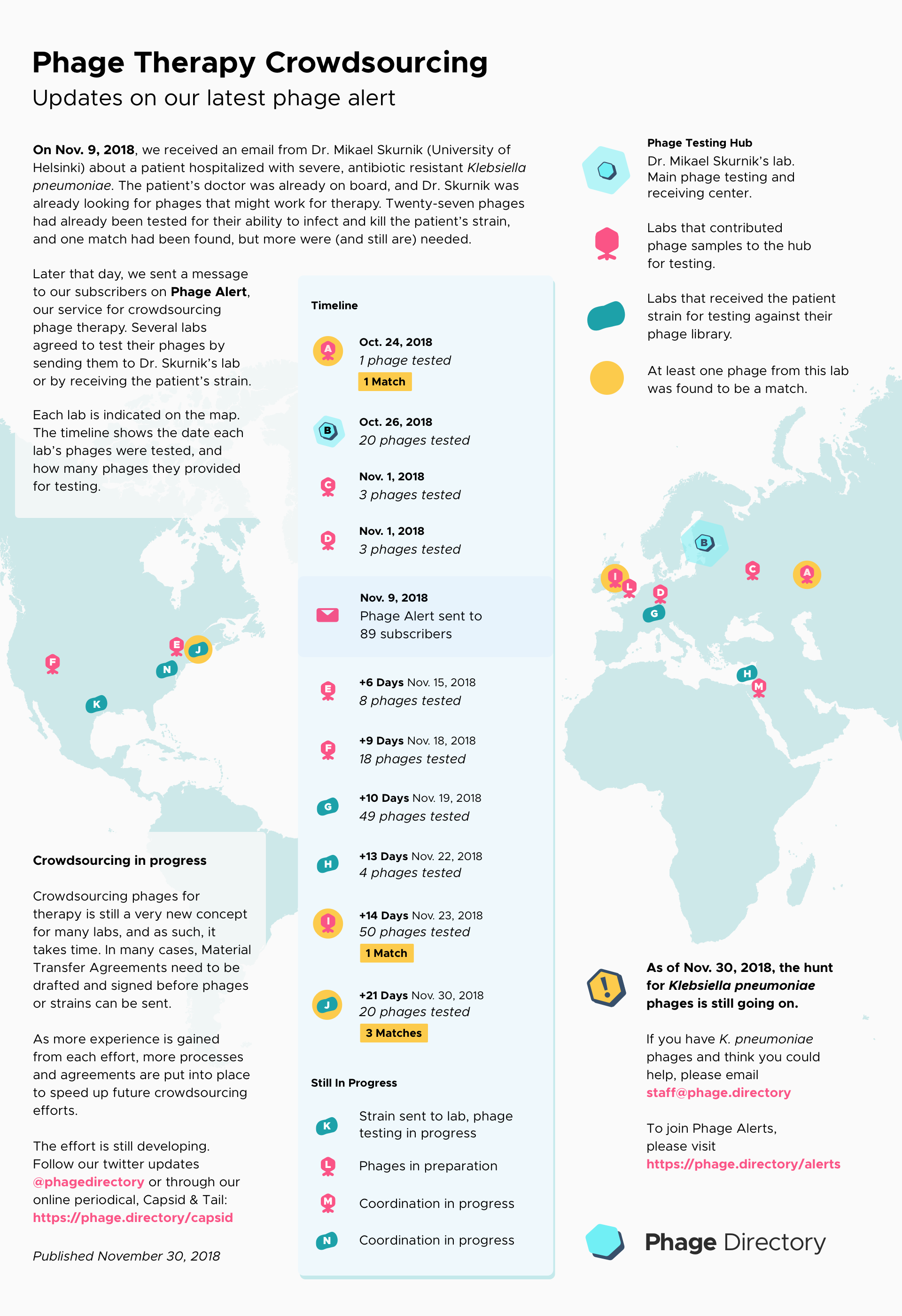
To provide a window into what happens during a phage hunt, we're devoting this issue to showing some of what's happened over the last three weeks. We've put together the above infographic to help illustrate how labs across the globe have come together in support of this cause.
Link to the infographic: https://phage.directory/PhageTherapyCrowdsourcing.png

On Nov. 9, 2018, we received an email from Dr. Mikael Skurnik about a patient hospitalized with severe, antibiotic resistant Klebsiella pneumoniae. The patient’s doctor was already on board, and Dr. Skurnik was already looking for phages that might work. The Skurnik lab had already tested 27 phages (some of which had been contributed by other collaborators). So far, only one that could lyse the patient's isolate had been found, and more were needed.
That day, we put out a Phage Alert, which means that anyone subscribed to the service at the time (89 members) received an email.
By the end of that same day, we’d received emails from labs around the world offering to either send Klebsiella phages to Dr. Skurnik's lab in Finland, or to receive the patient’s strain for phage testing in their own labs. Several others emailed to suggest names of other labs that might be able to help.
The offers came from across the globe: from the USA, UK, Israel, and Switzerland. Most came within the first day after the Phage Alert.
As of today, just three weeks later, a total of 10 labs have contributed/tested phages and at least four more are preparing to do so. So far, 175+ phages have been tested, and five of these can lyse the patient's strain.
This phage hunt is not over. Some labs are still in the process of testing their phage collections and isolating new phages against the strain. We’re still working to identify other labs interested in helping out, so please get in touch if you or someone you know can help.
We are immensely proud of the response from the phage community so far. Thank you to everyone who has responded to or forwarded our Phage Alert, and especially to everyone who has taken time away from their research to prepare, ship and test phages and strains on behalf of this patient.
Over the next couple of weeks, we'll be back with another update. We're also planning to bring you more information and perspectives from some of the labs involved in the process. That said, if you've been involved in a phage hunt (either this one or one in the past), please reach out to us! We'd love to chat with you about your experience so we can help improve the process and inform the community about what it's like to be involved on the front lines.
Thanks for reading!
Jessica and Jan <>={
Frequently Asked Questions
Q: How much phage should be sent? A: 200 uL per phage is sufficient
Q: How should the phage be shipped? A: Phages can be shipped as a filtered lysate by Fedex at room temperature
Q: Can the patient’s strain be shipped, instead of our lab sending phages? A: Yes, although this is not as trivial as shipping phages.
Q: Do you provide a standard material transfer agreement (MTA)? A: We don’t, but we can provide a copy of an MTA that was used in a previous phage therapy case.

Jessica Sacher, PhD
I'm a co-founder of Phage Directory and have a PhD in Microbiology from the University of Alberta (I studied Campylobacter phage biology). For Phage Directory, I help physicians find phages for their patients, and I'm always trying to find new ways to help the phage field grow (especially through connecting people and highlighting awesome stuff I see happening in the field).
I spent 2022-2024 as a postdoc in Jon Iredell's group at Westmead Institute for Medical Research in Sydney, Australia, helping get Phage Australia off the ground. I helped set up workflows for phage sourcing, biobanking, diagnostics, production, purification and QC of therapeutic phage batches, and helped build data collection systems to track everything we did. We treated more than a dozen patients in our first year, and I'm so proud of that!
As of 2024, I joined the Bollyky lab at Stanford University as a Staff Scientist, where I'm focused on phage engineering and delivery (to both microbial and human cells) and hydrogel-embedded phage cocktail development for wounds!