

Issue 65
How to find phages for your research

Need phages for your research? This week, we bring you a guide on how to use Phage Directory to find the phages you need.
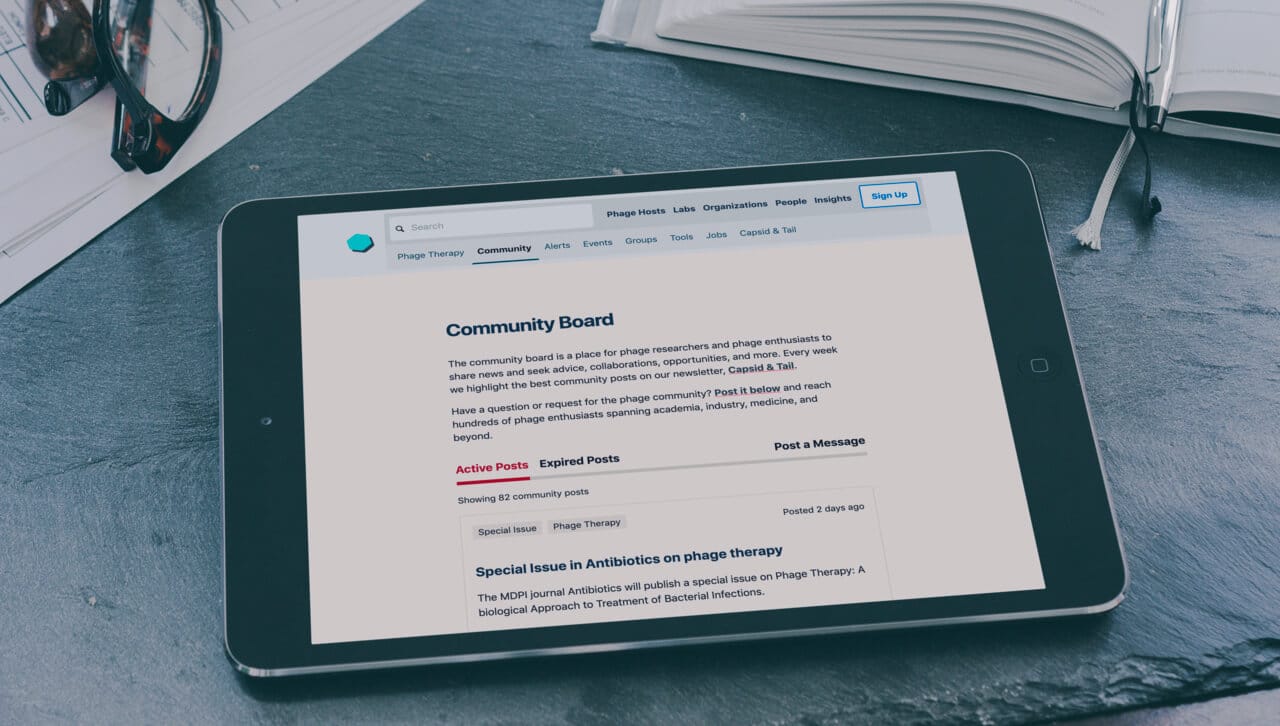
Community digest6updates3jobs2posts
Updates
Registration and abstract submission is now open for Viruses of Microbes 2020, which will be hosted in Guimarães, Portugal July 13-17, 2020!
P.S. Phage Directory is proud to have built the abstract submission and review system for this event!
Fernando Gordillo Altamirano (Monash University, Australia) and colleagues have published a new preprint on Acinetobacter baumannii phage resistance. They found that phage-resistant mutants were sensitive to complement, other phages, and antibiotics, and had reduced ability to colonize mouse blood and tissues. Plus, Jeremy Barr, who supervised this research, posted an informative Twitter thread explaining the paper!
A new Infection and Immunity minireview by Mihnea Mangalea and Breck Duerkop (University of Colorado) explores mechanisms and consequences of phage resistance.
Robert Schooley and Steffanie Strathdee wrote a commentary describing their take on the phage therapy case series published this month by the Iredell group, and on phage therapy as a field of growing importance. They consider this paper to represent "the best in investigator-initiated research" based in part on the study's collection of PK/PD and resistance kinetics data in patients that received phages.
Luís Melo (University of Minho, Portugal) and colleagues have published a new review on the efficacy of preclinical phage therapy done in the last 10 years.
DeepPetri is an AI-based tool by Phages4A that semi-automatically determines, measures, and categorizes lysis zones of images of phage spot tests. Sign up to be notified when they launch, and stay tuned to take part in a survey looking at how comparable researchers' current phage-counting methods are.
Jobs
Apply to work on a CNRS (French National Center for Scientific Research) project in Marseille, France involving characterizing phages against phytopathogenic bacteria.
Dr. Ellie Jameson (University of Warwick) is hiring a postdoc research fellow for a project on phage cocktail development. Hurry - today is the application deadline!
Contrafect, a company in New York City developing phage lysins as therapeutics, is hiring a senior research associate.
Community board
Seeking opinions: What makes a characterized bacteriophage?
I wish to find out from phage biologists on this platform what they would like to see in terms of metadata as a minimum for a characterised bacteriophage? Any comments can be sent to @AgendiaJuandem on twitter. Thanks
Special Issue in Antibiotics on phage therapy
The MDPI journal Antibiotics will publish a special issue on Phage Therapy: A biological Approach to Treatment of Bacterial Infections.
The deadline for manuscript submissions is 31 March 2020. The journal Impact factor is 2.921. Please see the link and contact Saija Kiljunen (via the link) for more information.
We started our Phage Alerts system in response to a patient's imminent need for phages, and we still use it for these kinds of requests. But we also get requests for phages for research purposes, and we handle these differently. Here's a quick guide on how to use Phage Directory to find phages for your research.
Start with a message on the Community Board
A good way to start is to post a request for what you need on our Community Board. Once approved, this message will appear in two places: in our weekly newsletter (the one you're reading right now), and on the Community page on the Phage Directory website. On this page, you can navigate between current posts and expired posts, and you can post a message.
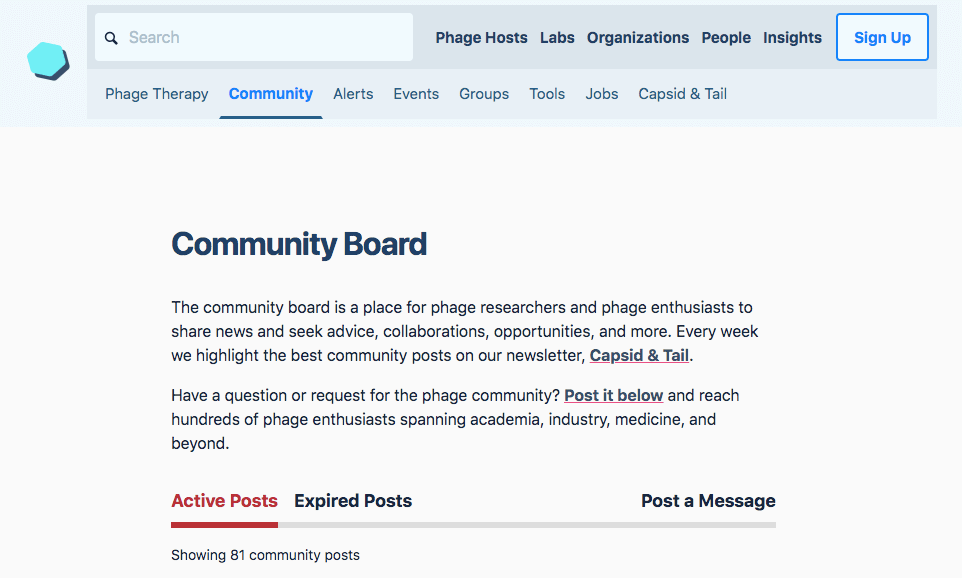 Post requests for phages, or browse posts anytime, on the Phage Directory Community Board.
What should you include in your post?
What are you looking for?
The most helpful piece of information is the host species you're looking to find phages against. If you're looking for a specific phage, specify its name (e.g. I am seeking phage P22), or if you're looking for any/all phages against a particular pathogen, go ahead and specify that (e.g. I am seeking phages that target Salmonella).
How should people get in touch with you?
The best thing to do is to leave an email address so people can get in touch with you to coordinate sending you phage(s) or to inquire further. If you don't want your email address to be public, leave a URL to your LinkedIn, ResearchGate, or Twitter profile, or some other URL that people can use to message you.
Search the Phage Directory database for researchers who work with the phage(s) you want
Another good way to find phages is to search our phage host database. You'll be able to type in a host genus or species and find individuals, labs and companies who work with phages that target that organism.
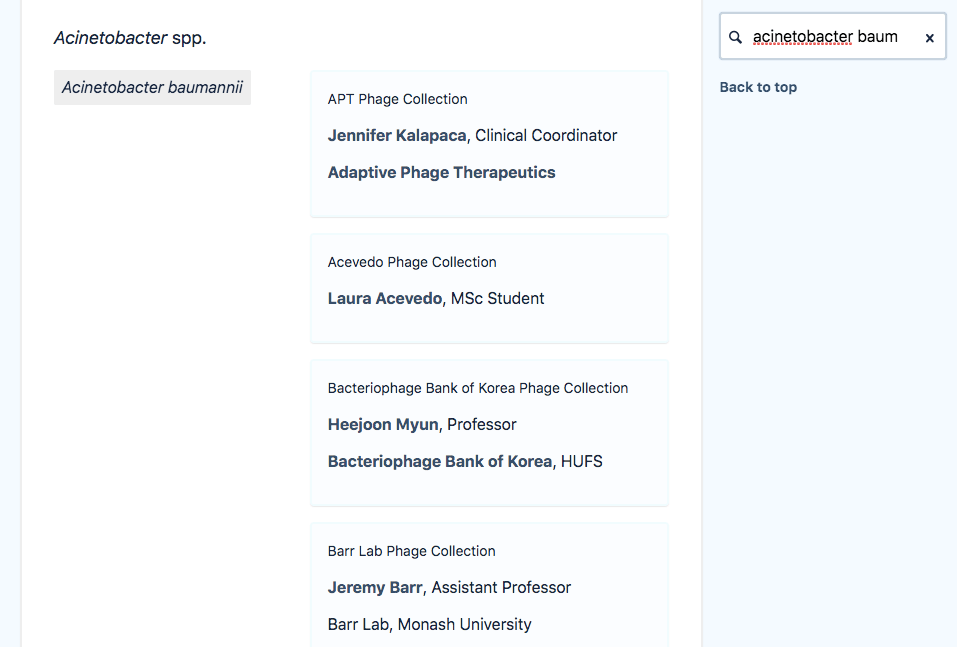 Searching Phage Directory's Phage Host database shows researchers, labs and companies who have phages against a given host genus/species.
Contact researchers and ask them to share their phages
Clicking on a person's name will take you to a profile for that person in our Phage People directory. Here you'll find ways that person would like to be contacted. Hint: clicking on the symbols in the upper right corner will take you to the person's linked accounts (in the example depicted below, Jeremy Barr has provided a Google Scholar account and a Twitter account).
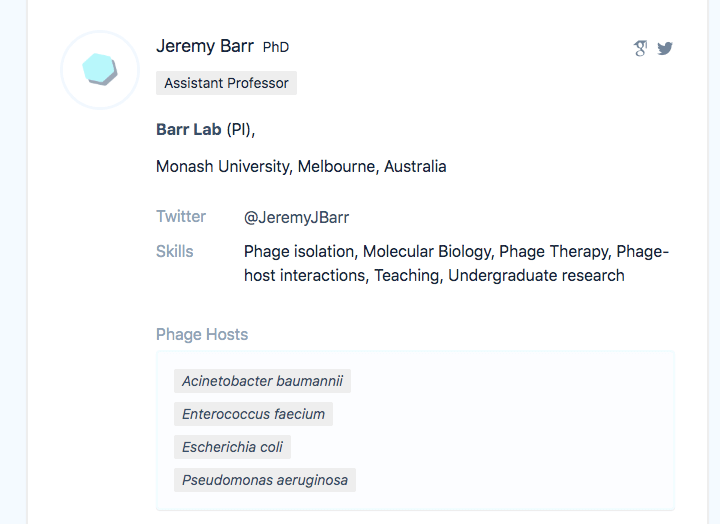 Clicking on a researcher's name in any of Phage Directory's databases brings up a profile and methods of contacting that person. Phage researchers can be searched by name in the Phage People database.
Search phages by keyword (e.g. application, field or use)
If you want to explore phages by keyword instead of by bacterial host, a great way to do this is to search our Phage People directory by keyword (e.g. searching the term "plant") returns three people who mention this keyword in their profiles. Then you can reach out and ask them if they're willing to share their phages.
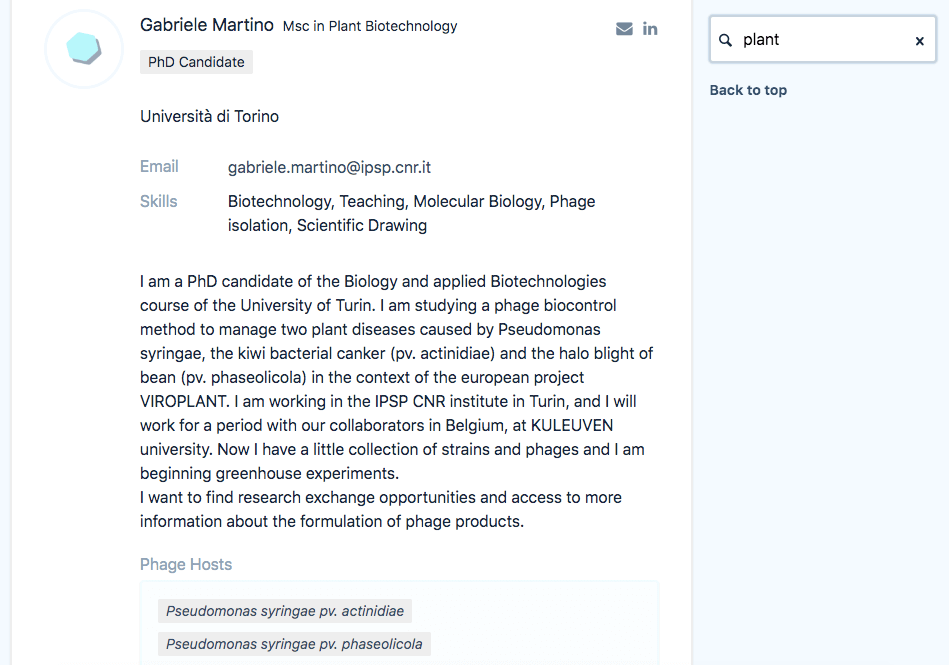 Searching Phage Directory's Phage People directory by keyword is a good way to find phages according to a specific application. This will search the profiles of phage researchers, labs and companies who have used that term in describing what they work on.
Order phages from repositories
A great way to find phages is to search commercial and nonprofit phage repositories. We profiled five phage repositories (also known as phage banks) in a Capsid & Tail post last year. Here you'll find info and links for each. (Stay tuned; Phage Directory's future plans include indexing phages from phage collections around the world, so you can search individual phages from multiple sources with one tool).
Still stuck? Email us for help
If you're having trouble finding phages, please feel free to email us at Phage Directory and ask for help. The directory of phages and people we maintain on our site is still only a fraction of the researchers we know of and have communicated with, so we may be able to help you find the right people even if they're not listed.
Do you work with phages?
We want it to be easier for people to find phages. The more people who list the phages they work on, the easier it will be for everyone to find each other, to find sources of phages, to get tips on isolating the ones they want, and ultimately to get their phage research moving more quickly!
If you work with phages, you can create a profile here.
What if I'm not sure if I can share my phages?
Most people we've talked to have certain phages they can share with other researchers, and other phages that they're not able to share, or are not ready to share. Listing yourself and your phages on Phage Directory does not obligate you to share your phages. If someone asks you for phages, the decision to share them will remain up to you.
What about material transfer agreements?
In the future, Phage Directory aims to help streamline this process. For now, we're leaving this up to researchers to figure out amongst themselves. One thing we can do now is connect people with groups willing to share phage material transfer agreements they've used in the past as examples.
Summary
To sum up, you can use Phage Directory to find phages for your research by sending out a phage request to the community using our message board, and/or by using our directories of phage hosts and phage people to search for the people who have the phages you need.
Once you've found people who work with the phages you need, contact them and ask them if they're willing to share their phages with you.
Phage Directory can help you find the right people, and can help by providing example MTA agreements if you need them. You can help us (and the community) by creating a profile that lists the kinds of phages you work with on Phage Directory.
Future directions
We're working toward a global, virtual phage catalogue (read about our plans here!) that will make it easier to request specific phages, and to search them by possible application and other characteristics. To get this started, we're cultivating partnerships with commercial and nonprofit phage repositories around the world so we can index their phages and the data they collect about each phage on our platform. After this, we'll be working with individual phage research labs to get their phages listed too!
Want to help?
Do you collect phages? We want to see your phage spreadsheets (even if you just send us an empty version)! It will help us big time if we can see what you already collect about your phages, so we can design a master phage catalogue with those characteristics in mind. We don't need the data itself yet; we just want to know what you care about when it comes to the phages you collect. Email us if you want to help!

Jessica Sacher, PhD
I'm a co-founder of Phage Directory and have a PhD in Microbiology from the University of Alberta (I studied Campylobacter phage biology). For Phage Directory, I help physicians find phages for their patients, and I'm always trying to find new ways to help the phage field grow (especially through connecting people and highlighting awesome stuff I see happening in the field).
I spent 2022-2024 as a postdoc in Jon Iredell's group at Westmead Institute for Medical Research in Sydney, Australia, helping get Phage Australia off the ground. I helped set up workflows for phage sourcing, biobanking, diagnostics, production, purification and QC of therapeutic phage batches, and helped build data collection systems to track everything we did. We treated more than a dozen patients in our first year, and I'm so proud of that!
As of 2024, I joined the Bollyky lab at Stanford University as a Staff Scientist, where I'm focused on phage engineering and delivery (to both microbial and human cells) and hydrogel-embedded phage cocktail development for wounds!