

Issue 322
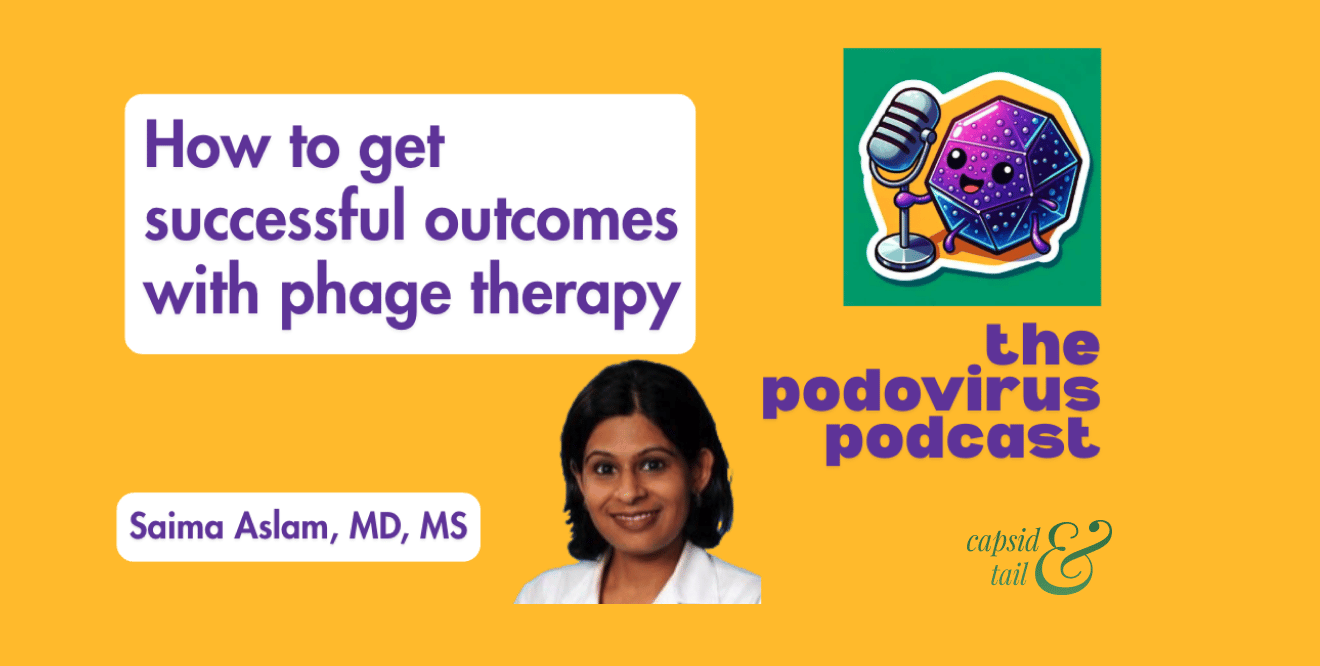
How to get successful outcomes with phage therapy

"When I first treated, we had no idea how much to give, how often to give... we weren't aware of what the concentration of phage should be." IPATH's Dr. Saima Aslam shares how eight years of treating patients has taught her team to achieve consistent success with phage therapy, and why the next decade will make or break the field.
Community digest1alert5updates3jobs2posts
Phage alert
Urgent need for Burkholderia multivorans phages for CF patient in France
We are urgently seeking Burkholderia multivorans phages for a cystic fibrosis patient in France
Ways to help at this stage:
- By sending your phages for testing on the patient's strains
- By receiving the patient's strain and testing your phages
- By helping spread the word about this request
- By providing us with names/email addresses of labs you think we should contact
Please email staff@phage.directory if you can help in any way, or if you would like further details/clarification.
Let’s make a difference, Phage Directory
Updates
Saima Aslam and colleagues at University of California, San Diego have announced Phase I/II phage vs placebo trial for recurrent E. coli UTIs in female kidney transplant recipients.
Jérémy Cherbuin (Lausanne University Hospital) and colleagues published a new paper on in vivo podovirus resistance via tarS mutations, showing tarS disruption causes phage 66 resistance in MSSA endocarditis through impaired wall teichoic acid β-GlcNAcylation.
Jiayu Gu (Chinese Academy of Sciences) and colleagues published a new paper on crosstalk between inovirus core gene and accessory toxin-antitoxin system, showing RepG4 protein from Pf4 phage triggers degradation of PfpC antitoxin, coordinating polylysogeny in Pseudomonas aeruginosa biofilms.
Matt Walker (Columbia University) and colleagues published a new paper on RNA-guided flagellar remodeling by temperate phages, showing prophages use TldR transcription factors to alter host flagellar composition, enhancing bacterial motility, immune evasion, and gut colonization fitness.
Andrian Gajigan (University of Hawaii at Manoa) and colleagues published a new preprint on a dinoflagellate giant virus with a micron-length tail with visual similarities to a phage. They show PelV-1’s 459 kb genome encodes diverse metabolic genes and a 2.3 µm tail, expanding marine virus diversity.
Jobs
Lawrence Berkeley National Lab is hiring a Postdoctoral Fellow to study microbial genomics and engineered living materials for critical mineral recovery.
Invitris is hiring a Senior Scientist, to develop next-gen protein-based tech (like cell-free phage production!) in Munich.
ATCC (Gaithersburg, Maryland), the iconic nonprofit biological resources and standards organization, is hiring a Scientist, Biomedical Genomics, to contribute to the implementation and computational analysis of 'omics data and next-generation sequencing (NGS) projects.
Community board
The 6th International Conference on Bacteriophage Research & Antimicrobial Resistance is taking place November 12–13, 2025, in Varanasi, India.
Hosts: the Institute of Medical Sciences–Banaras Hindu University along with the Society for Bacteriophage Research and Therapy.
The conference aims to advance phage applications in health, environment, food, and antimicrobial resistance.
Abstracts are due September 10, 2025.
The Interdisciplinary Meeting on Antimicrobial Resistance and Innovation (IMARI) is coming up early next year on January 28-30, 2026 in Las Vegas. The meeting will bring together the top scientists, innovators, and cross-sector leaders to address one of health care’s most resistant problems: AMR. But we can’t do that without your contributions. ASM and IDSA are looking for the latest research across the innovation pipeline – from uncovering emerging resistance mechanisms to advancing next-generation therapeutics and accelerating translation into clinical studies. Mark your calendar for the meeting (registration will open soon!) and begin preparing your abstract to submit by October 1, 2025. I hope to see you – and your research – at the meeting!
What does it take to make phage therapy work in clinical practice in 2025? Who better to ask than the clinical lead at IPATH, the well-known phage therapy center run by UCSD in San Diego, which has set the example for phage therapy centers in so many states and countries since.
On this week’s episode of the Podovirus podcast, Joe and I were excited to sit down with Dr. Saima Aslam to understand how her approach has evolved since treating her first patient in 2017, and what her advice is for other phage clinicians.
The answer, it turns out, lies in a fundamental shift from "treating anything and everything" to strategic patient selection, as well as prioritizing close collaboration between phage researchers and clinicians. This way, trials can be designed that make sense for patients, clinicians and scientists.
One thing I really appreciated hearing was Saima's assessment of where the field stands now: "I feel like this coming decade, where we have enough knowledge to design good trials, I personally think is going to either make it, or if we have multiple failed trials, that's the end of it."
I agree with this sentiment, and am excited to see what these next few years hold for phage therapy.
Highlights:
- Patient selection evolution: How Saima's team moved from treating all-comers to targeted approaches, learning which infections respond best to phage therapy.
- The importance of collaboration: Why bringing together phage researchers and clinicians from the start leads to better clinical trial design with more realistic endpoints, so patients can be more easily recruited (they of course have lives to work around too!).
- Dosing insights: From treating phages like antibiotics every 8 hours, to understanding serum neutralization, biofilms, and the importance of local delivery for device infections, and adjusting dosing to fit that.
- Finding the sweet spot: Why recurrent UTIs in kidney transplant patients represent promising applications (even low hanging fruit, according to Saima) for proving phage efficacy.
- Infrastructure needs: The case for a centralized US phage repository and manufacturing center to eliminate the current 6-12 month delays that make compassionate use challenging for many cases.
A few snippets from the episode...
On the reality of complex cases:
"Even with the best phage, if we can't change the underlying disease, I'm not sure treating the infection will help the patient get what they want."
On the stakes for transplant patients:
"To have waited 10 years to get a kidney transplant and then you get recurrent UTIs and you lose it in two years is awful. It's just terrible... If you don't have recurrent UTIs, your kidney is good for the next 10 years."
On trial design challenges:
"Some of the companies I've seen start trials have done so because they know the phage piece really well, but they haven't really researched that clinical piece well. I think that's a big reason why some of these studies have failed."
On endpoints and timing:
"I think if we work collaboratively, if we can show it works in one thing, then we certainly will have a lot more money to figure out how it works in something else... We should pick sort of the lowest hanging fruit rather than the hardest ones to go after."
On working across networks:
"I literally send out emails to whoever can help a patient... Texas A&M, Baylor College of Medicine, Daria Van Tyne’s lab in Pittsburgh, Graham Hatfull... It used to be mass emails, but now they're more targeted because we know who really has phages that are ready to go."
On the current phage-making bottleneck:
"Initially you would think ‘maybe this is a patient I would treat with phage’, and you would get phage a month later. Now there's such a long backlog of cases that it takes more than six months, sometimes up to a year to get phage."
What's next:
Saima is leading an NIDDK-funded placebo-controlled trial for recurrent UTIs in kidney transplant patients. Her approach involves treating asymptomatic patients to target colonization rather than active infection, and the team just began enrolling this week!
Concluding thoughts
To me, this conversation crystallized why patient selection has become such a recurring theme across our phage therapy interviews. On one hand it's driven by the need to ration a scarce resource, and not get patients' hopes up unnecessarily, but it's also about using phages only where we know they can succeed, so we can build solid evidence and insight quickly, and use that to design trials that are actually doable. By showing we can do this, we can bring in the funding and gain the experience to properly test the next set of indications, and expand out from there.
Thanks so much Saima for your time sharing these lessons!
Listen to the full episode:
🎧 Spotify
📺 YouTube
Learn more:
- Saima's team is enrolling for their kidney transplant clinical trial
- IPATH at UC San Diego
- Our previous episode with Mayo Clinic's Dr. Gina Suh: another US physician’s perspective on patient selection and clinical experience
Jessica Sacher, PhD
I'm a co-founder of Phage Directory and have a PhD in Microbiology from the University of Alberta (I studied Campylobacter phage biology). For Phage Directory, I help physicians find phages for their patients, and I'm always trying to find new ways to help the phage field grow (especially through connecting people and highlighting awesome stuff I see happening in the field).
I spent 2022-2024 as a postdoc in Jon Iredell's group at Westmead Institute for Medical Research in Sydney, Australia, helping get Phage Australia off the ground. I helped set up workflows for phage sourcing, biobanking, diagnostics, production, purification and QC of therapeutic phage batches, and helped build data collection systems to track everything we did. We treated more than a dozen patients in our first year, and I'm so proud of that!
As of 2024, I joined the Bollyky lab at Stanford University as a Staff Scientist, where I'm focused on phage engineering and delivery (to both microbial and human cells) and hydrogel-embedded phage cocktail development for wounds!