

Issue 293
Mapping global Acinetobacter strains to speed up phage therapy


A team of Hungarian scientists created a global ‘superbug map’ for Acinetobacter baumannii strains, paving the way for scalable phage therapy to combat antibiotic-resistant infections in hospitals.
Sponsor
Sponsor

Why don't we have phage therapy yet? We want to understand why. Come join the fun, with the new Podovirus podcast!
🎙️ Most recent episode: NIAID's Joe Campbell joins as a co-host for an interview with Dr. Gina Suh, Mayo Clinic ID physician, about what makes the best phage therapy patients, getting phage therapy up and running at her institution, and her current hopes and challenges.
🎧 Listen: Podovirus on Spotify
🎥 Watch: Podovirus on YouTube
Subscribe to get the next episodes!
🍅 Up next: Joe and I interviewed Alexander (Sandro) Sulakvelidze, CEO of Intralytix, about his 26-year (!) journey toward getting phage cocktails on the market in the food industry, the 3 clinical trials they've got running, and the efficacy data (hopefully) around the corner!
💰On deck: Joe and I interviewed Amanda Burkhardt and Mayukh Das, who are leading Phiogen Pharmaceuticals, a new Texas phage therapy company. We talk about drug pricing and how it applies to phages. In other words, how can we avoid phage companies going as bankrupt as antibiotics companies?!
Community digest5updates3jobs2posts
Updates
Cheng Peng (City University of Hong Kong) and colleagues published a new paper on a genome foundation model for virus discovery, showing ViraLM outperforms existing tools in identifying novel viral contigs in metagenomic data, especially improving F1-score on short contigs by 22%.
Rachel Seongeun Kim (Seoul National University) and colleagues published a new paper on a large repository of predicted viral protein structures, showing BFVD contains 351,242 structures covering major viral clades and offering unique opportunities to explore viral diversity.
Arturo Carabias (University of Copenhagen) and colleagues published a new paper on phage-encoded NAD restoration pathways, showing how phages counter bacterial immunity through innovative strategies to replenish NAD, providing insights for novel antimicrobial approaches.
The Innovate UK Phage Innovation Network published a new report on developing phage technologies in the UK, showing the UK has strong phage research but limited translation into real-world solutions across sectors. Key actions include establishing GMP manufacturing capability and formulating a national strategy.
Lorenz Leitner and Shawna McCallin (Balgrist University Hospital) published a new paper on guiding phage therapy with genomic surveillance, showing how integrating global and local genomic data can inform phage cocktail design for a middle ground between personalized and product-based approaches.
Jobs
University of Edinburgh is hiring a PhD student, to study prediction of E. coli capsule types to improve phage cocktail efficacy for eradicating multi-drug resistant strains from livestock gastrointestinal tracts.
Karolinska Institutet is hiring a PhD student, to study antimicrobial resistance and phage biology using phenomics and functional genomics in Dr. Andrea Fossati's lab in Stockholm, Sweden.
University of Sheffield is hiring a PhD student, to study phage therapy impacts on C. difficile evolution using experimental evolution and genome sequencing.
Community board
The International Society for Viruses of Microbes has elected its new board! (Of 1401 members, 32% voted!) • President-Elect: Rob Edwards, Flinders University, Australia • Vice-President: Hany Anany, Agriculture and AgriFood Canada, Canada • Membership Officer: Cedric Lood, University of Oxford, Great Britain • Treasurer: Tracy Peters, University of Idaho, USA • Information Officer: Luis Melo, University of Minho, Portugal • Website administrator: Hugo Olivera, University of Minho, Portugal • Assistant Secretary: Katja Suster, Valdoltra Orthopaedic Hospital, Slovenia • Industry Outreach: Sandra Morales, Phage Consulting Pty Ltd., Australia Congratulations to all the elected members! The new Executive Board will start working for ISVM from January 1st, 2025, including Lone Brøndsted as President and Zuzanna Drulis-Kawa as member-at-large.
New North American phage biology and therapy conference alert!
Save the date: Sunday, October 12 to Tuesday, October 14, 2025 at the Washington Hilton Hotel, in Washington, DC.
Organizers: Graham Hatfull, Chip Schooley, Paul Bollyky and colleagues.
More info coming soon!
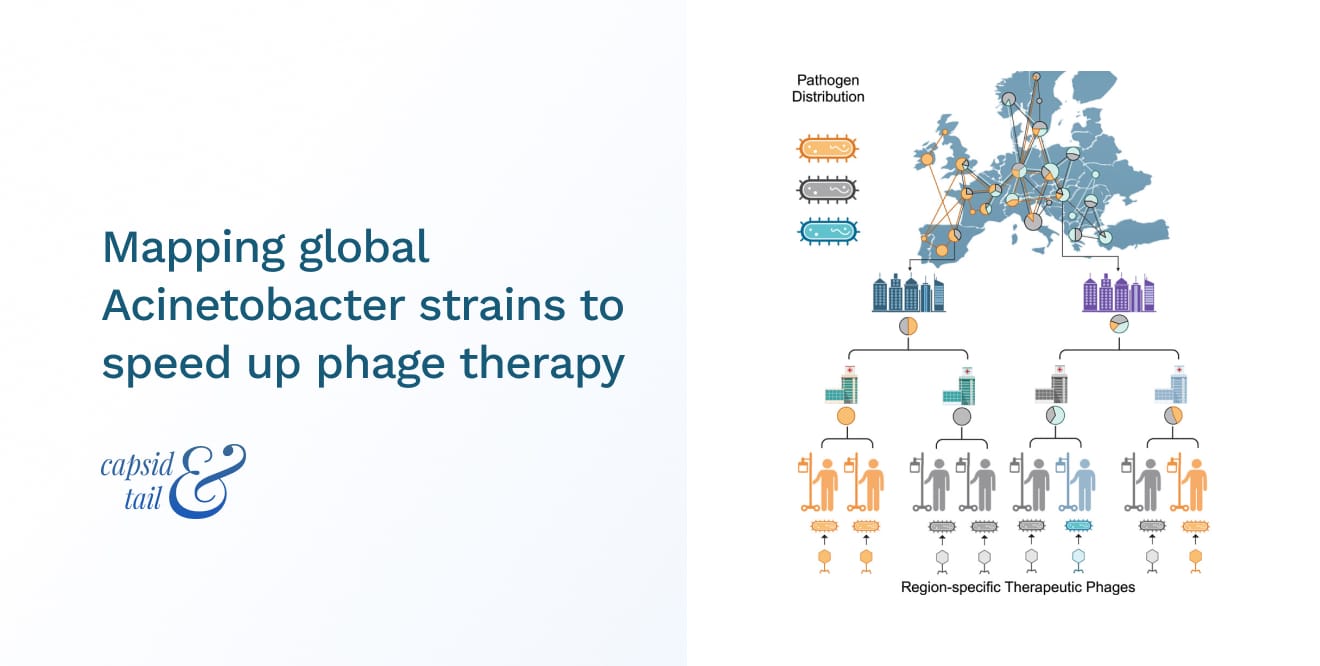
A team of Hungarian scientists created a global ‘superbug map’, paving the way for scalable phage therapy to combat antibiotic-resistant infections in hospitals
The fight against antibiotic-resistant infections has received a significant boost with the publication of the world’s first ‘superbug map’ for Acinetobacter baumannii, intended to aid the development of phage therapies.
Tracing A. baumannii around the world
In a paper published in October in Cell, an international collaboration led by scientists at the HUN-REN Biological Research Centre in Szeged, Hungary, analysed the genomes of over 15,000 cases of Acinetobacter baumannii, tracing its global existence and spread.
The team identified the dominant strain types from around the world, discovering that the specific strains spread relatively slowly and remained dominant for approximately six years in a given country. As Acinetobacter phages are specific to strain types, this observation highlights the timeframe that hospitals may have to apply pre-emptively prepared phages for treatment as ‘off-the-shelf’ region-specific phage therapies that could address up to 80% of local infections.
“Currently many bacterial infections cannot be effectively treated and phages offer a promising alternative or complementary therapy to combat the rising number of hospital-acquired antibiotic-resistant infections,” said Balint Kintses, lead author of the paper and Group Leader at the Laboratory of Translational Microbiology at HUN-REN Biological Research Centre. “This is where our map offers a solution for phage therapy. By analysing how superbugs spread and dominate in hospitals, we can now prepare region-specific phage treatments in advance."
Helping clinicians move faster
To address the need for phage therapy in acute, AMR infections where patients die within days if a treatment cannot be found. The ‘superbug map’ is intended to enable the production of pre-emptive phage treatments based on the A. baumannii strains most likely to cause infections in each region. The same approach is used by scientists when selecting epitopes to target in the development of a new vaccine.
The hope is that, after turning these research findings into real-world treatments, healthcare providers will be able to significantly improve the management of infections that develop quickly and don’t respond to antibiotics.
“To reach this strategic goal, the superbug map will also help clinicians identify patients for phage therapy clinical trials, accelerating the validation and approval process for these treatments,” added Balint Kintses. “Researchers using the mapping framework will be able to access global data and share insights, contributing to a worldwide effort to combat antibiotic resistance through precision medicine approaches and bring phage treatments to the patients who need them most.”
“We are actively seeking collaborators willing to provide clinical isolates to help us evaluate the host specificity of phages on a truly global collection of isolates. If you’re interested in contributing, please feel free to send us an email,” said Balázs Papp, co-researcher and Group Leader at Lendület Laboratory of Computational Systems Biology at HUN-REN Biological Research Centre. “The ability to scale phage therapy is the key to making it a viable solution for hospitals worldwide.”
"This paper shows that an approach that directly addresses the diversity of phage targeting necessary for good therapeutic design,” said Prof Jonathan Iredell, Director of Phage Australia. “It also illustrates the open spirit of collaboration that is essential to success, and the generous provision of these novel therapies as a public good."
Compiling the map
The map was compiled by conducting a large-scale analysis of over 15,000 genome sequences of A. baumannii from public databases from 85 countries across five continents to assess the geographical distribution of the strains.
Additionally, the team collected samples from 44 hospitals in five Eastern European countries from Covid-19 ventilated patients with secondary, antibiotic-resistant bacterial infections.
Using phylogeographical methods, the dominant bacterial strains in different regions were identified and their distribution tracked. This data was combined with high-throughput phage typing to understand which phages are effective against specific strains, enabling the development of targeted therapies.
Want to learn more?
For more information and to visualize the research, an animated video is available on the HUN-REN Szeged Biological Research Centre website.
Read the paper here: Koncz, M., Stirling, T., Mehdi, H. H., Méhi, O., Eszenyi, B., Asbóth, A., ... & Kintses, B. (2024). Genomic surveillance as a scalable framework for precision phage therapy against antibiotic-resistant pathogens. Cell, 187(21), 5901-5918.

Balint Kintses
I am committed to advancing precision medicine strategies to combat antibiotic resistance, a critical global health issue. Using cutting-edge systems and synthetic biology approaches—including bioinformatics, genome engineering, genomics and metagenomics—we aim to:
-
Understand the evolution of resistance to new antimicrobials. Over the past five years, we have significantly contributed to elucidating how resistance develops against antimicrobial peptides and antibiotics in clinical development. To achieve this, we developed a new functional metagenomic method using engineered bacteriophages to study horizontal gene transfer in microbial communities.
-
Investigate pathogen spread. We studied the COVID-19 pandemic using genomic epidemiology tools and are investigating the transmission dynamics of nosocomial infections.
-
Create innovative therapeutic strategies with bacteriophages. We mapped the genetic diversity and geographic distribution of a critically antibiotic-resistant bacterial species, carbapenem-resistant Acinetobacter baumannii, on a continental scale. Using this data, we developed a therapeutic phage collection that targets the majority of infections within specific geographic regions. Understanding pathogen populations is essential for identifying patients who require the same phage treatment, facilitating clinical trials, and promoting the broader adoption of phage therapy.
Ultimately, our work aims to serve as a guide on how modern biological approaches can be harnessed to develop personalized treatments capable of tackling even the most resilient bacteria.
Balazs Papp
I specialize in bacterial genomics, evolution and epidemiology. My research aims to bridge the gap between genomic epidemiology and phage therapy. By analyzing bacterial genomes, we can identify specific phage targets and develop tailored phage therapies for different geographic regions. I'm open to collaborations and consortium research grants to advance the field of phage therapy.