

Issue 108
A fresh look at last century's phages


The NCTC in England has freshly re-characterized 100 phages originally collected for bacterial typing in the 1950s-1990s. If you want your phages to last as long as these, this is a great place to deposit!
Sponsor
Sponsor
This issue was sponsored by Kisaco Research for Phage Futures 2021.
Community digest1alert5updates2jobs5posts
Phage alert
Add your voice to the State of Phage 2020 Survey!
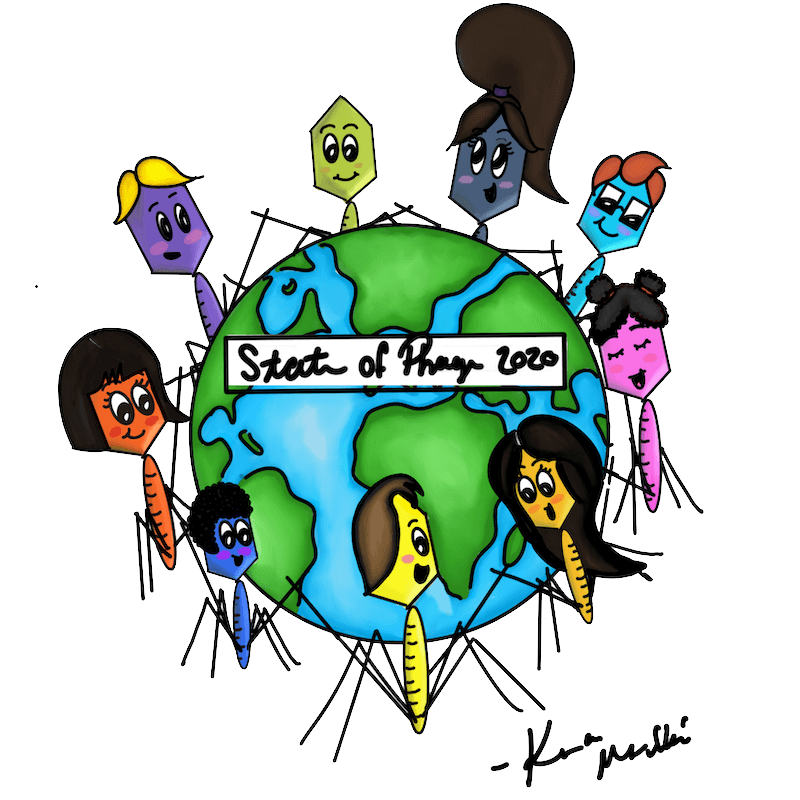
In celebration of our 100th issue of Capsid & Tail, we launched a survey called State of Phage 2020! We created this survey to help us all better understand the phage research community globally, including what kind of phages people are collecting, what methods they're using, and more. If you work with phages, please fill it out! We'll compile and share the results in Capsid & Tail in 2021, and repeat the survey annually so we can all follow and share our community's exciting growth over time.
SURVEY CLOSES IN 24 HOURS
Thanks so much to the 134 labs who've completed the survey, and to those who have shared it!! Today is the last day the survey will be open, so if you've started but haven't finished (58 of you — your browser should have saved your progress!) or you want to take it from the beginning, please fill it out today!
We'd love if you continued sharing it with friends! https://survey.phage.directory/
Updates
US biotech company Felix Biotechnology announced the initiation of its first clinical trial, CYPHY, a phase 1/2 single center trial that will test its first targeted phage therapy candidate, YPT-01, against chronic P. aeruginosa infections in cystic fibrosis. The trial will take place at Yale University.
Pherecydes Pharma intends to list on the Euronext Growth® Market in Paris, a European equity trading market designed for small to medium-sized firms. Pherecydes Pharma has developed a portfolio of phages against Staphylococcus aureus, Pseudomonas aeruginosa, and Escherichia coli, and will be pursuing an individualized treatment strategy which includes screening a large number of phages and selecting the efficient ones using a phagogram.
David Lebeaux (Université de Paris) and colleagues published the first demonstration of phage therapy in a lung-transplanted cystic fibrosis patient infected with pandrug resistant A. xylosoxidans. They successfully carried out two rounds of therapy on a 12-year-old patient with complex airway colonization of eight distinct types of phage-resistant and -susceptible strains. The outcome: improved respiratory conditions, low airway colonization, and no further recolonization after two years of therapy.
Repurposing CRISPR systems as antimicrobials is a new strategy being explored, and engineered phages could be a great way to carry them to their targets. Clément Fage (Université Laval, Canada) and colleagues published a new perspective in Current Opinion in Biotechnology on the delivery of CRISPR-Cas systems using phage-based vectors.
Julie Stenberg Pedersen (University of Copenhagen, Denmark) and colleagues published a paper on the isolation and characterization of a novel phage Jarilo, which is active against the plant pathogen Pectobacterium carotovorum that causes soft rot disease. Numerous methodologies like bioinformatics and host range analysis confirmed the presence of endonucleases, multiple conserved genes, and Jarilo's ability to infect across its host species.
Jobs
Vysnova (Silver Spring, MD) is seeking a highly qualified and motivated Research Technician III - Bacteriophage Therapeutics to work on a WRAIR contract.
The University of Georgia is hiring an assistant professor of Microbial Systems Biology.
Community board
PHAVES #11 will be a casual mixer to kick off the new year! We'll get together on Zoom January 12 at 11:00 AM Eastern. We'll start off with a bit of an "open mic" / "show and tell", where attendees will have the option to share something they're either proud of from last year or excited to be working on for the coming year. Then we'll do a few sets of breakout rooms so we can all meet some new faces in smaller-group settings!
Register for this event and/or the whole series at https://phaves.phage.directory.
The Africa Phage Forum is hosting a new phage webinar series, starting Jan. 14 at 11AM EST (4PM GMT) with special guest Dr. Paul Turner. Dr. Turner will give a talk entitled 'From the environment to bedside: understanding the basics of phage therapy research'. Phage Directory is proud to partner with APF to bring this webinar series to the broader phage community!
Register for this event and/or the whole series at https://apf.phage.directory.
The fifth iVoM event will be Thursday, January 21, 4pm GMT, and the theme will be "Agro-food, veterinary and environmental biotechnology applications".
It will feature talks by: Sam R. Nugen - Department of Food Science and Technology, Cornell University Danish J. Malik - Chemical Engineering Department, Loughborough University Ana Oliveira - Centre of Biological Engineering, University of Minho
Chairs: Mathias Middelboe - Department of Biology, Marine Biological Section, University of Copenhagen Lone Brøndsted - Department of Veterinary and Animal Sciences, University of Copenhagen
Register for this event and/or the whole series at https://ivom.phage.directory.
The TAILOR team at Baylor College of Medicine now has a YouTube channel! Check out their recent one, a recorded talk on AMR and phage therapy by one of TAILOR's founders, Dr. Anthony Maresso, called Chasing Change: A moving pandemic, an adaptable medicine. Also watch another TAILOR founder, Dr. Sabrina Green, show you how to isolate phages from environmental samples.
Phage Futures 2021 will have a young researcher showcase at their event this coming February! If you're a young researcher attending the conference ($149 for students — register here), don't forget to apply to present a poster virtually by Jan 22!
The National Collection of Type Cultures (NCTC) is one of the world’s oldest bacterial collections that was specifically established to provide strains globally to support scientific research. In addition to the general bacterial catalogue, NCTC has a fully curated bacteriophage collection which has recently been made available to the wider scientific community. The collection consists of over 100 bacteriophages, and their corresponding bacterial hosts, which were originally deposited between 1950 and 1992, primarily for their value in bacterial typing. The collection consists of bacteriophage from the following hosts Streptococcus agalactiae, Staphylococcus aureus and Campylobacter, supplied as freeze dried cultures.
Helping scientists access and preserve phages
The collection has been characterised and reauthenticated using a range of methods including electron microscopy and will be further characterised using genomic sequencing in the future. As the applications of phages for potential solutions to bacterial problems grows, having a repository from which scientists can both source and deposit phages is essential. The collection therefore aims to be dynamic, representing a repository into which microbiologists can deposit phages to support accessibility and reproducibility in science.
A two-year journey to re-characterize old phages: Juandem's perspective
What a journey it has been with NCTC since June 2018! I have thoroughly enjoyed getting acquainted to the phages within this collection and it feels so good to be able to share this unique resource with the scientific community. When I got this job offer to re-authenticate the bacteriophages in the NCTC collection, I genuinely felt like I would be working in a museum of sorts.
On my first day, I got to see the ampoules and was very excited when I opened my first one a few weeks later. I had my own ideas of what I expected but it was not plain sailing all the way. It took me a good month at least to see my first plaques in the lab! Every phage biologist understands the exhilarating feeling that comes with. The more challenges I found, the more drive I had to keep going. Another high was doing the imaging via electron microscopy. This actually was like meeting your baby for the first time. Even more exciting was the move to launch these phages to the public at Phage Futures Europe in 2019 and establishing some contacts which have ultimately led to our first external deposition which we have only just begun to unfold.
Despite the turbulence this past year, I am even more determined to do more to make this collection as dynamic and open to scientists as possible. I truly believe that the road ahead is full of exciting stops and I cannot wait to see where that will lead me.
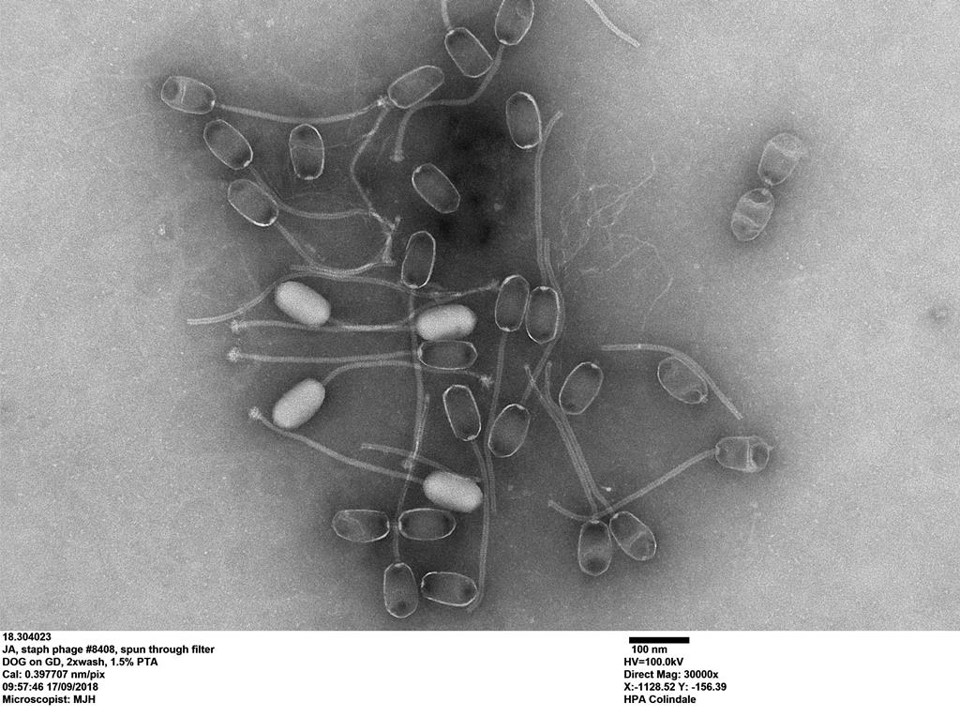
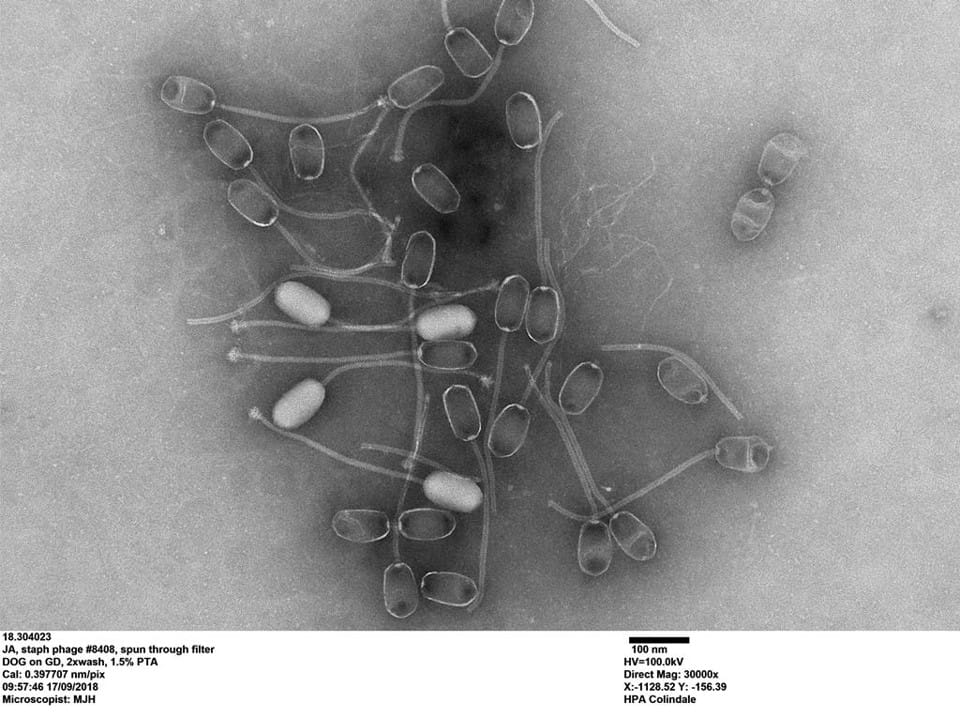 Staphylococcus aureus bacteriophage NCTC 8408, imaged by electron microscopy, one of the ways NCTC's team characterizes its phages. Crown Copyright, Public Health England. View full image
Depositing phages with NCTC
The NCTC bacteriophage collection welcomes new depositions of phages. As with our bacterial strains, we encourage depositions of phages targeting hosts with any clinical or veterinary importance or relevance. To find out more please contact us: culturecollections.businessE@phe.gov.uk
Benefits of depositing with NCTC:
- Contribute to an established repository
- Deposited phages are authenticated and characterised
- Phages are preserved indefinitely and made available for future scientific research
- Ensures availability of dynamic, relevant resource
- Supports accessibility and reproducibility in science
Are phages sourced from NCTC only available for research purposes or also for therapeutic and/or commercial purposes?
NCTC routinely supplies all our biological reference materials for research purposes only. It may be possible that some products could be considered for commercial purposes, scientists will need to contact NCTC (CultureCollections.BusinessE@phe.gov.uk) to ensure that a business agreement is in place prior to use.
Are phages further characterized by NCTC after they're deposited? Will that data be made accessible?
Some data is supplied to us by the depositor; we then confirm the viability, purity and titre and undertake microscopy. A lyophilised sample is also sent back the to the depositor for confirmatory checks. Electron microscopy gives us an indication of the bacteriophage family, and this data along with the quality control data is available to the depositor as well as those purchasing the bacteriophage. Data is available on the website on the catalogue entry page and each bacteriophage has a Certificate of Analysis. We plan to do more genomic studies in the future and this data will be shared when available. Use of any NCTC strain or bacteriophage or associated data in a publication should be clearly cited and referenced, and information sharing is certainly possible.
Learn more
- Check out NCTC's phage catalogue here
- Follow NCTC on Twitter @NCTC_3000!
- In collaboration with ID Hub, NCTC has recently released a number of online bacteriophage resources, which include an infographic, video, and podcast interview with NCTC Curator Dr Sarah Alexander and Molecular Microbiologist Juandem Agendia. All are available through an eBook, which you can download here!
- Check out the 2019 Capsid & Tail interview with NCTC's team to learn more about their phage collection!
Thanks to Atif Khan for his work writing summaries for the What's New section this week!

Ayuen Lual, MSc
Ayuen graduated from the University of Southampton in 2000 with a BSc in Biochemistry. She joined the Public Health Laboratory Service (now Public Health England) in 2001. She has experience of working within the PHE Food, Water and Environmental (FWE) Laboratories and also produced UK Standards for Microbiology Investigations (UK SMIs) clinical microbiology diagnostic SOPs. Since 2016 Ayuen has worked as the Scientific Marketing Manager for PHE’s Culture Collections based at Porton Down and recently completed an MSc in Science Communication and Public Engagement with the University of Edinburgh. Her interests span method development/standardisation and quality assurance, with a focus on scientific communication and public engagement.

Juandem Agendia
Juandem has been with NCTC since 2018 on the microbial projects team working as a molecular microbiologist leading the bacteriophage project. She has a background in biochemistry and biotechnology and besides being a keen phage enthusiast is a busy mum of three.