

Issue 166
The Phage Directory Slack Community

Undergraduate phage enthusiast Sayde Perry’s 2022 guide to the former Phage Directory Slack community, its channels and conversations. The community is now retired.
Community digest5updates4jobs2posts
Updates
Clinical trial: Armata Pharmaceuticals announces clearance of investigational new drug application to initiate phase 2 clinical trial of AP-PA02 in non-cystic fibrosis bronchiectasis.
Paper: RNA targeting with CRISPR-Cas13a facilitates bacteriophage genome engineering
Paper: Bacteriophage therapy as a treatment option for complex cardiovascular implant infection - The German Heart Center Berlin experience.
Paper: Phage banks as potential tools to rapidly and cost-effectively manage antimicrobial resistance in the developing world
Article: Can Phages Help Where Antibiotics Have Failed? By Dr. Judy Stone, MD
Jobs
Postdoc: Join a multidisciplinary team using microbiology and molecular biology techniques to investigate relationships between bacteria and their viruses, bacteriophages.
Research Associate: Work in the Centre for Molecular Bacteriology and Infection (CMBI) to focus on the mechanisms of dissemination of Aspergillus fumigatus from the lung.
Senior Research Assistant: Investigate nanoparticle encapsulation of phages for improved activity against bacteria.
Research Assistant: Implement novel and existing Next-Generation Sequencing (NGS) applications, including assembly and annotation of bacterial and phage genomes.
Community board
iVoM Season 2, episode #5: Environmental impact of virus-host interactions Date: 2 pm CET, Tuesday, March 15th, 2022 Register at https://ivom.phage.directoryy
Talks Coupling metagenomics to correlative microscopy for identification of novel viruses in the deep biosphere
- Prof. Alexander Probst, University of Duisburg-Essen, Germany
From phage to shark: microbial and macrobial predation govern state transitions on coral reefs
- Dr. Cynthia Silveira, International Center for Genetic Engineering and Biotechnology (ICGEB)
Harnessing virus for alleviating plant stress
- Dr. Neeti Sanan-Mishra, International Center for Genetic Engineering and Biotechnology (ICGEB)
Chairs
- Dr. Matthias Fischer , Max Planck Institute for Medical Research, Heidelberg, Germany
- Prof. Corina Brussaard , Royal Netherlands Institute for Sea Research, Netherlands
The first ESGNTA Online Course titled: “Personalised Phage Therapy: Basic Principles of Monitoring and Treatment”, will take place virtually on the 7-10th of June 2022.
It will include four sessions with cutting-edge scientific talks in the field of personalised phage therapy, including (1) therapeutic monitoring, (2) immune response to bacteriophages, (3) formulation and administration of bacteriophages for therapy, and (4) current state and prospects of oral phage therapy.
Register here by June 1 2022.
€50 for ESCMID members and €100 for non-members
At the time of publication, the Phage Directory Slack community had over ten channels, from “introductions” to “phage-manufacturing” to “readings” to “random.” Members could suggest other topics and new channels.
Introductions
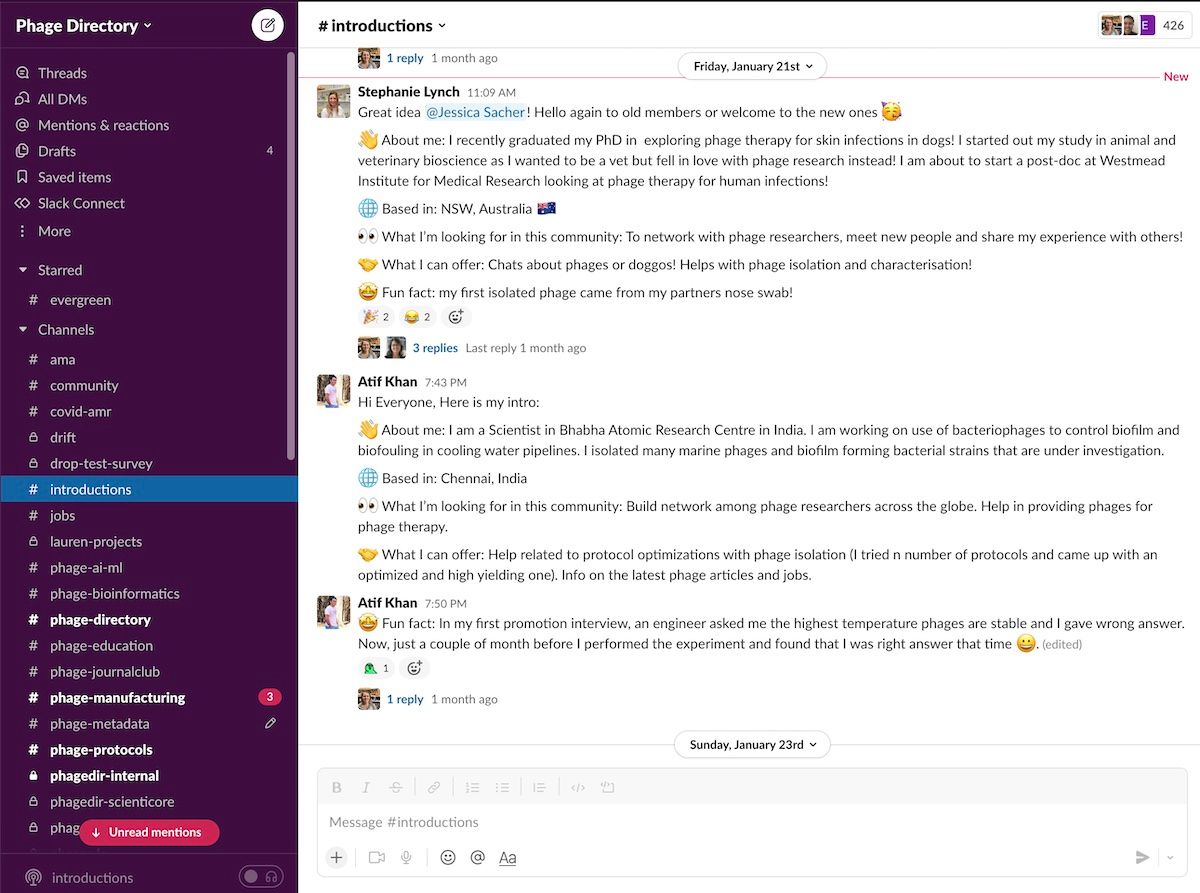
The “introductions” channel is especially great as it is a place for members to introduce themselves and meet new phage phriends. Recently, the “introductions” channel has featured an introduction challenge that has invited members to fill in these prompts and get to know each other:
👋 About me:
🌐 Based in:
👀 What I’m looking for in this community:
🤝 What I can offer:
🤩 Fun Fact:
For example:
From Enrique González Tortuero:
👋 About me: I'm nowadays working as a postdoctoral researcher in the UK in the role of temperate phages of clinic Pseudomonas aeruginosa strains in the host physiology and behavior, mainly focused on the the bioinformatic analyses. I was working previously in phages from my first postdoc in the University College Cork, Ireland (2016 - 2018)
🌐 Based in: Salford, United Kingdom - But who knows where I will be in the future... (Originally I came from Spain, but I was living out of my country for nine years...)
👀 What I’m looking for in this community: Networking with other phage researchers (wet-lab and dry-lab), staying up-to-date in phage research and helping with my (humble and short) experience in bioinformatics applied to microbes and viruses.
🤝 What I can offer: advice on bioinformatics applied to microbes and viruses, including phages obviously
🤩 Fun fact: I can start telling a lot of stories, but I do not want to bother all of you. Let's say one funny: as a consequence of working with computers for a long time, everybody believes that I am computer scientist or mathematician when I originally studied biology and worked as a lab technician in a plant physiology lab before performing my PhD studies. So, please, do not hesitate to ask to your computer fellows about their background... Maybe you will have a surprise!
Asking Questions
In addition to being a great place to make new phage connections, the Slack community is especially wonderful for asking and answering questions. In each of the topic channels, people can pose questions and members of the community are always eager to answer. Some examples of questions posed by the Slack community:
- What is the average molecular weight of bacteriophage particles?
- I am interested to get in touch with labs and companies focusing on genetically engineered phages. We are looking for potential collaboration partners for a major pharmaceutical company. Any tips or ideas?
- I need some help with Unicycler in Galaxy!
- Anyone know the best way to recover phage from freeze-dried ampoules to create laboratory stocks?
- I’m super new to bioinformatics and I was wondering what tools should I use if I would like to see the differences between WT bacteria and mutants? What should be the approach? And tools
Group chats and direct messages
Slack also features the ability for community members to create group chats and send direct messages.
Community status
The Phage Directory Slack community is now retired. Read the retirement notice.

Sayde Perry
I am a fourth-year undergraduate student at Pomona College where I study molecular biology. I currently research bacteriophage interactions with Vibrio cholerae! After graduating, I hope to continue learning about phage biology, bacterial infections, and phage therapy through a research exchange or a PhD program. I love meeting people in the phage community and would eagerly welcome any opportunities to chat!