

Issue 156
Molecular multitasking: inhibition of phage infection by aminoglycoside antibiotics

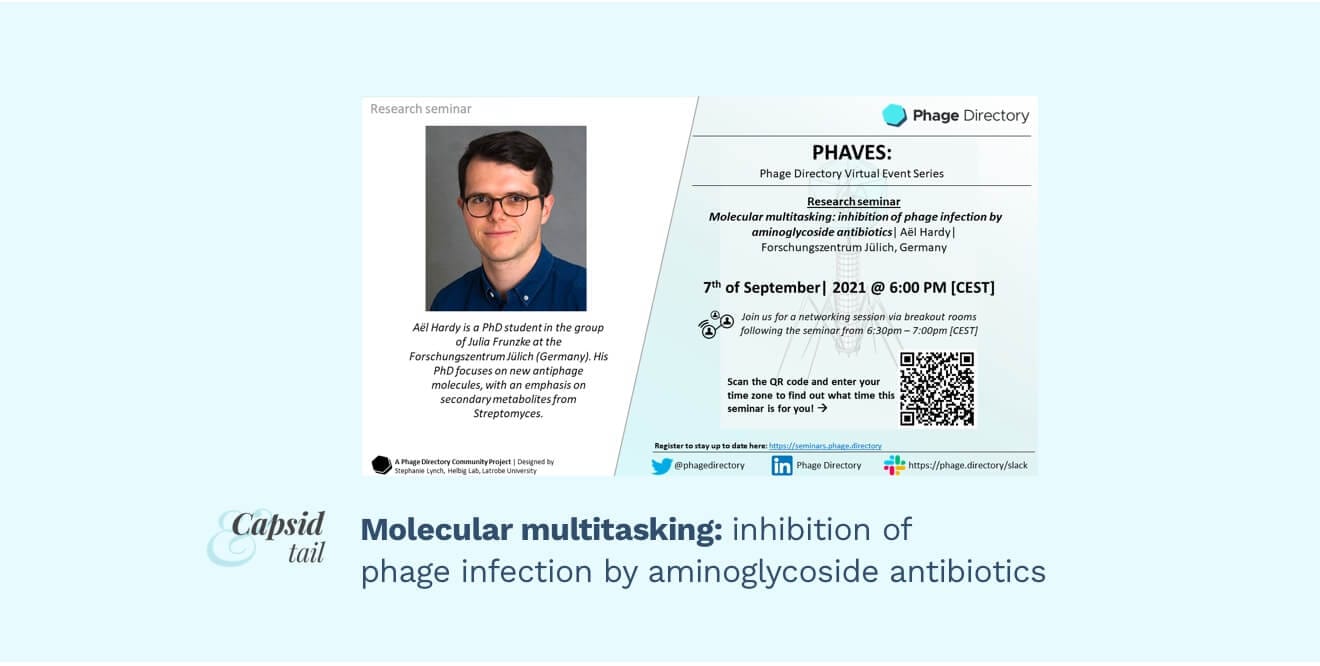
In our PHAVES series this fall, Aël Hardy, PhD student at Forschungszentrum Jülich, Germany, spoke about his research into the inhibition of phage infection by aminoglycoside antibiotics. Here’s the recording, along with a recap by Sayde Perry!
Sponsor
Sponsor
PHAGE is the only peer-reviewed journal dedicated to bacteriophage research and its applications in medicine, agriculture, aquaculture, veterinary applications, animal production, food safety, and food production. Submit today to this exciting and dynamic publication!
Community digest5updates6jobs4posts
Updates
Paper: Multi-species host range of staphylococcal phages isolated from wastewater
Paper: Anti-biofilm activity of phages against clinical Staphylococcus aureus isolates from patients with LVAD infection
Paper: Polymer-mediated cryopreservation of phages
Preprint: Phage resistance accompanies reduced fitness of uropathogenic E. coli in the urinary environment
Paper: Classification of in vitro phage–host population growth dynamics
Jobs
Internship in high throughput sequencing of viruses and phages in water samples at Luxembourg Institute of Science and Technology
Student Assistant to study phage-host interactions, microbial community manipulations using phages, and develop synthetic biology tools for rapid design-assembly-testing of phages at Lawrence Berkeley National Laboratory, California
Research Specialist to study viral adaptation using the phage phiX174 and characterize novel phages from honey bees at University of Idaho
Research Fellow to focus on phage genome engineering, phage display, and directed evolution at the National University of Singapore
Postdoctoral position to study phages that infect marine bacteria at The University of Tennessee, US
Assistant Professor in Microbial Physiology to study phages at North Carolina State University, Raleigh
Community board
The Africa Phage Forum is excited to announce the APF 2021 Symposium, taking place next week!
Theme: Opportunities in One Health for Phage Research in Africa.
Speakers include Dr. Emmanuel Nnadi, Dr. Evelien Adriaenssens, Dr. Janet Nale, Dr. Jeroen Wagemans, Prof. Paul Turner, Prof. Martha Clokie, Dr. Tobi Nagel, Dr. Jonas D Van Belleghem, and Dr. Jesca Nakavuma.
Talks will run Monday Dec 13, Thursday Dec 14, and Friday Dec 17.
All past attendees of APF have been invited; please register here to receive the join links if you haven't already.
Evelien Adriaenssens has asked a question "What is your favourite genome comparison visualisation tool? EasyFig and Mauve don't work for me anymore after updating OS. Clinker is great, but doesn't compare the nucleotide sequence. BRIG works, but I don't want a circle". If you have any suggestions, head over to her Twitter thread and leave a comment!
Official trailer for 'Salt in My Soul', a documentary about Mallory Smith, the young woman with CF who passed away in 2017 just before she could receive phage therapy.
Thank you to everyone that joined us for our final PHAVES for 2021! The seminar was a by Dr. Stephanie Lynch talking about phage therapy for skin infections in dogs — watch the recording here! If you miss any of the PHAVES events you can always watch the recordings on the Phage Directory YouTube.
PHAVES #21: Molecular multitasking: inhibition of phage infection by aminoglycoside antibiotics, a seminar by Aël Hardy (September 7, 2021)
Highlights of Aël's talk
Background and Overview
Aminoglycosides (AGs) are bacterial antibiotics derived from Streptomyces, a genus of gram-positive bacteria. An antibiotic widely used today, known as streptomycin, was the first AG isolated. Five different phages were isolated in 2018 with activity against Streptomyces and previous reports and observations indicated the potential inhibition of phage infection by AGs.
Aminoglycosides can inhibit a range of phages
- To determine the interaction between AGs and phages, AG-resistant bacterial strains were challenged with phage in the presence and absence of different AGs. This experiment determined that:
- In the absence of AGs there was plaque formation observed, however,
- In the presence of AGs, there was no plaque formation, even when the same phage was used.
- Therefore, this indicates that AGs inhibit phage infection.
- These experiments conducted using a wide range of bacterial hosts and a wide range of phages. Similar results were observed across the board indicating that AGs inhibit phage infection in a wide range of hosts (both gram-positive and gram-negative).
- Similar experiments were also conducted using liquid cultures. When phage infection occurs, there is a large decrease in the concentration of bacterial cells. However, when AGs were added, the normal bacterial growth curve was restored, with an increase in concentration of bacterial cells.
- Apramycin, a class of AGs were found to completely inhibit Alderaan (a Streptomyces phage) infection of Streptomyces.
- Further experiments were conducted where phages were added to the spent medium of AG producers. The spent medium of an apramycin producer showed the same effect as a purified apramycin producer indicating that spent mediums of apramycin can also inhibit phage infection.
Apramycin Functions by Preventing Replication and Transcription of Phage Genome
- To determine which step of the phage life cycle is inhibited by AGs, a variety of experiments were performed.
- First, a potassium efflux assay was conducted to look at whether AGs impacted the injection of phage DNA. They found that apramycin did not have an effect on phage adsorption or DNA injection.
- Second, qPCR allowed the researchers to look at whether AGs impacted phage replication. Using qPCR they were able to measure the intracellular phage DNA concentration overtime and found that while generally phage DNA concentration increases exponentially overtime, when apramycin was added, the concentration of phage DNA increases earlier and to a lesser extent overall.
- Whole genome sequencing was also used during phage infection to look at transcriptional profiles. Results showed a significant difference in transcription readouts between the control and apramycin groups. These two experiments allowed the researchers to determine that apramycin prevents replication and transcription of the phage genome, which was further supported by fluorescent microscopy.
- AGs inhibit phage through the direct impact on the phage lifecycle and not through their other antibacterial activity.
Significance and future steps
- AGs are just one of the types of antiphage molecules recently described, and future work should explore more antiphage molecules, as such molecules may have negative implications for phage therapy.
- Phage sensitivity to AGs should be tested for when considering a phage’s suitability as a treatment component.
Many thanks to Atif Khan and Stephanie Lynch for finding and summarizing this week's phage news, jobs and community posts, and to Stephanie Lynch for editing!

Sayde Perry
I am a fourth-year undergraduate student at Pomona College where I study molecular biology. I currently research bacteriophage interactions with Vibrio cholerae! After graduating, I hope to continue learning about phage biology, bacterial infections, and phage therapy through a research exchange or a PhD program. I love meeting people in the phage community and would eagerly welcome any opportunities to chat!