

Issue 281
Our Phage Picks for September 2024!

It's Phage Picks time! This week we've got the sixth rendition of our new format, where we share the papers we keep bookmarked, and keep coming back to.
Sponsor
Sponsor
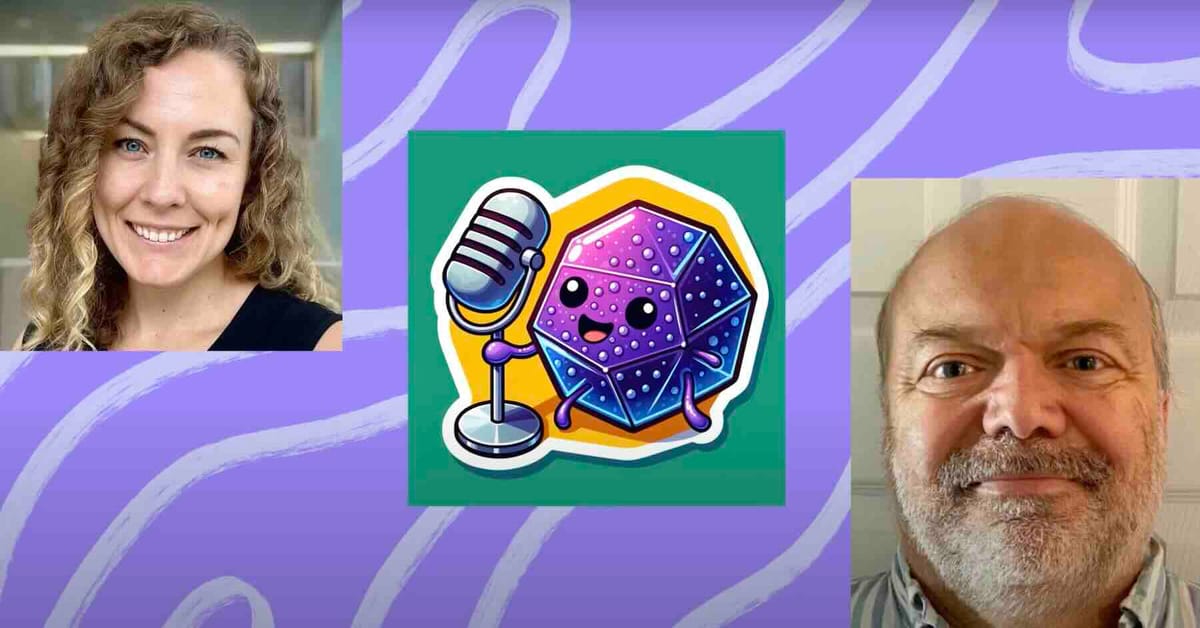
Why isn’t phage therapy a thing yet? What’s taking so long?
I’m super excited to share our new podcast, Podovirus. This is a new experiment. I wanted a (better?) excuse to have in-depth conversations with some of my favorite phage people, and ask them about what they’re doing, what work still needs to be done, why certain things are hard, etc.
Come join the fun!
🎙️ Most recent episode: Getting phage research funded — Former NIH program officer Joe Campbell reflects on his career watching & helping phage work get funded
🎧 Listen: Podovirus on Spotify
🎥 Watch: Podovirus on YouTube
Subscribe to get the next episodes! ✂️ Up next: Jesus Fernandez (Eligo Bioscience’s VP Technology) on Eligo's new microbiome editing tech & how it works
🩺 On deck: Joe Campbell will join as a co-host as we interview Dr. Gina Suh about phage therapy bottlenecks she’s facing as a clinician
Community digest5updates1job3posts
Updates
Guadalupe Valencia-Toxqui and Jolene Ramsey (Texas A&M University) published a new phage classification guide, orienting newcomers to four common ways phages are currently classified: infection cycle, morphology, taxonomy, and supergroup. By using these classifications, researchers can determine where any novel phage fits into the scheme of the known “phage-verse”.
Nicolas Kieffer (Universidad Complutense de Madrid) and colleagues published a new preprint on identification of phage defense systems encoded by mobile integrons, showing that integrons can encode phage defense systems, including Lamassu, CBASS, and abortive infection systems, and that these systems can confer resistance to multiple phages in various bacterial species.
Max Wilkinson (Massachusetts Institute of Technology) and colleagues have described how phage-triggered reverse transcription assembles a toxic repetitive gene from a noncoding RNA, showing a new mode of genetic regulation in prokaryotes.
Rabia Fatima (McMaster University) and colleagues published a new paper on temperate phage-antibiotic synergy in P. aeruginosa, showing widespread synergy between temperate phages and antibiotics, but varying by phage, host, and antibiotic pairing.
Eleonora Turrini, Luca Ulfo (University of Bologna) and colleagues published a new paper on molecular engineering of an M13 phage nanovector for photodynamic treatment of colon cancer cells. They show effective colorectal cancer cell targeting and photodynamic therapy in 3D spheroids, promoting the phage as a potential tool for cancer treatment.
Jobs
Karolinska Institutet, Solna, Sweden is hiring a postdoc to investigate phage biology and enhance phage efficacy using genetic engineering techniques.
Community board
Congratulations to Simon Roux for winning the 2025 ASM Microbiome Data Prize for his outstanding contributions to microbiome research!
The Phage Hunters Training and Research Program (PHTRP) has launched a fundraiser to support their Phage Training Startup Fund.
This initiative aims to equip young scientists in Africa and other developing countries with the skills needed to combat AMR through phage research. Inspired by the SEA-PHAGES program, PHTRP focuses on in-silico phage hunting and bioinformatics training, empowering the next generation of researchers to address the global AMR crisis.
The funds raised will cover startup registration costs, legal fees, and operational expenses.
The ISVM (International Society for Viruses of Microbes is launching a logo design competition to create a new visual identity for the society, with submissions due by October 6th via the ISVM Board's email.
Hi phage phans,
I hope you’re enjoying the summer!
There’s a lot packed into this month’s phage picks — from a cool filamentous phage paper, to a whole slew of very cool computational / AI projects. As you might have noticed, the Phage Directory site has been quite neglected, because I’ve been building a lot of new tools that work with AI, which we’re planning to coincide with a new Phage Directory launch. The pie’s still in the oven, but I can’t wait to start sharing some of the tools that we’ve been putting together for the phage community.
With that said, OpenAI just launched a new model yesterday, the o1-preview and o1-mini, and apparently it excels at scientific reasoning, and has been consistently beating humans on benchmark tasks. I haven’t actually used it yet, but I can’t wait to build system on top of it for experiment planning, protocol brainstorming, and grant planning for the phage community. Big things are coming soon!
Oh, in today’s phage picks, we’re experimenting with using language models to generate summaries (Claude is now way better at summarizing these papers than I am) and… we’re also now creating audio “interviews” of these picks with Google’s NotebookLM. It’s wild, give it a listen. Oh, and it’s free — go play with it: https://notebooklm.google.com.
If you get tired of all the computational and AI projects… I’d love to feature your community submissions for phage picks — you get to feature whatever paper you want — including your own — if you’re looking for citations or a postdoc. Just sayin’. Just email me at jan@phage.directory!
~ Jan
The lysogenic filamentous Pseudomonas bacteriophage phage Pf slows mucociliary transport
What is it about?
This study reveals that the Pseudomonas aeruginosa filamentous bacteriophage Pf can significantly impair mucociliary transport in airway cells, particularly in the context of cystic fibrosis. By forming liquid crystalline structures in mucus and entangling cilia, Pf phage reduces the efficiency of this crucial defense mechanism. These findings not only shed light on the pathogenesis of P. aeruginosa infections in CF but also open up new avenues for therapeutic interventions targeting bacteriophages. The research highlights the complex interplay between phages, bacteria, and host physiology, emphasizing the need to consider phages as important players in chronic infections.
Audio Overview: https://media.phage.directory/capsid/phage-picks-sep-2024/pf-phage-paper.mp3
Why I’m excited about it:
There’s so much to uncover about how phages interact with phage hosts and their environments — especially with “weird” ones like filamentous phages. Jess’ lab works on Pf phages, and are exploring ways to take advantage of the liquid crystalline structures that Pf can create. More excitingly, there’s probably way more undiscovered mechanisms out there between phages and their surroundings.
~ Jan
Paper: https://academic.oup.com/pnasnexus/advance-article/doi/10.1093/pnasnexus/pgae390/7750923
Elizabeth B Burgener, Pamela Cai, Michael J Kratochvil, Laura S Rojas-Hernandez, Nam Soo Joo, Aditi Gupta, Patrick R Secor, Sarah C Heilshorn, Andrew J Spakowitz, Jeffrey J Wine, Paul L Bollyky, Carlos E Milla, The lysogenic filamentous Pseudomonas bacteriophage phage Pf slows mucociliary transport, PNAS Nexus, 2024; https://doi.org/10.1093/pnasnexus/pgae390
Antibiotics damage the colonic mucus barrier in a microbiota-independent manner
What is it about?
This research paper investigates the impact of antibiotic treatment on the colonic mucus barrier, a crucial component of the intestinal immune system. The study demonstrates that certain antibiotics can disrupt this barrier by directly inducing ER stress in colonic cells, independent of their effects on the gut microbiota. This ER stress leads to a reduction in mucus secretion, which, in turn, weakens the barrier function and increases the susceptibility to intestinal inflammation. The authors also provide evidence that vancomycin, a commonly used antibiotic, can exacerbate colitis in a mouse model, highlighting the potential for antibiotics to negatively impact gut health.
Audio Overview: https://media.phage.directory/capsid/phage-picks-sep-2024/abio-mucus-dmg.mp3
Why I’m excited about it:
Papers like these reveal that antibiotics do way more harm than we thought — and we already thought they were bad! Papers like these also provide a different angle to the traditional “antibiotics will stop working on the year 2050!” types of phage paper introductions, as they show us antibiotics really need to be a last line drug.
~ Jan
Paper: https://www.science.org/doi/10.1126/sciadv.adp4119
Jasmin Sawaed et al. Antibiotics damage the colonic mucus barrier in a microbiota-independent manner. Sci. Adv. 10 (2024). DOI:10.1126/sciadv.adp4119
Introducing Chai-1: Decoding the molecular interactions of life
What is it about?
Chai-1 is a multi-modal foundation model for molecular structure prediction. This model excels in various tasks relevant to drug discovery, including protein-ligand and multimer prediction. Chai-1 is particularly notable for its ability to incorporate experimental constraints, enhancing its accuracy, and its single-sequence mode, which performs competitively even without multiple sequence alignments (MSAs).
The attached report details the model's architecture, training data, and evaluation results, highlighting its performance compared to existing methods like AlphaFold3 and RoseTTAFold All-Atom.
Audio Overview: https://media.phage.directory/capsid/phage-picks-sep-2024/chai-tech-report.mp3
Why I’m excited about it:
I’ve been interested in biology prediction tools for a while. I think these predictive tools, when used correctly, can help us quickly validate (or invalidate) ideas. Though this one isn’t about phages, the field benefits from learning about these new models (and how they’re built).
~ Jan
Blog Post: https://www.chaidiscovery.com/blog/introducing-chai-1
Report: https://chaiassets.com/chai-1/paper/technical_report_v1.pdf
Chai Discovery Team
PaperQA2: Superhuman scientific literature search
What is it about?
This research paper describes the development of a language model agent called PaperQA2, which is designed to assist scientists with research tasks such as information retrieval, summarization, and contradiction detection. The authors demonstrate that PaperQA2 achieves superhuman performance in these tasks, surpassing the abilities of human experts in answering scientific questions, creating accurate Wikipedia-style summaries of scientific topics, and identifying contradictions within the scientific literature. The paper also provides a comprehensive methodology for rigorously comparing the performance of AI systems with human performance in real-world scientific research settings.
Audio Overview: https://media.phage.directory/capsid/phage-picks-sep-2024/futurehouse-paperqa2-language-agents-science.mp3
Why I’m excited about it:
Imagine having an army of interns (AI) go into the literature and search for any hypothesis and dig up evidence for you. And imagine running these machines 24/7. Tools like PaperQA2 can help you pre-vet ideas and hypotheses before you spend a few weeks going down various rabbit holes.
The best part, is that it’s completely free (and open source)!
~ Jan
Blog post: https://www.futurehouse.org/research-announcements/wikicrow
Report: https://storage.googleapis.com/fh-public/paperqa/Language_Agents_Science.pdf
Code: https://github.com/Future-House/paper-qa?tab=readme-ov-file
Jan Zheng, MHCI
I'm Jan, the other half of Phage Directory, and co-write Capsid & Tail.
Previously, I did data work at Phage Australia / Westmead Institute, where I built the biobank databases, data systems, and bioinformatics workflows for the clinical trial
I have a background in computer science and human-computer interaction, and I'm currently full-time at building the agentic layer for science at Nvidia.