

Issue 268
Insights from the 6th Bacteriophage Therapy Summit 2024

This week we're featuring Michael Shamash's reflections on a couple of noteworthy topics covered at this year's Hanson Wade phage summit. Michael is a McGill University PhD student by day / awesome Phage Directory volunteer by night — thanks for covering the conference and bringing us all back what you learned, Michael!
Community digest5updates2jobs1post
Updates
One hundred personalized phage treatments, combined! Not only did Jean-Paul Pirnay and colleagues at the Queen Astrid Military Hospital in Belgium provide phages for 100 cases, they also published a full analysis of the outcomes! This led Nature Microbiology to write an editorial advocating for phage therapy development (win!). See also this commentary on the paper from Jon Iredell and colleagues, and this blog post and Twitter thread by coauthor Sabrina Green, who breaks down the main learnings.
Katie Wiebe (Cytophage Technologies, Inc) and colleagues have outlined a scalable and efficient production strategy for the ETEC phage ‘Phage75’, which accounts for infection load, MOI, temperature, media, harvest time, and host bacteria (they screened variables impacting production in a high throughput OD assay). They demonstrate this works in flasks at 3 scales as well as in the Cellexus CellMaker bioreactor.
Qingquan (Kevin) Chen (Stanford University) and colleagues have demonstrated that filamentous Pf phages of P. aeruginosa hinder antibiotic diffusion through CF sputum via electrostatic binding.
In a recent perspective piece, Christine Szymanski (University of Georgia) highlights the limitless resources for exploitation that phages provide. She discusses their use in various fields such as phage therapy, gene transduction, and glyco-tool discovery, among others.
The Centre for Phage Research at the University of Leicester, UK is celebrating its one-year anniversary! Martha Clokie and Andrew Millard reflect on the first year.
Jobs
Franklin Nobrega (University of Southampton, UK) is hiring a PhD student to work on phage therapy for TB.
McGill University (Montreal, Canada) is hiring a teaching assistant to assist with the Fall 2024 SEA-PHAGES: Phage Discovery course.
Community board
Check out this episode of the Phage Therapy Today podcast, which features Dr. Mercedes Gonzalez from INCATE (an AMR startup funder/accelerator) and Dr. Gregorio Iraola at Kinzbio, an INCATE recipient and founder of a new phage startup in Uruguay, about global funding opportunities for phage therapy.
I recently had the opportunity of attending the 6th Bacteriophage Therapy Summit in Boston, USA, on behalf of Phage Directory. This gathering brought together leading industry experts in the field of bacteriophage research and therapy and was full of innovative ideas and exciting research. What stood out to me the most were the discussions on the applications of bacteriophages in the agrifood sector, particularly in animal health and agriculture.
Agrifood Applications of Phages
Researchers presented compelling evidence on how phages can be utilized to combat bacterial infections in livestock, reducing the reliance on antibiotics without disrupting the beneficial commensal microbiota. Presentations also showcased how phages could be employed to protect food from spoilage, promoting more robust global supply chains.
I learned about 3 companies doing work in this space, and am looking forward to seeing their advancements and new applications over the coming years.
-
PhageLab, a Chilean company which presented their rapid phage manufacturing pipeline for animals, and discussed the difficulties associated with targeting high serovar diversity.
-
NexaBiome, a Scottish company which showcased their plasma immobilization technology to attach phage particles to solid surfaces such as animal feed and food packaging, reducing food spoilage.
-
Proteon Pharmaceuticals, a Polish company which produces feed additives to reduce Salmonella burden in poultry.
Jason Clark from @NexaBiome is sharing how they use plasma immobilization to attach phage to solid surfaces like animal feed & food packaging. Bagged salads saw a 20% extension in shelf life, reducing food waste. Immobilized phage is significantly more stable than adsorbed phage. https://t.co/cdQGxcKTZk pic.twitter.com/Cd34pfutWX
— Michael Shamash (@michaelviridae) February 29, 2024
Jaroslaw Dastych from @Proteonpharma is describing the journey their poultry feed additive aimed at reducing Salmonella burden in obtaining regulatory approval from EU authorities. Quite a long and arduous journey identifying many gaps in current regulatory guidance! https://t.co/b1p7U8Bzv8 pic.twitter.com/BqWXYkr7zE
— Michael Shamash (@michaelviridae) February 29, 2024
Optimizing Phage Dosing
Another important point of discussion at the summit was the optimization of phage dosing in both human and animal therapies. Currently, there seems to be a lack of standardized dosing protocols, and many resort to previously published dosing regimens without further optimization.
This issue stems from the complexity of phage-bacteria interactions and the variations in an individual’s response. Factors such as the immune system's interaction with phages, the presence of bacterial biofilms, and the specific location of the infection all play a role in determining the effective dose. As a result, there's a need for more research to establish evidence-based guidelines for phage dosing, ensuring patients and animals receive the most effective treatment with minimal risk of adverse effects.
It was great to attend the conference, and I look forward to following these companies and topics as they develop in the future!
Live-Tweeting
Jan’s Notes: Michael also live tweeted the entire conference! He covered presentations from organizations like Locus Bio, Tolka AI, Cobik, and PhageLab. Follow him at @michaelviridae to follow along the entire Phage Summit.
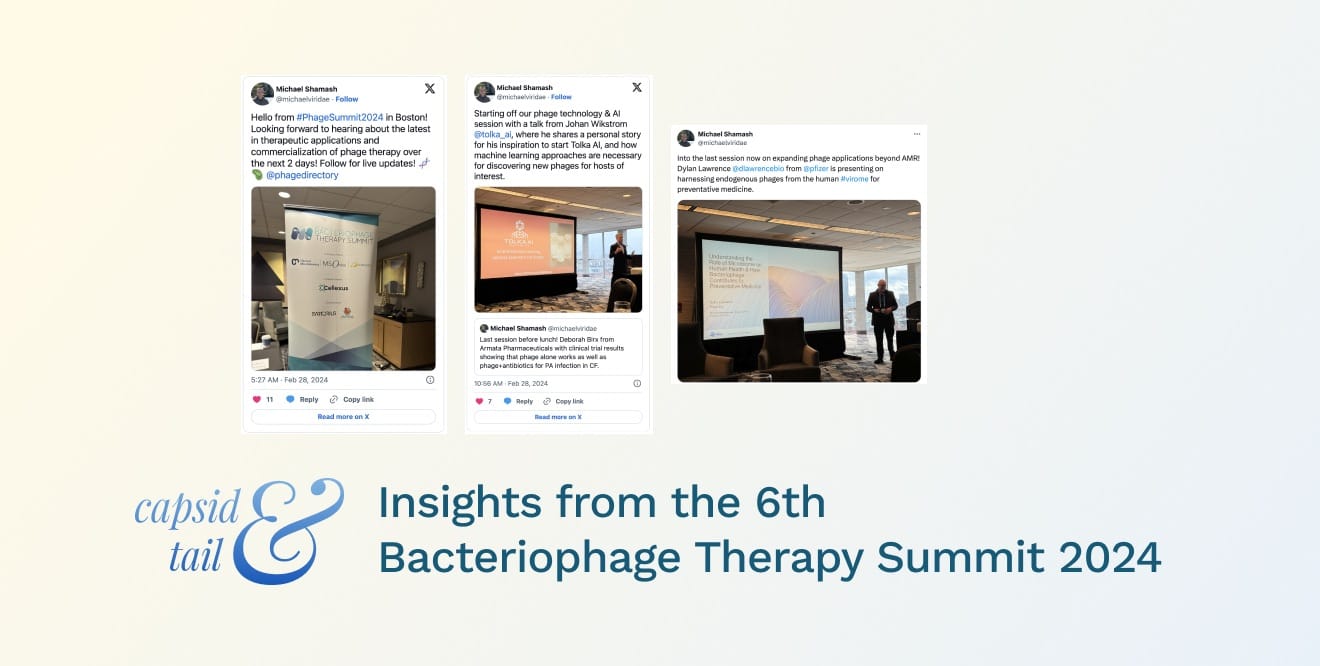
Hello from #PhageSummit2024 in Boston! Looking forward to hearing about the latest in therapeutic applications and commercialization of phage therapy over the next 2 days! Follow for live updates! 🧬🦠 @phagedirectory pic.twitter.com/gONDiQ0mnf
— Michael Shamash (@michaelviridae) February 28, 2024
Starting off our phage technology & AI session with a talk from Johan Wikstrom @tolka_ai, where he shares a personal story for his inspiration to start Tolka AI, and how machine learning approaches are necessary for discovering new phages for hosts of interest. https://t.co/Xuic0drSuP pic.twitter.com/sudcVB3hgk
— Michael Shamash (@michaelviridae) February 28, 2024
Phage students! Want to be our next Conference Correspondent?
If you want to go to a phage conference and report back to the community, like Michael did here, let us know! Email jessica@phage.directory about which conference you're interested in, plus a bit about yourself if I don't already know you, and we'll see what we can do!

Michael Shamash
I’m currently a PhD student in the Maurice Lab at McGill University. My research focused on studying the dynamics of bacteriophage-bacteria interactions in infant gut microbiota in the contexts of health and malnutrition. To do so, I use single-cell techniques combined with viral and bacterial metagenomics, as well as animal models of early life development. I also developed and maintain OnePetri, an open-source mobile application which accelerates plaque counting and common assays using computer vision and artificial intelligence.