

Issue 260
What do we know about phages and neutrophils?

There's been a few studies lately on phages and neutrophils. Do they help each other? Do they get in each other's way? Who can keep track? This week we take a look at three phage-neutrophil papers and what they found.
Sponsor
Sponsor

Join us for the Viruses of Microbes 2024 conference in beautiful Cairns, Australia to hear all about the latest advances in the field and reconnect with friends & colleagues. We are currently building the full scientific program, but there is still time to submit late-breaking abstracts until the 19th of April.
Community digest1alert5updates2jobs2posts
Phage alert
Urgent need for Peptostreptococcus/Finegoldia phages for a patient in Canada
We are urgently seeking Peptostreptococcus/Finegoldia phages for a patient in Canada.
Ways to help at this stage:
- By sending your phages for testing on the patient's strains
- By receiving the patient's strain and testing your phages
- By helping spread the word about this request
- By providing us with names/email addresses of labs you think we should contact
Please email staff@phage.directory if you can help in any way, or if you would like further details/clarification.
Let’s make a difference, Phage Directory
Updates
Big news! After years in the making, the European Pharmacopoeia Commission has adopted a new general chapter on ‘phage therapy medicinal products’, providing a framework of requirements for their production and control, in an effort to standardize requirements for phage therapy.
An anonymous donation to the University of Toronto has led to a grant call of up to 1.5 million Canadian dollars for phage therapy research, with letters of interest due on April 19th. There are options for $200,000 and $50,000 allocations. Primary applicants are required to have an academic appointment in Canada, and international collaborations are encouraged.
For 6 decades, it has been a mystery how ssDNA phages use their ‘maturation’ (Mat) protein (1 of 4 proteins encoded by the phage, known to be involved in plus recognition) to enter the host cell. Jirapat Thongchol (Texas A&M University) and colleagues have now shown that ssRNA phage PP7 binds to type IV pilus via Mat, and as the pilus retracts, the phage physically causes the pilus to bend and snap off.
Maik Wolfram-Schauerte (Max Planck Institute for Terrestrial Microbiology) and colleagues published a preprint revealing that T4 phage RNA is NAD-capped, and alters the NAD-cap epitranscriptome of E. coli during infection through a phage-encoded decapping enzyme. This study introduces epitranscriptomics as a new field in phage research.
Siva Uppalapati (University of Colorado School of Medicine) and colleagues discovered that a Salmonella prophage terminase is redox sensitive — it unexpectedly switches into acting as a tRNAse under oxidative stress, arresting host translation and giving the host an opportunity for genome repair.
Jobs
The Laboratory of Bacteriology Research at the University of Ghent, Belgium, is hiring a postdoc to computationally understand and model the efficiency of the Diversity Generating Retroelements system used by phages to diversify their proteins. This will be used in collaboration with David Bikard's group (Institut Pasteur) to generate new variants of the Cas9 protein.
The Hoer Lab at the Helmholtz Institute for RNA-based Infection Research in Würzburg, Germany, is hiring a postdoc to investigate RNA phages, focusing on their role in bacterial immunity and regulation.
Community board
Baylor College of Medicine researchers Anthony Maresso and Michael Tisza, have won the 2024 STAT Madness competition for their groundbreaking work on using wastewater monitoring as an early-warning system for disease outbreaks, demonstrating the detection of over 450 disease-causing viruses in public wastewater.
Wilfried Moreira is serving as Guest Editor for a new Special Issue on "Bacteriophage Biology and Phage-Derived Technologies" in the open access journal International Journal of Molecular Sciences, with a submission deadline of August 31, 2024.
Last week as I was writing about Echterhof et al. (about how their new preprint showed that neutrophils aren’t the culprit when it comes to phage lifespan in serum), I started thinking back to another phage+neutrophil paper I remember reading. This was a few years back; but I seemed to remember neutrophils being important/essential for phage therapy to work. It made me want to check back to that paper and see how these two phage-neutrophil papers might fit together.
As I was looking for that paper I came across an even newer one about the same topic by the same main author, Dwayne Roach (who now runs a lab at SDSU). Interesting — what did this new one find? And how does that fit with the others?
What is going on with phages and neutrophils?
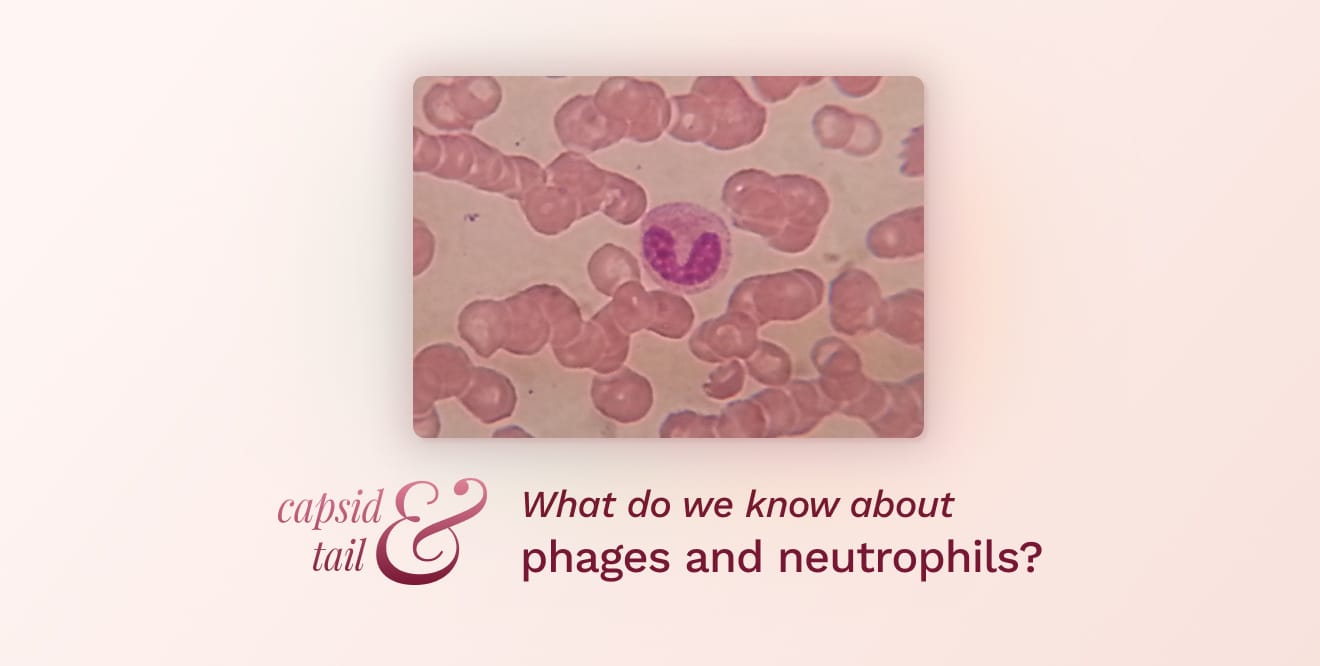
What are neutrophils again?
But first! What are neutrophils again? None of us have taken immunology since undergrad, right?
- White blood cells (they are the most abundant kind, making up 55-70% of most adults’ white blood cells!)
- First-line responders meant for quickly fighting/neutralizing infection (bacteria and fungi mostly)
- Phagocytes — they engulf microbes and release factors (like reactive oxygen species and NETs) that kill them
- Unlike macrophages, they only last for hours/days (not months/years), and they don’t really present antigens to T cells like macrophages do.
So neutrophils are the short-lived, quick-acting, more simplistic first responders of the white blood cells. And they’re super prevalent!
A quick look at 3 ~recent phage-neutrophil papers
Now back to phages, and what we know about how they see and interact with neutrophils. First, a brief look at the three papers I mentioned (I am sure there are more; this is not exhaustive!) and what they found:
Paper 1: Roach et al. 2017
Roach et al. (2017) demonstrated that neutrophils play a crucial role in the success of phage therapy against a Pseudomonas aeruginosa lung infection in mice.
- They used PAK_P1, a Myovirus
- They infected mice with P. aeruginosa and administered phages intranasally
- They had neutropenic and normal mice (neutropenia was induced by administering anti-granulocyte receptor-1 (Gr1) monoclonal antibody) (neutrophils are granulocytes)
- They saw the neutropenic mice were ‘completely unresponsive’ to phage treatment
- They did a lot of mathematical modeling to build a predictive model of when phage therapy would work, and what matters (and tested a bunch of other immunodeficiencies other than neutropenia, that I haven’t gone into here)
- They concluded that synergy between phages and neutrophils leads to resolution of bacterial infection
Paper 2: Roach et al. 2023
Roach et al. (2023) investigated the direct effects of P. aeruginosa phage PAK_P1 on isolated human neutrophils in vitro.
- They used PAK_P1, a Myovirus
- They isolated neutrophils; incubated directly with several concentrations of phage
- Phage did not significantly affect other neutrophil functions such as apoptosis, oxidative burst, or NET formation.
- The highest concentration of phages (a cell:phage ratio of 1:10,000) they tested triggered a small increase in IL-8 production
- Phage exposure did not alter neutrophil responses to other inflammatory stimuli
- Of note, the phages were not actively replicating in this experiment (host was not present since that would have impacted the neutrophils)
Paper 3: Echterhof et al. 2024
Echterhof et al. (2024) focused on the role of neutrophils in the clearance and pharmacokinetics of intravenously administered phages in uninfected mice.
- They used LPS-5, a Podovirus
- They depleted neutrophils by dosing mice with cyclophosphamide and administered phages intravenously
- They found that neutrophil depletion had minimal impact on phage half-life in blood and spleen, suggesting that neutrophils do not significantly contribute to phage clearance in the absence of infection.
- More on this paper in last week's C&T; it was one of our Phage Picks!
Summary
So taken together, what do we know about phage-neutrophil interactions?
- In the absence of infection, neutrophils don’t clear phage LPS-5 from circulation.
- During an active infection, neutrophils work synergistically with phage PAK_P1 to clear P. aeruginosa. Or in other words, without neutrophils, this phage didn’t work therapeutically.
- PAK_P1 phage by itself does not strongly activate or modulate neutrophil functions in vitro.
So neutrophils are friends (of phages), not foes?
Based on these three papers, this is my rough hand-wavey conclusion.
If generally true, this could be construed as good news from a safety perspective (it’s nice if phages don’t freak out the innate immune system and make patients sicker). That said, sometimes the immune system is helpful, and we don’t always want it to be silent. Fortunately when bacteria are present, the immune system does tend to kick in, and it seems like can really help a phage do its job.
Other things that would be cool to explore
It will be interesting to find out if this generally neutral-to-positive neutrophil relationship is true for more phages than the ones tested to date. Are neutrophils always going to pretty much either ignore or help phages? Or are some phages harder to ignore? Or harder to help?
And of course, it will be interesting to find out more about what aspects of the immune system do perk up when they see a phage (since many have shown that something is clearing phages from circulation), and what those responses look like.
Reach out if you’re working on something in this area! I would love to chat, and dive into one of your papers in a future post (or you can write one!!).
References
Roach, D. R., Leung, C. Y., Henry, M., Morello, E., Singh, D., Di Santo, J. P., Weitz, J. S., & Debarbieux, L. (2017). Synergy between the host immune system and bacteriophage is essential for successful phage therapy against an acute respiratory pathogen. Cell Host & Microbe, 22(1), 38-47.e4. https://doi.org/10.1016/j.chom.2017.06.018
Roach, D. R., Noël, B., Chollet-Martin, S., de Jode, M., Granger, V., Debarbieux, L., & de Chaisemartin, L. (2023). Human neutrophil response to Pseudomonas bacteriophage PAK_P1, a therapeutic candidate. Viruses, 15(8), 1726. https://doi.org/10.3390/v15081726
Echterhof, A., Dharmaraj, T., McBride, R., Berry, J., Hopkins, M., Selvakumar, H., Miesel, L., Chia, J.-H., Lin, K.-Y., Shen, C.-C., Lee, Y.-L., Yeh, Y.-C., Liao, W. T., Suh, G., Blankenberg, F. G., Frymoyer, A. R., & Bollyky, P. L. (2024). The contribution of neutrophils to bacteriophage clearance and pharmacokinetics in vivo. bioRxiv. https://doi.org/10.1101/2024.01.25.577154

Jessica Sacher, PhD
I'm a co-founder of Phage Directory and have a PhD in Microbiology from the University of Alberta (I studied Campylobacter phage biology). For Phage Directory, I help physicians find phages for their patients, and I'm always trying to find new ways to help the phage field grow (especially through connecting people and highlighting awesome stuff I see happening in the field).
I spent 2022-2024 as a postdoc in Jon Iredell's group at Westmead Institute for Medical Research in Sydney, Australia, helping get Phage Australia off the ground. I helped set up workflows for phage sourcing, biobanking, diagnostics, production, purification and QC of therapeutic phage batches, and helped build data collection systems to track everything we did. We treated more than a dozen patients in our first year, and I'm so proud of that!
As of 2024, I joined the Bollyky lab at Stanford University as a Staff Scientist, where I'm focused on phage engineering and delivery (to both microbial and human cells) and hydrogel-embedded phage cocktail development for wounds!