

Issue 103
Engineering phage ΦX174's genome: a recap of November's PHAVES talk

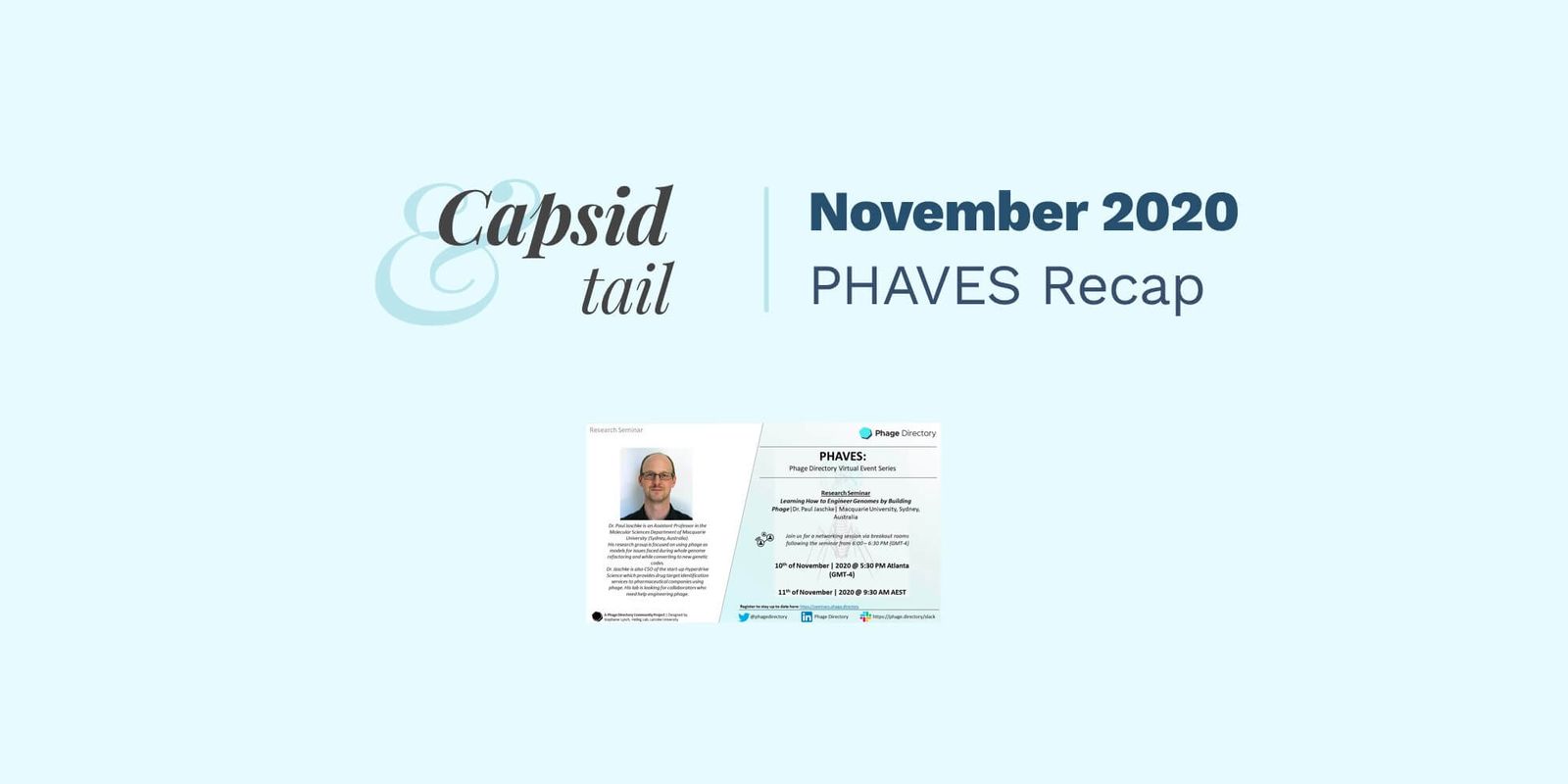
This month, we hosted episode 10 of PHAVES, a talk on phage engineering by Dr. Paul Jaschke, Lecturer at Macquarie University! Here's the recording, along with a recap written by Stephanie Lynch, PhD candidate at La Trobe University (and our amazing volunteer PHAVES coordinator)!
Community digest2alerts5updates4jobs2posts
Phage alert
Urgent need for Extended Spectrum Beta-Lactamase (ESBL)-E. coli phages for a patient
We are urgently seeking Extended Spectrum Beta-Lactamase (ESBL) E. coli phages for a cystic fibrosis patient in the USA.
Ways to help at this stage:
- By sending your phages for testing on the patient's strain
- By receiving the strain and testing your phages
- By receiving the strain and using it to search for new phages against the organism
- By helping spread the word about this request
- By providing us with names/email addresses of labs you think we should contact
Please email staff@phage.directory if you can help in any way, or if you would like further details/clarification.
Let’s make a difference, Phage Directory
Add your voice to the State of Phage 2020 Survey!
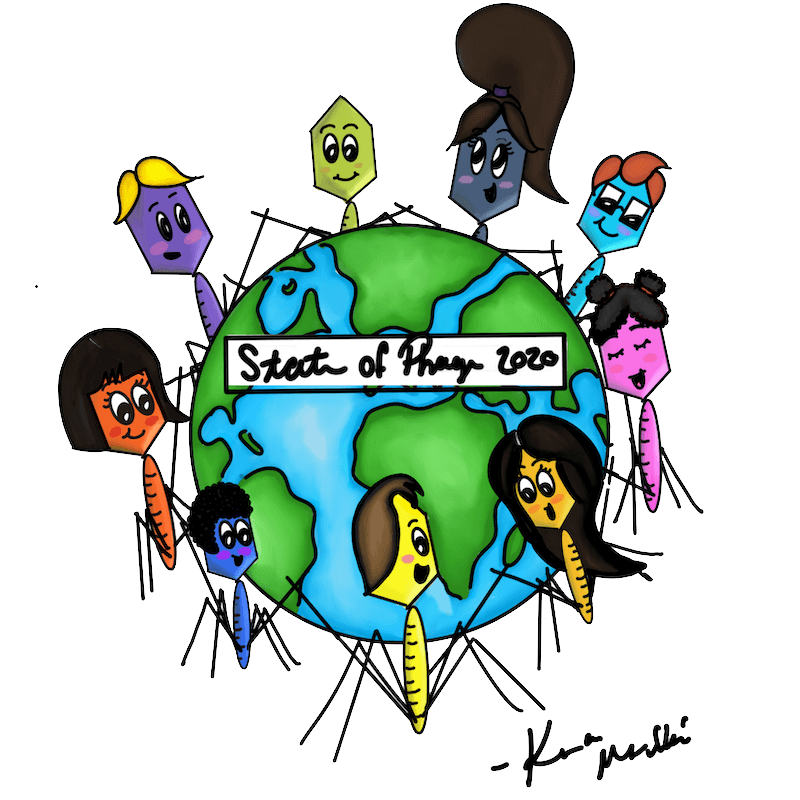
In celebration of our 100th issue of Capsid & Tail, we launched a survey called State of Phage 2020! We created this survey to help us all better understand the phage research community globally, including what kind of phages people are collecting, what methods they're using, and more. If you work with phages, please fill it out! We'll compile and share the results in Capsid & Tail in 2021, and repeat the survey annually so we can all follow and share our community's exciting growth over time.
SURVEY CLOSES IN 24 HOURS
Thanks so much to the 134 labs who've completed the survey, and to those who have shared it!! Today is the last day the survey will be open, so if you've started but haven't finished (58 of you — your browser should have saved your progress!) or you want to take it from the beginning, please fill it out today!
We'd love if you continued sharing it with friends! https://survey.phage.directory/
Updates
Ameneh Khatami (University of Sydney) and colleagues published a new preprint showing therapeutic monitoring of the host-bacterium-phage interaction in a child. They describe how they treated a 7-year-old with a chronic osteoarticular Pseudomonas infection, and how monitoring phage and bacterial kinetics and the human host response allowed them to adjust dosing early on, leading to a strong therapeutic effect within two weeks. Phage Directory is proud to have helped source phages for this effort, and especially proud of the 12 labs who responded to our alert last summer.
Lorraine Draper (APC Microbiome Ireland) and colleagues published a new paper in BMC Biology showing the impact of faecal viral transfer (FVT) on the mouse microbiome after antibiotic perturbation. They saw that FVT helped the mice get back to a pre-antibiotic microbiome, but only when the FVT contained viable phages.
Roberto Molina-Quiroz (Centro de Estudios Científicos, Chile) and colleagues published a new paper in mSphere showing that prophage-dependent neighbor predation in Vibrio cholerae leads to enhanced horizontal gene transfer by natural transformation.
The WHO's 4th Clinical Antibacterial Pipeline Advisory Group Meeting took place this week. Haileyesus Getahun, MD (Joint Secretariat on AMR at WHO) stated via Twitter that for the first time, available data on phage therapy was set to be evaluated.
Adaptive Phage Therapeutics (APT) is working toward a phage-based COVID vaccine — a phage engineered to express epitopes of SARS-CoV2 on the surface of the capsid. Phage-based vaccines are attractive because they are considered safe in the body and self-adjuvanted. APT is exploring the potential for an oral delivery system in the form of a lozenge.
Jobs
Dr Andrew Millard (University of Leicester) is hiring a PhD student to study the development of phage-based vaccines for animal health.
Professor Martha Clokie (University of Leicester) is hiring a PhD student to understand and characterize gut phages.
Dr Ed Galyov (University of Leicester) is hiring a PhD student to study the development of targeted phage metagenomics.
Professor Julie Morrissey (University of Leicester) is hiring a PhD student to study the effect of air pollution on the interaction between bacteria and bacteriophage.
Community board
Thanks so much to the labs who reached out in response to our request for Serratia phages last week. In just a few days, the strain was shipped out to the first set of labs for testing. A few days after that, an active phage was found (by Ronen Hazan's team at the Israel Phage Bank!) Sadly, the patient passed away this week, before they could receive the phage. Nonetheless, this formidable teamwork is worth celebrating, and we are proud of our phage community! Sign up to receive future urgent phage alerts here.
Join Jean-Paul Pirnay, PhD, Gina Suh, MD, and Nicholas Chia, PhD Nov 30, 2020 12:00 PM Central time for an engaging virtual discussion on phage therapy as a tool in the fight against antibiotic-resistant infections. The talk is entitled "Bacteriophages: It's a Medicine, Jim, But Not As We Know It".
This month, we hosted Dr. Paul Jaschke, Assistant Professor at Macquarie University, Sydney, Australia, and CSO of Hyperdrive Science for our November episode of PHAVES; check out the recap below!
PHAVES 10
Learning how to engineer genomes by building phage
YouTube video of PHAVES 10 (1:00:24)
Highlights of Paul’s talk
- Throughout his career, Paul has extensively studied a phage that belongs to the Microviridae family known as ΦX174. This phage is known to infect specific strains of Escherichia coli and Salmonella spp.
- Interestingly, throughout its infection process, ΦX174 creates a protein known as ‘Protein E’ which is an antibiotic-like lysis protein which disrupts peptidoglycan synthesis, which may be of interest from a therapeutic point of view.
- However, Paul’s work (at Macquarie University, Sydney, Australia) has focused on the genome of ΦX174, which is a circular ssDNA genome with extensive gene overlap. The overlap allows the 11 genes to only span across 5,386 bp. Does this overlap account for a message from extra-terrestrial intelligence? Unfortunately, probably not. However, importantly, a genome size >5kb does result in a lowered infectivity rate!
- Due to the structure of the ΦX174 genome, Paul and his team are interested in using this phage for synthetic genomics, which is the “extensive and intentional genetic modification of a replicating system for a specific purpose”. Why phage genomes for synthetic genomics?
- Phages are self-contained genetic programs with a constant operating system, therefore easier to tell if changes affect points of the phage lifecycle
- Phage lifecycles share characteristics such as DNA replication with other self-replicating systems
- Understanding how to engineer phage genomes may help accelerate them as next generation antimicrobials
- However, as mentioned, ΦX174 has gene overlaps, therefore, Paul begun by decompressing the genome of ΦX174 to remove all overlaps. Characterisation of decompressed ΦX174 found that it had smaller plaque sizes, smaller burst size, poor attachment and a downregulation of two proteins involved in scaffolding and replication in comparison to wild type ΦX174. Despite this, CryoTEM revealed that the structure of decompressed ΦX174 was indistinguishable from wild type ΦX174, and decompressed ΦX174 lysed cells at a similar efficiency in vitro at a higher MOI. This highlights the important trade-offs between removing overlaps and phage fitness.
- Paul finished up by talking about the cryptic genes in ΦX174. When conserved genes among the Microviridae family were erased (resulting in phage kleenX174), plaque size was reduced and therefore phage fitness was reduced, confirmed by creating chimeric genomes. This reduction in fitness was shown to be due to a nucleotide mutation in the ‘H protein’. Reverting the single nucleotide mutation back to wild type allowed the doubling of protein H production.
- Coming soon(ish), Paul and his team have some very exciting studies up next. One that particularly interested the audience was the creation of a Plaque Quantification Tool by Master's Student Ellina Trofimova – stay tuned!
Phage Directory is on YouTube!
Subscribe to Phage Directory's YouTube channel to keep up to date with future PHAVES recordings!
Sign up for PHAVES!
Register for upcoming PHAVES seminars — not only do we host speakers, interviews and AMAs, but we always host breakout rooms after the talks to encourage casual socializing/networking among the phage community!
Stephanie Lynch, PhD
Stephanie is a postdoctoral researcher for the Iredell Group at Westmead Institute for Medical Research, NSW. Her project focuses on phage therapy for compassionate human cases (as part of Phage Australia), with a particular interest in Staphylococcal phages. In 2021, Stephanie completed her thesis titled ‘Exploring phage therapy for Staphylococcus pseudintermedius infections in canines'. Steph is always willing to chat about phage research and would like to connect with phage biotech companies.