

Issue 94
From gut phages to fish phages: a recap of September's PHAVES talks

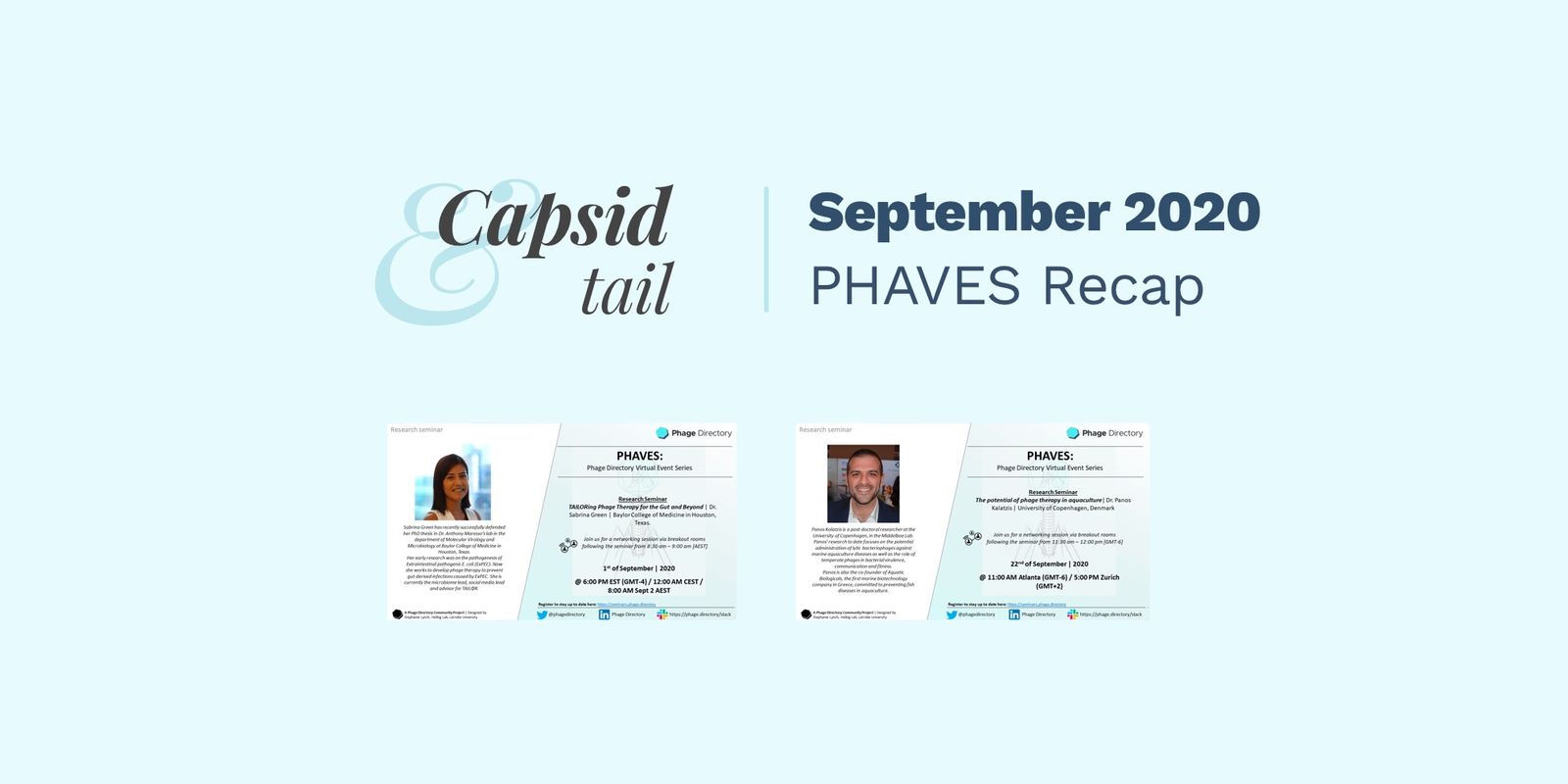
This month, we hosted two episodes of PHAVES! Here's your recap of both, along with links to the recordings. Thanks very much to our special guests, Dr. Sabrina Green and Dr. Panos Kalatzis.
Community digest8updates1job2posts
Updates
Viperins are known to function in the eukaryotic antiviral response, and now they've been found in prokaryotes. Aude Bernheim (Weizmann Institute of Science) and colleagues published a new paper in Nature on prokaryotic viperins, which protect against phages. Paper | Press release
The use and selection of excipients are critical to stabilize phages in solid formulations. Yajie Zhang (University of Texas at Austin) and colleagues have reviewed the current classes of phage excipients, outstanding challenges with phage formulation, and new strategies that could help.
Niels Vander Elst (Ghent University) and colleagues published a new paper in Antibiotics on the characterization of two phage lysins, PlySs2 and PlySs9, which have in vitro lytic activity against bovine mastitis pathogen Streptococcus uberis.
What's the prevalence of antibiotic resistance genes and virulence genes in complete/near-complete phage genomes? The Millard Lab did an analysis; here are the results.
Clément Girardot wrote a new piece on phage therapy for The Guardian's Global Development section; in it he interviews Tobi Nagel and Martha Clokie of Phages for Global Health.
Micreos has initiated a clinical trial to evaluate a topically-applied phage endolysin as a therapy for Atopic Dermatitis.
The Central Institute of Brackishwater Aquaculture, an Indian research institute, has been developing phage cocktails for aquaculture. They've now transferred their phage technology to Salem Microbes Private Ltd, so it can be made available to shrimp farms.
An international team of scientists are calling for the European Union to enforce non-animal antibody production, and phage display may be the ideal replacement. Report | Press release.
Jobs
Lund University (Lund, Sweden) is hiring a researcher to be responsible for research tasks dealing with development of biocatalysts for designing effective antimicrobial strategies. Phage knowledge required.
Community board
The Indian ‘Society for Bacteriophage Research and Therapy’ (SBRT) is a platform for phage researchers to share their expertise & resources. SBRT is pleased to announce a webinar on “Knowing the unknown: Approaches to characterize the vast uncharacterized proteome of bacteriophages” by Dr. Julianne H. Grose, Associate Professor, Microbiology and Molecular Biology, Brigham Young University, Provo, Utah, USA. The talk would be preceded by a keynote address by Prof. B.N. Tripathi, Deputy Director General, Animal Sciences, Indian Council of Agriculture Research Head Quarters, New Delhi. Please join us on 01 October (Thursday), 2020 at 7 pm IST/7.30 am MDT. We look forward to your participation. Register here.
The next rendition of PHAVES will be a seminar/Q&A with Dr. Emma Bell, Principal Bacteriophage Scientist at FixedPhage, and will take place October 6th at 4PM GMT+1. She'll discuss their phage immobilization technology and how they've improved their phage production with the Cellexus CellMaker. Small group networking to follow.
Thanks to Cellexus for sponsoring this event!
This month, we hosted two PHAVES events; here's your recap of both!
PHAVES 6
"TAILORing" phage therapy for the gut and beyond with Dr. Sabrina Green
YouTube video of PHAVES 6 (47:26)
Highlights of Sabrina's talk
- Through her research at Baylor College of Medicine (Anthony Maresso's lab), she's found that while there are lots of phages in the gut, some phages are inhibited by gut conditions (e.g. the presence of mucin)
- One phage particularly well-suited to killing in the gut had mucin-binding activity, and mucin helped the phage bind its host
- During her grad studies, Sabrina co-founded BCM TAILOR Labs, a service center that prepares therapeutic phage preparations for patients in need
- They isolate phages mostly from the Houston sewage system, and it's generally unlikely that they can't find a phage for a given patient's isolate
- Most patients who've received their phages have done well, many have cleared their initial infections
PHAVES 7
Phage potential in aquaculture with Dr. Panos Kalatzis
YouTube video of PHAVES 7 (38:45)
Highlights of Panos' talk
- Most of the animal protein humans eat is attributed to fish, but fish production is hampered by bacterial disease, especially in hatcheries where vaccines and antibiotics are problematic
- His work (in part at the University of Copenhagen, as well as through his company, Aquatic Biologicals) has involved testing phages as "smart disinfectants" in aquaculture settings, and they've seen that phage treatment can grant quite a high level of protection in an aquatic context
- There is not currently a defined regulatory pathway for phages in an aquaculture context (should it be a drug or a feed additive?), and many other challenges exist (endotoxins are bad for fish larvae too!), but the future appears promising for phage use in aquaculture
Phage Directory is on YouTube!
Subscribe to Phage Directory's YouTube channel to keep up to date with future PHAVES recordings!
Sign up for PHAVES!
Register for upcoming PHAVES seminars — not only do we host speakers, interviews and AMAs, but we always host breakout rooms after the talks to encourage casual socializing/networking among the phage community!

Jessica Sacher, PhD
I'm a co-founder of Phage Directory and have a PhD in Microbiology from the University of Alberta (I studied Campylobacter phage biology). For Phage Directory, I help physicians find phages for their patients, and I'm always trying to find new ways to help the phage field grow (especially through connecting people and highlighting awesome stuff I see happening in the field).
I spent 2022-2024 as a postdoc in Jon Iredell's group at Westmead Institute for Medical Research in Sydney, Australia, helping get Phage Australia off the ground. I helped set up workflows for phage sourcing, biobanking, diagnostics, production, purification and QC of therapeutic phage batches, and helped build data collection systems to track everything we did. We treated more than a dozen patients in our first year, and I'm so proud of that!
As of 2024, I joined the Bollyky lab at Stanford University as a Staff Scientist, where I'm focused on phage engineering and delivery (to both microbial and human cells) and hydrogel-embedded phage cocktail development for wounds!