

Issue 265
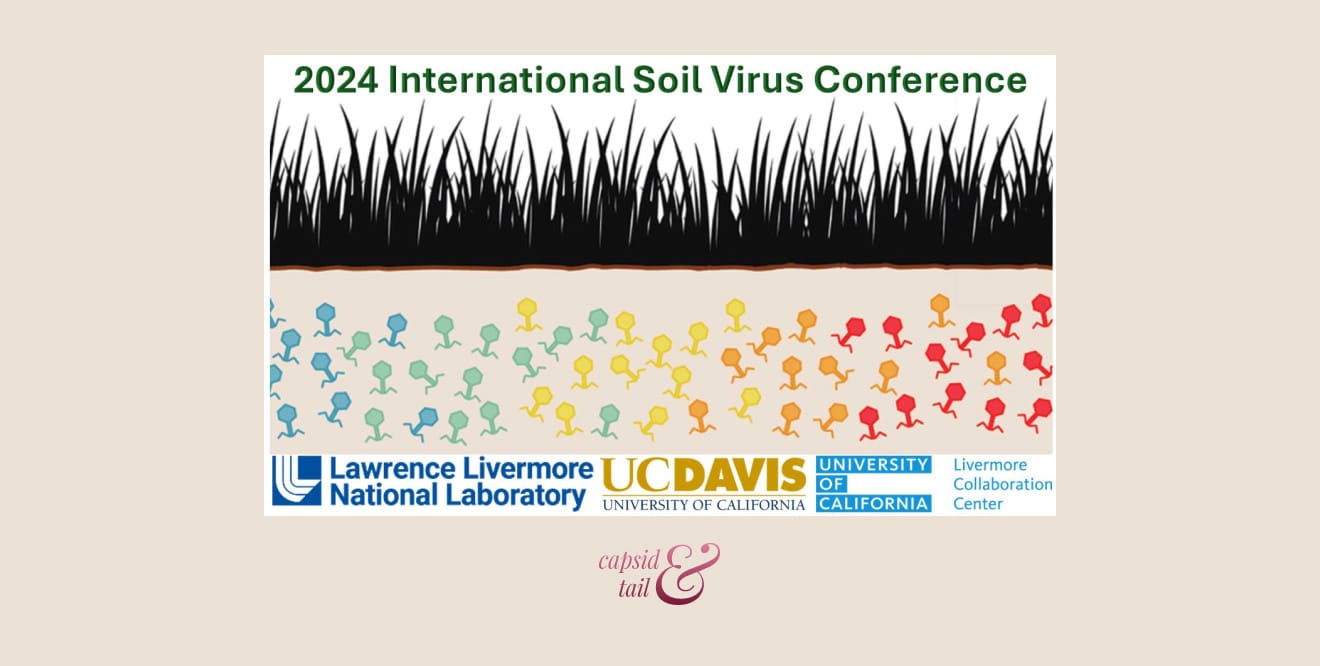
You're invited to the 2024 International Soil Virus Conference!

What are viruses doing in soil? This week we hear from Dr. Gary Trubl about an upcoming conference he's co-organizing in Livermore, California dedicated to soil virus biology!
Sponsor
Sponsor
Join us for the Viruses of Microbes 2024 conference in beautiful Cairns, Australia to hear all about the latest advances in the field and reconnect with friends & colleagues. Early bird registration rates close on the 24th of May, so please ensure you register by this time for the lowest rates. Student early bird registration is just $595 AUD, while academic and industry rates are $995 and $1550 AUD respectively.
Community digest5updates7jobs1post
Updates
Dr Ameneh Khatami (University of Sydney, Phage Australia) has been awarded $4.3 million to investigate the use of a locally produced two-phage combination that targets S. aureus to see if it provides an advantage in addition to antibiotics in treating patients with severe bloodstream infections.
Marie Attwood (University of Leicester) and colleagues published a new preprint on the development of antibacterial drug-plus-phage combination assays. They demonstrate that microbroth methodologies based on ISO 2776 and time-kill curves can effectively assess their combined efficacy.
Could phages play a role in microbial adaptation to spaceflight conditions? Iris Irby and Jared Broddrick (NASA Ames Research Center) have shown that bacterial strains from the International Space Station show significant differences in phage-associated genes compared to terrestrial strains.
Chutikarn Chitboonthavisuk (University of Wisconsin-Madison) and colleagues published a new preprint on systematic genome-wide discovery of host factors governing phage infectivity. They describe 'PHAGEPACK', a novel assay combining CRISPR interference with phage packaging, revealing new host pathways affecting phage fitness and potential targets for enhancing phage susceptibility by a billion-fold.
Stephanie Lynch (University of Sydney) and colleagues published the results of a survey on clinical needs and attitudes towards phage therapy among the cystic fibrosis community. The study highlights a significant reliance on antibiotics among CF patients, 62% awareness of phage therapy, and 96% interest in participating in phage therapy trials.
Jobs
Vulcan Biologics (Claremont, California) is seeking a phage enthusiast to provide crucial leadership and oversight as interim CEO during a pivotal transitional period.
The company's founder, Dr. Mike Koeris, has taken on the role of Office Director for the Biological Technologies Office at DARPA. The interim CEO will have a unique opportunity to shape the company's strategic direction, particularly in areas critical to phage research and biologics production. Dr. Koeris will lend support throughout, and return once his tour of duty at DARPA concludes.
For more information please contact Mike Koeris at mike@vulcanbiologics.com or on LinkedIn.
The Atkinson lab at Lund University (Lund, Sweden) is hiring a doctoral student in computational biology of infection to study prophages in E. coli genomes and annotate their genes using high-throughput AlphaFold.
The Bacterial Networks and Interactions group at Forschungszentrum Jülich, Germany) is hiring a PhD student in bacterial antiviral immunity to study secondary metabolites and their role in defending against phages infecting actinobacteria.
The Swedish University of Agricultural Sciences (Uppsala, Sweden) is hiring a researcher in parasitic interaction of aquatic microbes to study host-virus dynamics and other parasitic interactions in lake ecosystems using multi-omics analyses.
The Luque Lab at the University of Miami (Coral Gables, Florida) is hiring a postdoc in biology to predict the physical properties of uncultured viruses using computational biophysics and multi-scale modeling.
Howard Hughes Medical Institute (Chevy Chase, Maryland) is hiring a Research Assistant to support the Science Education Alliance program's research and training activities, focusing on the genetic diversity of the phage population.
The Lai lab at the University of North Carolina at Chapel Hill is hiring a postdoc to develop new strategies and translatable medicines using phage vectors.
Community board
The Phage Bioinformatics Wish List Survey is live!
(Thanks to the 31 respondents to date! The data is shaping up to be super informative!)
This survey aims to better understand the needs and satisfaction levels of phage biologists regarding various functions and bioinformatics tools used for phage sequence analysis, particularly in support of phage therapy. Your insights are invaluable in guiding future developments in this field.
This survey has been prepared by Bishoy M. Zaki and Ramy K. Aziz. It is not affiliated with any private or academic organization to which they belong.
Hello phage enthusiasts!
I want to welcome you to join us in Livermore for the 2024 International Soil Virus Conference! Here’s an overview of what you can expect from the conference.
Where: University of California Livermore Collaboration Center
(7000 East Ave Building 661 L-794, Livermore, CA 94550; virtual option available)
When: June 25–June 27, 2024, with optional networking activities June 24 and June 28
Why: Gather soil virus enthusiasts to foster collaboration, shape the trajectory of the field, and facilitate engaging discussions on cutting-edge research. Connect with fellow attendees, including early-career researchers, through a series of interactive sessions, presentations, and networking opportunities. Expect a dynamic conference program featuring talks, group discussions, poster presentations, and National Lab facility tours designed to inspire and advance our understanding of soil virology.
The conference format is modeled after a Gordon Research Conference, with the exception that we will conclude at dinner. It is specifically tailored to support students and early career researchers, providing ample opportunities for networking.
- The conference is limited to 60 in-person participants (virtual option available).
- Registration is $750 ($400 for virtual participation) and includes conference attendance, transportation to and from the conference venue each day from the designated conference hotels, breakfast, lunch, and snacks each day, and two group dinners.
- There are no abstract fees for poster and oral presentations.
Abstract deadline (just extended): May 31, 2024.
Registration deadline: May 31, 2024.
Hotel accommodation is not included, but a block of rooms at two hotels has been reserved at a discounted rate which will serve as the pickup and drop off location for venue transportation.
The objective of the conference is to gather soil virologists in a collaborative setting to foster networking and explore the multifaceted roles of soil viruses within a One Health framework. Special emphasis will be placed on exploring the meta-omics characterization of soil viruses and their connections with biogeochemistry, food web dynamics, and soil health.
We look forward to welcoming you to Livermore, California!
If you have any questions, please don’t hesitate to contact the scientific committee:
Gareth (Gary) Trubl: Trubl1@llnl.gov
Joanne Emerson: jbemerson@ucdavis.edu
Program
Monday June 24
3:00pm — Hotel check-in
6:30pm–8:30pm — Pre-conference reception at Homewood Suites hotel (pizza provided)
Day 1 (Tuesday June 25)
7:15am–7:30am — Load bus at conference hotels and depart of conference venue
8:00am–9:00am — Breakfast at conference venue
8:30am–9:00am — Welcome
9:00am–9:30am — Keynote: Kurt Williamson — (Re)Considering mechanisms of phage persistence in soils
9:30am–10:00am — Oral presentations
10:00am–10:30am — Break (light snacks and refreshments provided)
10:30am–12:00pm — Oral presentations
12:00pm–1:00pm — Lunch at conference venue
1:00pm–1:30pm — Keynote: Uri Neri — Insights and lessons from mining RNA viruses en masse
1:30pm–2:30pm — Oral presentations
2:30pm–3:00pm — Break (light snacks and refreshments provided)
3:00pm–4:00pm — Oral presentations
4:00pm–6:00pm — Poster session
6:00pm–6:15pm — Load bus and transportation back to hotels
6:30pm — Arrive at hotels and no host dinner | several dinner options available around the hotels
Day 2 (Wednesday June 26)
7:15am–7:30am — Load bus at conference hotels and depart of conference venue
8:00am–9:00am — Breakfast at conference venue
8:30am–9:00am — Welcome
9:00am–9:30am — Keynote: Paula Dalcin Martins — Viral impacts on greenhouse gas emissions from agricultural peat soils
9:30am–10:30am — Oral presentations
10:30am–11:00am — Break (light snacks and refreshments provided)
11:00am–12:00pm — Oral presentations
12:00pm–12:45pm — Lunch at conference venue
12:45pm–1:00pm — Load buses for LLNL tours
1:00pm–5:00pm — LLNL tours | (1) National Ignition Facility, (2) Center for Accelerator Mass Spectrometry, (3) Nanoscale Secondary Ion Mass Spectrometry
5:00pm–5:45pm — Free Time / Breakout Discussion Groups | light snacks and refreshments provided
5:45pm–6:00pm — Transportation back to hotels
7:00pm — Group dinner at Dust Bowl Brewery
Day 3 (Thursday June 27)
7:15am–7:30am — Load bus at conference hotels and depart of conference venue
8:00am–9:00am — Breakfast at conference venue
8:30am–9:00am — Welcome
9:00am–9:30am — Keynote: Andrew Millard — Utilising multiple omics approaches, to reveal the diversity and activity of viruses in the rhizosphere
9:30am–10:00am — Oral presentations
10:00am–10:30am — Break (light snacks and refreshments provided)
10:30am–12:00pm — Oral presentations
12:00pm–1:00pm — Lunch at conference venue
1:00pm–1:30pm — Keynote: Christina Hazard — Using Viruses of Autotrophic Prokaryotes as a Model System in Soil Virus Ecology
1:30pm–2:30pm — Oral presentations
2:30pm–3:00pm — Break (light snacks and refreshments provided)
3:00pm–5:00pm — Oral presentations
5:00pm–5:30pm — Poster awards
5:45pm–6:00pm — Transportation to downtown Livermore
6:00pm–7:00pm — Explore downtown Livermore
7:00pm–8:30pm — Group dinner at Locanda Wine Bar
8:30pm–9:00pm — Transportation back to Hotels
Day 4 (Friday June 28) optional networking activity
We have organized a networking trip to San Francisco from Livermore. The trip includes a visit to the historic Ferry Building, a boat ride around the Golden Gate Bridge and Alcatraz Island, free time around Pier 39 and Fisherman’s Wharf (option to see Ghirardelli Square or Coit Tower), lunch, and a cable car (trolly) ride.
Please see the event website for more details!
Gareth (Gary) Trubl
I am a soil microbial ecologist, with more than a decade of experience characterizing viruses and virus-host interactions in soil ecosystems via meta-omics approaches. Throughout my career, I have been interested in the fundamental ecology of virus-microbe interactions in soil, and the role these relationships play in soil carbon cycling. I have pioneered wet-lab and computational protocols for capturing viruses from complex soils and contributed foundational research on characterizing viral communities in soils. At LLNL, I have focused on optimizing SIP-meta-omics to enhance our understanding of how viruses control microbial physiology and the broader ecosystem-level impacts.
Collaborations/opportunities: Sequencing, bioinformatics, access to datasets, Access to soil samples, undergrad, MS, PhD and postdoctoral opportunities.