

Issue 129
ɛ²-phages: naturally bred high-tech phages which are superior to wild types in critical properties


This week, we're featuring a guest blog post by David Sáez and Lorenzo Corsini of PhagoMed; they dive into their recent paper describing how they're breeding phages to be better for therapy using a modified Appelman's protocol.
Community digest5updates5jobs3posts
Updates
A study led by Carlos Gonzalez and colleagues at the Center for Phage Technology at Texas A&M has led to the development of the first curative and preventive phage treatment against Xylella fastidiosa, which causes Pierce’s disease in grapevines. This is the world's first organic treatment for Pierce's disease in grapevines, and has been approved by the US EPA, registered as a pesticide in California, and approved for use in organic farming.
Valuable phages have good shelf-life properties, but how can we reliably characterize the structural parts of the phage particle? Tze Thung (Centre to Impact AMR, Monash University) and colleagues published a new mSystems paper on their new machine-learning approach and prediction tool, STEP3, to define the component parts of phage virions. For a nice bite-sized walk-through, see this Twitter thread by @CentreImpactAMR.
Branko Rihtman (University of Warwick) and colleagues have published a new paper in Current Biology on their identification of an unusual nucleotide substitution from deoxythymidine to deoxyuridine in a novel family of phages belonging to Naomiviridae. Due to these substitutions, the phage DNA is resistant to digestion by common restriction enzymes such as EcoRV, XbaI and HindIII.
Medeea Popescu (Stanford University) and colleagues published a new review in Annual Review of Virology covering what is currently known about phages and the immune system.
Recognition for the importance of studying phages is growing! Frontiers in Microbiology has introduced a new Phage Biology section!
Jobs
Kevin Forsberg is starting a new phage lab at UT Southwestern in Fall 2021 (to study how bacteria defend against phage attack and how phages circumvent these defenses), and is recruiting at all levels! See his Tweet thread here for details on applying!
The University of Copenhagen Department of Food Science is offering a PhD scholarship in faecal phage transfer for enhanced gastrointestinal tract maturation in neonates.
Dr. Lukas Y. Wick and Prof. Dr. Antonis Chatzinotas (UFZ Leipzig, Germany) are hiring a postdoc for a project on the role of soil phages in nutrient cycling.
The Scanlan lab (University of Warwick School of Life Sciences) is hiring a postdoctoral research fellow, to work on the ERC funded VIRFIX project, which seeks to broadly understand how cyanophages subvert host metabolism, particularly CO2 fixation.
Looking for phage postdoc positions or have one to list? Check out this Tweet thread started by Sabrina Green on Twitter.
Community board
PHAVES #18 will be a seminar by Rob McBride, co-founder of Felix Biotechnology, on Tues, June 8, 5PM Pacific time. Rob will give a talk on 'Using machine learning to design phages with enhanced therapeutic features'. Small group networking to follow! Register here for this event or future PHAVES events!
The African Phage Forum (APF) hosted its third and fourth events in April and May — thanks to all those who attended!
APF 3: Dr. Jesca Nakavuma, Veterinarian, Senior Lecturer, Microbiologist, and Former Deputy Principal of the College of Veterinary Medicine, Animal Resources and Biosecurity at Makerere University, Uganda, East Africa (Recording here)
APF 4: Dr. Arshnee Moodley, who leads the CGIAR AMR Hub, Kenya, gave a talk entitled 'Challenges of using phages in the veterinary world: My learning curve'. (Recording here)
My advisor is looking for a student who’s interested in phage biology to study with him for Master’s degree at University of Florida, college of veterinary medicine. He has tuition fee and expenses for the student. If anyone knows a undergraduate student who’s seeking the degree, please contact Dr. Tuanyok, tuanyok@ufl.edu
Read our recent paper for more details: Saez et al., 2021
Many natural phages are unreliable and unfit for therapy. Obviously, only those phages that never eradicated their host can be found in nature today. When we compiled known S. aureus phages from public sources, we noticed that, while plaquing host ranges were generally large, the phages performed less well in other tests, such as suppressing bacterial growth in suspension or in biofilm assays.
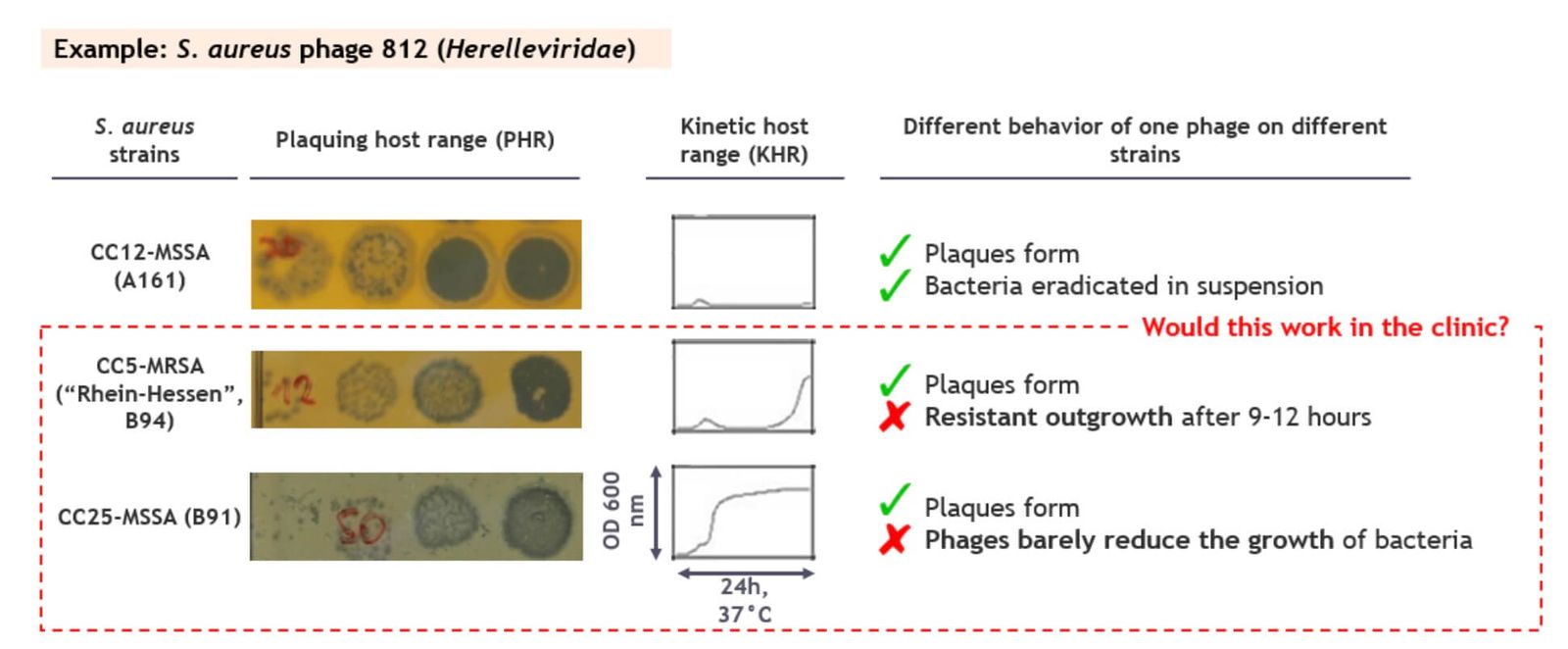
A common problem is illustrated in the figure below: while phage 812 plaques similarly well on the 3 example strains, it suppresses growth in suspension only for the first strain. For the second strain, resistant outgrowth is detected after 9-12 hours, and the growth of the third one is only barely suppressed at all. Would that be a problem in the clinic? Shouldn’t the phages reduce the bacterial populations by many logs and keep them low to be effective therapeutics?
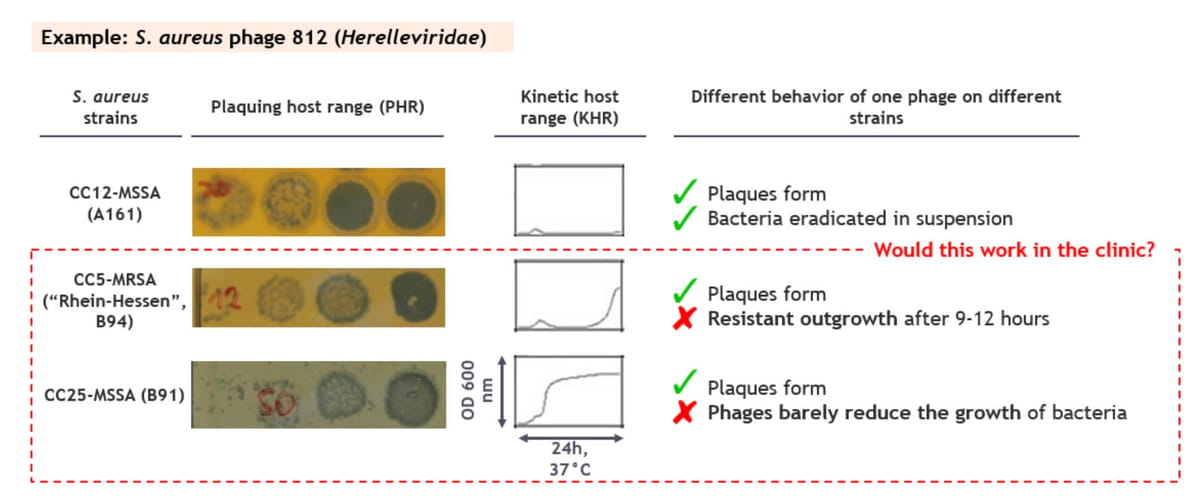 Figure 1. A high efficiency of plaquing does not always translate to high virulence, especially not for wild type phages. Image credit: PhagoMed Biopharma GmbH.
Therefore, we set out to improve the virulence, or lytic aggressiveness, of the phages, to close the gap between the plaquing host range and what we call the “kinetic host range”, KHR.
Phage breeding by homologous recombination upon superinfection (‘phage sex’)
Of the many published methods to improve phages over the wild types, we chose to let natural evolution go wild. We started with a method similar to the one called Appelman’s protocol described in the Burrowes 2019 paper. We changed many aspects — for example because the original Appelman's paper from 1921 is optimized for titering, not for breeding. Also, we compiled a panel of S. aureus host strains with a highly controlled diversity, to direct the host range of the bred phages to as many human-relevant clonal complexes as possible.
To the best of our knowledge, the first scientist to systematically cross-breed phages by this method was Alfred Hershey, one of the founding fathers of molecular biology, in 1949. Hershey cross-bred E. coli phages by inducing superinfections and selecting for combined host range and plaque-type phenotypes — not unsimilar to what Mendel did with his peas.
We optimized the technique of inducing phage superinfections and combined it with efficient selection filters. This virtually doubled the kinetic host range of some phages compared to the best ancestor, essentially closing the gap between plaquing and kinetic host range.
ɛ2-phages specific to S. epidermidis were already used to help a patient
We also bred S. epidermidis phages on a diverse panel of S. epidermidis strains, largely from implant infections. James Doub of the University of Maryland asked if we had S. epidermidis phages for a patient with an infected implant, who could not undergo the (normally required) full prosthesis exchange. We tested wild type and ɛ2-phages against the patient strain, and the ɛ2-phages were clearly superior. The patient was treated and is under remission for more than 6 months – the first time ɛ2-phages were used to help a patient!
What did we learn from promoting phage sex?
-
A phagogram by plaquing may not be the appropriate (sole) predictor of phage efficacy in vivo.
-
Phage recombination upon superinfection seems to be a very frequent event, as long as the parental phages have a minimum degree of homology.
-
Counterintuitively, the host range expansion in our phages was not driven by changes in the tail spike proteins, which are often cited as the main drivers of host range.
-
As the genetic recombinations are random, no a priori knowledge of phage genes is required – in this respect, the method has huge advantages over more targeted genetic engineering approaches.
-
The breeding also enables an approach to patenting not possible for natural phages.
Concluding thoughts
Phages did not evolve to eradicate bacteria, but to propagate themselves. Just imagine applying the power of systematic cross-breeding with selection for biofilm eradication, avoidance of bacterial resistance, propagation in physiological environments, pharmacokinetics and tissue distribution, etc. We believe this is just the beginning, and that systematic phage cross-breeding combined with selection for useful pharmaceutical properties will hugely improve the prospects of phage therapy.
What's next?
We are looking for collaborations to extend the application of ɛ2-phages. Reach out if you are interested!

David Sáez, MSc
David Saez is a PhD student in the Azeredo Lab, in the Centre for Biological Engineering in the Univ. of Minho working in the yeast display of endolysins.
Before starting his PhD, he worked in PhagoMed Biopharma as a researcher and gathered experience in different labs in Europe.
He is a passionate about phages and phage-based products and thrilled to see the phage community and knowledge grow, reason why he started PhageCast together with Alex and Maria.

Lorenzo Corsini, PhD
Lorenzo Corsini is the co-CEO and co-founder of PhagoMed, an Austrian biotech startup focused on endolysins and phages as targeted antimicrobials.