

Issue 130
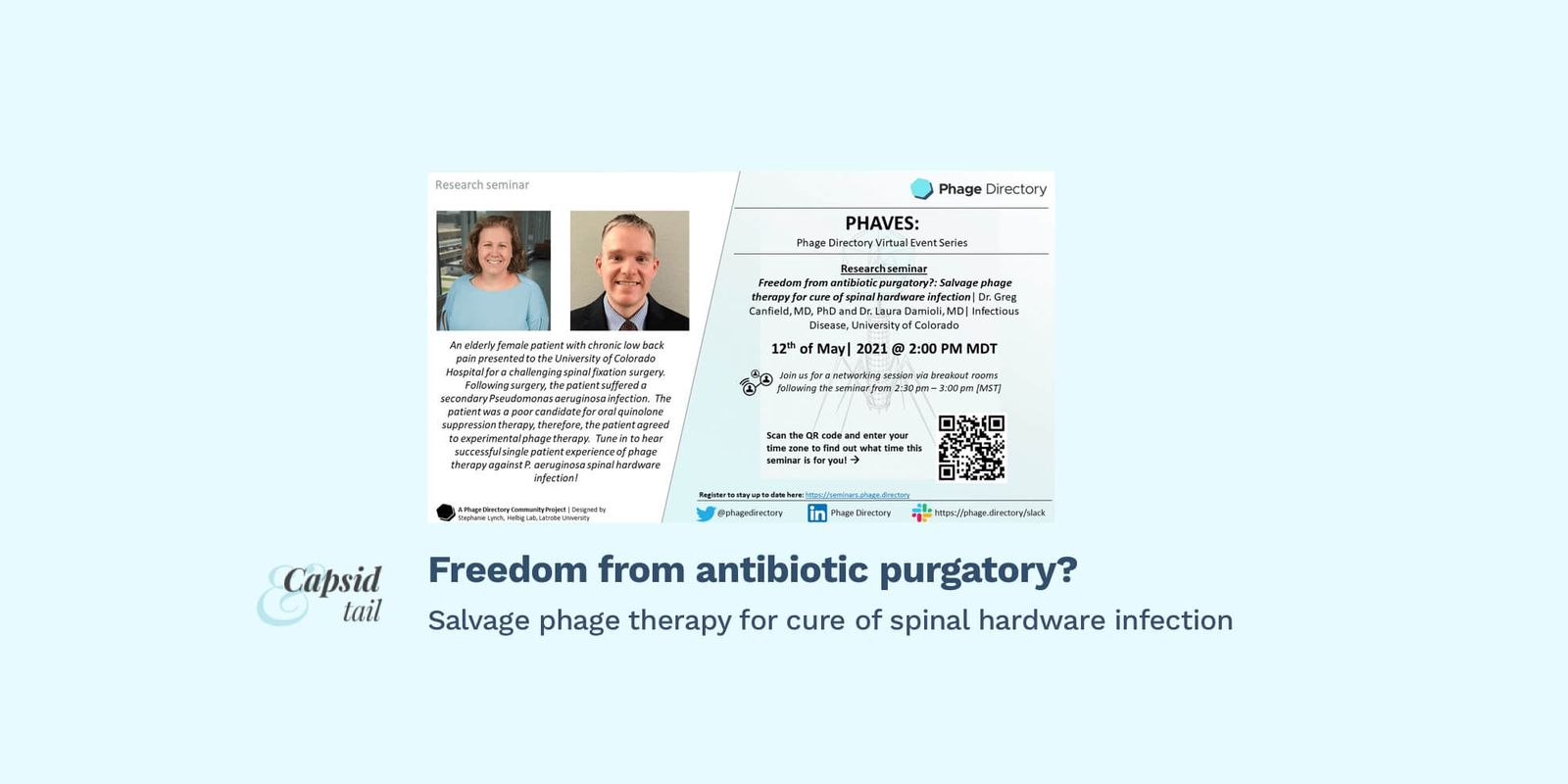
Freedom from antibiotic purgatory? Salvage phage therapy for cure of spinal hardware infection

In our PHAVES seminar series last month, Dr. Laura Damioli and Dr. Greg Canfield (University of Colorado Anschutz) shared their experience treating their first patient with phage therapy for a spinal hardware infection. Here's the recording, along with a recap by Stephanie Lynch!
Community digest5updates2jobs4posts
Updates
Adaptive Phage Therapeutics will be collaborating with Oyster Point Pharma (Nasdaq: OYST) to develop therapies to target multiple opthalmic diseases using APT’s PhageBank™ technology.
Adaptive Phage Therapeutics dosed the first patient in their phase 1/2 study to evaluate their PhageBank™ technology as a treatment for UTIs.
Michael Tisza and Christopher Buck (National Cancer Institute, NIH) published a new paper in PNAS showing how a catalog of > 45,000 viruses associated with human bodies reveals hidden associations with chronic diseases. Specifically, they found that > 2,000 phages correlate with common chronic diseases!
Saartje Uyttebroek (UZ Leuven & KU Leuven) and colleagues published a new review in Antibiotics showing the potential role of phages in the treatment of recalcitrant chronic rhinosinusitis. They also discuss considerations for implementing phage therapy in otorhinolaryngology practice.
Tridib Mahata (Tel Aviv University) and colleagues published a new paper in PNAS showing a new phage mechanism for selective nicking of dUMP-containing DNA.
Jobs
A post-doc position is available in the Parent Lab (Michigan State University) to work on mechanisms of phage attachment to enteric pathogens. Genetics, biochemistry, and computational approaches as well as single-particle cryo-EM will be combined to study the molecular mechanisms of host recognition. Interested candidates should contact Dr. Kristin Parent (kparent@msu.edu) with a CV and cover letter.
The Roach lab at San Diego State University is recruiting a postdoc to work as part of a highly interactive multidisciplinary research team focused on deciphering how the mammalian immune system directly interacts with phages and the potential implications of such interactions for shaping the host immune system.
Community board

Evergreen is coming and we are all-in!
Sign up here to be part of the longest running phage meeting.
Phagebiotics Research Foundation and Phage Directory present the 24th biennial Evergreen International Phage Meeting August 2-5th 2021. This year you can participate in person or virtually. The meeting will include primary session talks, live and virtual poster sessions, daily flash talks and Q&A for all participants.
Please submit abstracts by July 2nd if you would like to be considered for oral presentations.
We would love to see your posters! Please submit by July 16th.
As always, we look forward to hearing about all the exciting phage work going on worldwide!
Dear current & future members of ISVM (International Society for Viruses of Microorganisms)
Please take 4 min to fill out this survey to keep your membership active or to join our society. Stay up-to-date with exciting events that await the Viruses of Microbes community! And don't forget, basic membership is free!
Some of you may recall that, last year, I put out a call to contribute to a special issue of Pharmaceuticals on “Bacteriophages as Therapeutic Delivery Vehicles.”
We have 10 articles published or near completion already but there’s room for more. We’ve had the submission deadline extended to July 30th.
If you are doing any work or want to review work using phages that have been modified in some way to improve or create new therapies, your work will fit here. We have articles on phage encapsulation to improve delivery, phage use in cancer therapeutics, and luminescent reporter phages among others already so the topic is pretty broad.
More information about the issue is here or you can contact me, Paul Hyman (phyman@ashland.edu) or Tina Schneider (clschnei@carrollu.edu) or Bryan Gibb (bgibb@nyit.edu). I’m looking forward to hearing from you.
This is Hala Ali, a postdoctoral researcher at Bacteriology Department, Animal Health Research Institute, Egypt. I am looking for sponsor lab to host me for 6 or 9 months as a postdoc scholar funded by Egypt. I am interested in developing novel phage-antibiotics strategy for combating MDR-S. aureus mastitis. Please email me at alihala312@gmail.com if you know of any opportunities or may be willing to host me.
PHAVES #16, a seminar by Dr. Laura Damioli and Dr. Greg Canfield (May 12, 2021)
Overview and highlights
The patient case
- 80 year old patient, complaints of wound dehiscence (wound separation) following spinal hardware surgery to correct kyphoscoliosis (abnormal curve of the spine).
- The patient also had medical co-morbidities, including recurrent UTIs, which placed a higher risk of infection following hardware surgery.
- Cultures from the open wound found to grow 3 colony variants Pseudomonas aeruginosa, all with similar antibiotic sensitivity patterns.
- A lack of wound healing after wound vacuuming, antibiotic treatment, and subsequent wound wash-out and muscle flap surgery. The drainage from the wash-out cultured Pseudomonas aeruginosa.
Challenges
- Hardware infections are hard to treat due to Pseudomonas aeruginosa biofilms
- Antibiotics aren't good at sterilising the hardware, and the patient was not a good candidate for hardware extraction.
- Quinolones are the only oral antibiotic with activity against Pseudomonas aeruginosa, however, the patient was a poor candidate for quinolones. Additionally, previous data shows that 36% of patients had intolerability to quinolones following prosthetic joint infections, with 43.3% of these experiencing adverse reactions
Options for the patient
- IV antibiotics for 6-12 months, followed by hardware extraction if infection resolved.
- Antibiotics + phage therapy
- Hospice care
The patient chose option 2.
Option 2: Phage Therapy
- The three Pseudomonas aeruginosa strains isolated from the patient were sent to Paul Turner's Lab (Ben Chan & Jon Koff) at Yale University.
- Multiple lytic phages were found to lyse the clinical isolates of Pseudomonas aeruginosa, however, the 3 strains showed varying degrees of phage sensitivity.
- 5 phages were chosen based on qualitative (spot test) and quantitative (killing kinetics, EOP etc.,) characterisation.
The treatment plan
- Over an 8-week period, 4 different phage regimens were administered, either singly or in a phage cocktail combination (1 x 10^9 - 5 x 10^10). Between 5-100 mL of the phage formulation was administered, either into the patient's catheter or spinal drain.
- 2 hours after phage therapy, antibiotics were administered (as previous literature has shown that the order of phages/antibiotics matters).
- New phages were chosen every 2 weeks (as it has been shown previously there is a fitness trade-off between phage resistance and antibiotic resistance).
Patient monitoring
- Inflammatory tests (Biomarker of resolving infection)
- Organ monitoring
- CT scans of the spine
Results
- Successful resolution of Pseudomonas aeruginosa infections. No sign of hardware of infection 60 days after treatment.
- Recurrent UTIs on-going and C. difficile diarrhea.
June 2021 update: The patient is off all antibiotics, with no signs of recurrence of the hardware infection.
Audience question highlight
Q: The propagation strain of Pseudomonas aeruginosa harboured 7 prophages. Did you check to see if these excised and were present? Do you see this as a problem?
A: Yes this a potential problem, but was NOT observed in this study. Given the potential of induced prophages to horizontally transfer antibiotic resistance and toxin-associated associated genes to susceptible bacterial hosts, it might be important to use prophage-less bacterial strains for lytic phage amplification.
Want to take part in future PHAVES?
Register for upcoming PHAVES seminars — not only do we host speakers, interviews and AMAs, but we host breakout rooms after the talks to encourage casual socializing/networking among the phage community!
Missed a seminar? Find it on YouTube!
Subscribe to Phage Directory's YouTube channel to keep up to date with future PHAVES recordings!
Thanks to Atif Khan for help finding and summarizing this week's job posts!
Stephanie Lynch, PhD
Stephanie is a postdoctoral researcher for the Iredell Group at Westmead Institute for Medical Research, NSW. Her project focuses on phage therapy for compassionate human cases (as part of Phage Australia), with a particular interest in Staphylococcal phages. In 2021, Stephanie completed her thesis titled ‘Exploring phage therapy for Staphylococcus pseudintermedius infections in canines'. Steph is always willing to chat about phage research and would like to connect with phage biotech companies.