

Issue 158
2022: Building the Operating System for Phage Therapy


Good morning, 2022! We’re extremely proud of our work empowering the community, running events like Evergreen and building Instill. This year, we'll be focused on building the “operating system” for phage therapy. From lab workflows to web portals and complex databases, we’ll build infrastructure to scale phage therapy from tens to thousands of treatments.

Sponsor
Sponsor
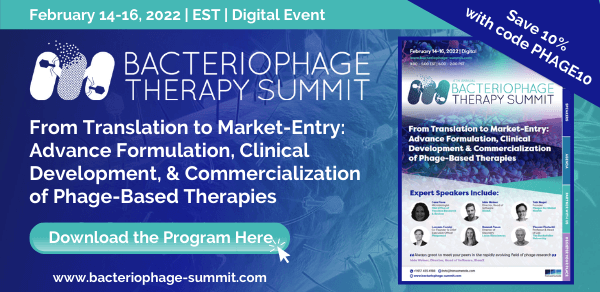
The 4th Bacteriophage Therapy Summit, February 14-16, 2022 (online) is the definitive gathering for global phage experts. Focusing on human health and disease, the 4th Bacteriophage Therapy Summit is returning to help you advance your phage-based therapies through clinical development and commercialization beyond compassionate use.
Next earlybird deadline is January 14!
For 10% off, use code PHAGE10.
Community digest1alert5updates6jobs
Phage alert
Urgent need for Pseudomonas aeruginosa and MSSA phages for a patient in the USA
We are urgently seeking Pseudomonas aeruginosa and Staphylococcus aureus (MSSA) phages for a patient in the USA.
Ways to help at this stage:
- By sending your phages for testing on the patient's strain
- By receiving the strain and testing your phages
- By receiving the strain and using it to search for new phages against the organism
- By offering to prepare phages supplied by others to clinical grade
- By helping spread the word about this request
- By providing us with names/email addresses of labs you think we should contact
Please email staff@phage.directory if you can help in any way, or if you would like further details/clarification.
Let’s make a difference, Phage Directory
Updates
The CF Foundation has awarded $5 Million to BiomX to conduct a Phase 1b/2a clinical trial to test the safety and tolerability of phage therapy for Pseudomonas aeruginosa infections in people with cystic fibrosis.
New profile of Citizen Phage, a new UK-based citizen science project run by Ben Temperton. “In the first few months of operation, the Citizen Phage Library has isolated 78 new phages from around 100 samples”. (Phage Directory is excited to be a partner on this project!)
Microbiome Times analysed its Microbiome Drug Database™, a repository of biotechs developing microbiome drugs, for phage-related drugs. They found that almost 70% of the total of 100 company-sponsored, phage-based drug development programs in their database focus on the treatment of infections.
Paper: Digital phagograms: predicting phage infectivity through a multilayer machine learning approach. See Dimi Boeckaerts’ Twitter thread for key points.
Paper: Isolation and characterization of novel lytic phages to combat multidrug-resistant E. coli and Salmonella spp. — Contributed by Ivy Mutai (Phage Team Kenya and Uganda)
Jobs
Undergrad project: Interested in working on bacteriophages, come to join us this summer! Looking for 2 bright and enthusiastic undergraduate students. Send your CV & transcript to dongyan.niu@ucalgary.ca
Master’s project: efficacy of phages at controlling Erwinia amylovora bacteria in vitro and in planta.
PhD Project: Improving bacteriophage efficacy in gut systems through transcriptomic and metagenomic analysis of the effect of novel synthetic biology-generated phage therapies
Postdoc: innovative new strategies to combat rising antimicrobial resistance.
Postdoc: Want to power Ohio State microbiome and/or virome research? Sullivan Lab is looking for genome-resolved metagenome researchers for upcoming postdoc and data analyst positions.
Creative Biolabs is one of the world's leading contract research organizations (CROs) with extensive experience in phage solutions. For people who are looking for a position in phage research, here is a list of openings.
Good morning, 2022!
It's hard to believe it’s been a year since our last outlook issue. At the beginning of last year, we set out to empower the community — and both Jessica and I are extremely proud of what we’ve accomplished last year — like launching Instill, running Evergreen , and publishing State of Phage results in the PHAGE journal.
2022 will have no shortage of exciting projects. This year will be slightly different — and we're very excited for what's to come!
G'day, phage!
As some of you might have heard, Jessica and I are partnering with Dr. Jon Iredell's team and the Australian / New South Wales government to establish a system for running personalized phage therapy clinical trials.
In Sydney, we look forward to building together a body of knowledge and a system to underpin personalized phage therapy. We’ll be collaborating with regulatory bodies, agencies like CSIRO, institutions like University of Sydney and the Westmead Institute of Medical Research (where we’ll be based), and healthcare providers and prescribers.
We will also be talking to a wider variety of stakeholders in the research healthcare space, like regulators, physicians, pharmacists, biobank operators, health economists, data scientists/bioinformaticians, and software engineers. Together, we’ll identify and understand all the pieces necessary to enable phage therapy at scale. We’ll incrementally build a framework and digital tools to better assist in data gathering, decision-making, regulating phage therapy, and operating future clinical trials. This is what we’re dubbing the “operating system” for phage therapy.
What is a phage therapy “operating system”?
Phage therapy is vastly complex. There are many pieces to keep track of: from regulatory concerns to patient monitoring, patient health data, experiment data, and sourcing and manufacturing. We just want to know: “what’s the best way to do something?” and “is it working?” Our operating system is a collection of SOPs, methods, and digital tools like apps, databases, APIs, and data dashboards to aid us in the data collection and decision-making. Regardless of whether phage cocktails or serial phage therapy is used, we need an objective framework for recording and analyzing why we made that decision, and did that decision lead to success or failure?
To build out our operating system, Phage Atlas, we will be collaborating with and learning from groups like the Queen Astrid Military Hospital, Israeli Phage Bank and TAILOR to establish best practices, SOPs, interoperable data standards, and such. We’ll need to design tools, workflows, and templates that make phages simple to work with, and experiments affordable and replicable. In the long term, Phage Atlas will incorporate concepts from bioinformatics, data design, biobank and lab inventory management software design.
The ultimate goal is having a system that can help us make better decisions in the phage therapy process, while communicating the effectiveness and efficiency of each decision that went into the phage treatment.
What about community projects?
Naturally, we’ll be preoccupied with building out the phage therapy infrastructure (and fending off spiders and drop bears. What does this mean for our phage community work?
Fewer PHAVES, more community-run events: When we first started PHAVES, there were very few phage “zoominars.” But today, organizations like Ibadan Phage Research Team and Africa Phage Forum are carrying the torch and sprinting forward! In 2022, we’ll be running fewer of our own events, but look forward to promoting various phages community events and voices from around the world. If you’d like us to promote your event and build a page for you, like iVoM Season 2 or the Viruses of Microbes Abstract Submission Portal, we’ll be more than happy to help. Just email jan@phage.directory.
More Capsid & Tail articles by the community: Our weekly Capsid & Tail of links, jobs, and community posts will continue. We’ll write fewer of our own stories, but we’ll encourage more voices — from students to professors, to discuss their research. This is an excellent way to get your papers noticed and cited! (Plus, you might find new collaborators!).
More Instill: Instill.xyz started out as a wild idea to address the increasingly dire peer review problem in our field. To our delight, we’ve been overwhelmed in the last few months with submissions and insights! We will be working hard to make it even more useful, and better integrate it with Phage Directory and our partners like PHAGE Journal.
We need your help more than ever!
We’d love to see more blogs, webinars, and podcasts from all corners of the world — we already have 1,200+ phage researchers from 80+ countries reading Capsid & Tail! We would love to promote various voices, and achievements of the phage world. Here are a few things you could do to help us:
Write something for Capsid: We’d love it if more researchers published editorials, voices, and opinions on science and the phage world. How could phages integrate with adjacent fields like microbiome, fecal matter transplant, antibiotic drug discovery, and longevity? Did you discover some cool, time-saving hack? Show it on Capsid, and maybe you’ll help someone else out! If you already have a blog, we’ll be happy to cross-post it! Learn how to contribute a guest post here.
Run an event! I’d love if someone could run more hyper-specific conferences in topics like plant phages, animal health, bioinformatics, regulatory implications in various countries, and many more topics. There are still so many questions to be worked out and answered in the phage world.
Promote your event, meetup, blog, newsletter or podcast: If you run a webinar or meetup or other community activity, send us your promotion, and we’ll help you get noticed. Also, if you send us the recording and/or meeting notes afterwards, we’re more than happy to promote your work to the wider community, and add to the corpus of phage knowledge.
2022: the year of the phage
I have a strong feeling 2022 will be THE YEAR of phage. New phage sub-communities are popping up everywhere. ISVM is ramping up its efforts. Everyone’s itching to get back into the lab and back to conferences to share their science again. I think this year we’ll see massive leaps in the field: we’ll see an explosion of niche in-person and zoominar meetups; more cohorts will want to bring phage therapy to their countries; maybe we’ll even see a few successful clinical trials this year?
Here’s to dreaming big — here’s to a brilliant year of the phage!
With 🥂,
— Jan & Jessica, Phage Directory

Jan Zheng, MHCI
I'm Jan, the other half of Phage Directory, and co-write Capsid & Tail.
Previously, I did data work at Phage Australia / Westmead Institute, where I built the biobank databases, data systems, and bioinformatics workflows for the clinical trial
I have a background in computer science and human-computer interaction, and I'm currently full-time at building the agentic layer for science at Nvidia.

Jessica Sacher, PhD
I'm a co-founder of Phage Directory and have a PhD in Microbiology from the University of Alberta (I studied Campylobacter phage biology). For Phage Directory, I help physicians find phages for their patients, and I'm always trying to find new ways to help the phage field grow (especially through connecting people and highlighting awesome stuff I see happening in the field).
I spent 2022-2024 as a postdoc in Jon Iredell's group at Westmead Institute for Medical Research in Sydney, Australia, helping get Phage Australia off the ground. I helped set up workflows for phage sourcing, biobanking, diagnostics, production, purification and QC of therapeutic phage batches, and helped build data collection systems to track everything we did. We treated more than a dozen patients in our first year, and I'm so proud of that!
As of 2024, I joined the Bollyky lab at Stanford University as a Staff Scientist, where I'm focused on phage engineering and delivery (to both microbial and human cells) and hydrogel-embedded phage cocktail development for wounds!