

Issue 79
Phage lysins as simple as Lego

This week, Prof. Yves Briers of Ghent University in Belgium takes us behind the scenes of his group's new paper on an efficient new way of engineering thousands of phage lysins at once.
Community digest8updates1job6posts
Updates
Adaptive Phage Therapeutics and the Mayo Clinic have announced a collaboration to commercialize a phage susceptibility test. The test will enable rapid identification of patient-specific phages for therapy (based on screening hundreds of candidates selected from APT's PhageBank), and will be offered for worldwide commercial availability by Mayo Clinic Laboratories.
Charlotte Brives (CNRS, France) and Jessica Pourraz (Université de Bordeaux) published an anthropologist's take on the field of phage therapy. This paper digs into how the way we think about and develop antibiotics continues to inhibit phage therapy's development. Resulting from three years of interviews with phage therapy stakeholders, it is worth a read.
Ronen Hazan (Hebrew University of Jerusalem) and colleagues at the Hadassah Medical Center have been awarded an Israel Precision Medicine Partnership grant to pursue their phage therapy program. So far they've banked 300 phages and have treated four patients. Congrats!
The Skurnik group at the Unviersity of Helsinki recently published three phage papers in Viruses! The papers span Yersinia phages, Acinetobacter phages, and Klebsiella phages, and between them they cover lytic, temperate and even "non-sequenceable" phages, as well as toxic phage proteins and transcriptomics.
Dragica Damnjanovic (UNSW Sydney) and colleagues published a paper in BMC Microbiology on phage genotyping using repetitive-PCR, a rapid and inexpensive method to preliminarily screen phage isolates prior to selecting them for future studies.
Kristopher Kieft and colleagues (University of Wisconsin-Madison) published a new paper in Microbiome about VIBRANT, a new hybrid machine learning and protein similarity approach for automated recovery, annotation and curation of microbial viruses, and evaluation of viral community function from genomic sequences.
Rafael Gonzalez-Serrano (Universidad Miguel Hernández) and colleagues published a new paper in MSystems describing an Alteromonas-targeting phage representing a new marine myovirus genus. They also determined that this phage requires a tail fiber chaperone for host recognition.
Taylor Miller-Ensminger (Loyola University, Chicago) and colleagues published a new paper in PLOS ONE introducing Lu-1, a novel Lactobacillus jensenii phage abundant in the urogenital tract.
Jobs
The Weitz group at Georgia Tech is hiring a Scientific Project Coordinator and Data Communication Specialist to help their group advance, communicate, and share discoveries of how viruses transform human health and the fate of our planet. Apply by 6/22.
Community board
New! Phage Directory Sustaining Sponsor Program
We're excited to announce that we've launched an ongoing sponsorship program for Phage Directory's community building activities, and we have our first Bronze Sponsor: JAFRAL!
JAFRAL is the world's only CMO/CRO dedicated primarily to phage manufacturing, and we are thrilled to have their ongoing support.
This support helps us continue to build up the phage community and especially to plan for the long term, and we are very grateful! Email sponsor@phage.directory to learn more about how you can support us.
PHAVES Kick-off Party!
Phage Directory's Virtual Event Series, PHAVES, starts this Tuesday, June 16 at 9:00 AM MDT (GMT-6)! For the kickoff event, Jessica and Jan will introduce the virtual series and Phage Directory's projects for 2020, and we'll then grab coffee and/or beer, catch up with everyone, and meet some new faces! No registration required: Zoom link will be posted here closer to the date: https://seminars.phage.directory/
Seeking scholarship support
My name is Atiwich and I am graduated from Horticultural Science at University of Bologna. I am a prospect Ph.D. student at Plant Pathology, INRAe PACA, Avignon, France, in the research project entitled “Building biocontrol of plant disease caused by Pseudomonas syringae from the knowledge of biodiversity of phages naturally present in agriculture”. I am nominated as a waiting list for Franco-Thai scholarship but the grant can be at 1060 euro per month while there is some amount to be fulfilled. I am writing this letter to ask for a partial scholarship. Thank you. If you can help, please email me at atiwith.pattha@gmail.com.
Lecture by Prof. Graham Hatfull: Mycobacteriophages: Diversity, dynamics and therapy
We are very pleased to have Prof. Graham Hatfull share his inspiring body of work on mycobacteriophages through live in discussion with us. Graham Hatfull’s research focuses on the molecular genetics of the mycobacteria and their bacteriophages. His work with students has served as an impressive model for the HHMI Science Education Alliance Phage Hunters Advancing Genomics and Evolutionary Science (SEA-PHAGES) program in the United States that introduces undergraduate students to authentic scientific research in a two-term course and has facilitated collection of over 15,000 phage isolates. This collection of phages led to the creation of a phage cocktail that was recently used to fight an antibiotic resistant infection in a 15-year old lung transplant patient.
Prof. Hatfull will be joining us from Pittsburgh, USA on Wednesday, 17 June at 6.30 pm Indian Standard Time (IST)/ 9 am Eastern Daylight Time (EDT). Register here.
Phages 2020 Virtual
09-10 September 2020 http://lpmhealthcare.com/phages-2020-virtual/ Twitter: @PhageOxford; Hashtag: #PhgOx20V Email: PhageOxford@gmail.com
The themes and focus of the meeting will be all aspects of bacteriophage research, in particular bacteriophage application in medicine, food and biotechnology.
The meeting will run over two days, with a 3-4 hour session each day, consisting of invited presentations by senior scientists, and submitted short presentations by emerging researchers and students. There will also be an opportunity to present posters digitally. We particularly invite emerging phage researchers – final-year doctoral students and early-/mid-career postdoctoral researchers/junior group leaders – to submit abstracts for short oral and poster presentations to benefit from this unique opportunity.
Episode 5 of "All About Phage Therapy"
In the fifth episode of All About Phage Therapy, we talked with Dr Aradhana Vipra, head of microbiology and Dr Jagadeesh Bhat, senior scientific manager at India's first phage research company, GangaGen Biotechnologies. If you have any questions regarding phage therapy, please write to us at contactus@vitalisphagetherapy.com
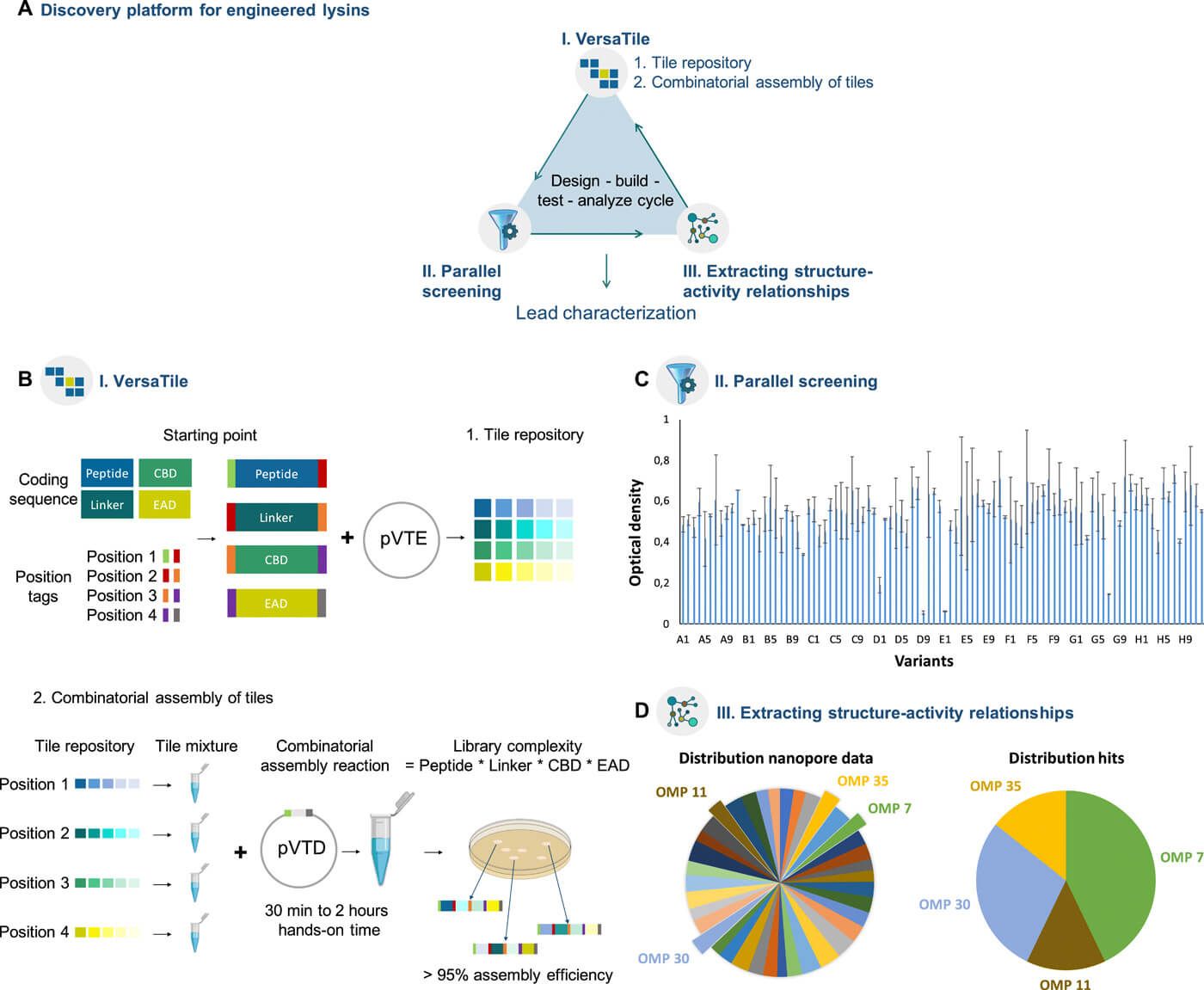
This article takes us behind the scenes of this paper: H. Gerstmans, D. Grimon, D. Gutiérrez, C. Lood, A. Rodríguez, V. van Noort, J. Lammertyn, R. Lavigne, and Y. Briers. A VersaTile-driven platform for rapid hit-to-lead development of engineered lysins. Science Advances 6, (2020).
Phage lysins have made exciting progress. In less than two decades they emerged from the initial preclinical proof-of-concept studies to the most advanced novel class of antibacterials in terms of safety, efficacy and feasibility. And they do not come too early, with a looming post-antibiotic era not far ahead of us. Some claim we are already there. The rapid action of lysins and the low probability to trigger resistance development are unusual but attractive properties to refuel the pipeline of antibacterials.
The most fascinating property of phage lysins is their modular structure and the potential to follow a click & play approach with lysin modules to modulate the lysin’s antibacterial properties and specificity. Phage lysins can in principal be selected and engineered against any pathogen. While the most advanced lysins under clinical evaluation are currently native lysins, evolution taught us that when using a protein outside its natural setting, there is plenty of room to re-evolve and optimize its properties to the prevailing conditions in the envisioned application, such as a bacterial infection. Therefore, I consider this click & play approach for lysins as the equivalent of the decade-long successful chemical engineering of natural antibiotics, which delivered us up to five generations of semi-synthetic cephalosporins and four generations of semi-synthetic fluoroquinolones. Lysins thus represent a truly broad class of antibacterials, and in my humble opinion, it is obvious that these days are only the infancy of lysins.
When we entered the field more than 15 years ago, we were courageous enough to move to the then-considered no-go zone of Gram-negative bacteria. Though, there were evident reasons to do so. The number of available antibiotics to treat infections of Gram-negatives was alarmingly low, and lower than the number for most Gram-positive pathogens. And apart from extensive biochemical characterisations of the lysins of the T-series E. coli phages, knowledge about lysins from Gram-negative infecting phages was generally limited. Not that we felt confident about our case. The long-hairy outer membrane popped up as a formidable brick wall. Most antibiotics are not able to cross this barrier, only those smaller than 600 Da do. But even the smallest lysins are roughly twenty-five times larger than this threshold. After some prospecting studies with chemical permeabilizers, the solution turned out to be relatively simple and surprisingly successful. We expanded the modularity principle that was proven so many times for lysins targeting Gram-positives. Specifically, we fused selected outer membrane permeabilizing peptides to the lysin and demonstrated that such a peptide can act as a drill bit, pulling the lysin through the outer membrane. The very thin peptidoglycan layer of Gram-negatives is then all but an obstacle. These engineered lysins are today known as Artilysins® and commercialized by Lysando.
As often happens in science, these joyful initial successes brought us quickly to the next hurdle. Not any outer membrane permeabilizing peptide fused to any lysin is successful. Often moderate antibacterial activities can be achieved, but the true killers are almost as rare as a needle in the haystack. In a follow-up study, we constructed 54 modular variants using diverse peptides, linkers and lysin domains. Pairwise comparisons taught us that each module matters and affects the eventual antibacterial activity. The outcome was exciting, but it took four years to construct and evaluate all these variants. Generating modular variants composed of three to eight building blocks was not straightforward at all. Yet, a practically infinite number of combinations can be considered as there are literally thousands of peptides that can be fused to thousands of lysins using thousands of different linkers. The lysins themselves can be also composed of a large diversity of cell wall binding and enzymatically active domains. It was frustrating to smell the potential, but not being fully able to grab it.
Frustration is often a good source for creativity. Turning back to basic gene technology, we designed and implemented a new method to eliminate this technical bottleneck, a method we coined VersaTile. VersaTile can be simply compared to Lego. You first make your collection of building blocks (‘tiles’), and then the endless joy of making new modular constructs can start. With VersaTile millions of modular lysins can now be constructed in a single step and a single day, ready for analysis. In our recently published proof-of-concept study, VersaTile was used to construct a library of 10,000 variants and a lead lysin killing Acinetobacter baumannii in human serum was identified by iterative screening.
We feel that the potential of VersaTile’s click & play approach is exciting, as the method is generic and can be applied to any modular lysin, and also any other modular protein. But as we learned before, tackling one hurdle means facing the next hurdle. We are now actively investigating novel approaches to deal with this high number of engineered lysins. Because we aspire that one day, lysins can be conveniently engineered against any pathogen under each condition, truly exploiting the most fascinating feature of lysins, their modularity.
Learn more
-
Read the Briers Lab's new paper describing this work: H. Gerstmans, D. Grimon, D. Gutiérrez, C. Lood, A. Rodríguez, V. van Noort, J. Lammertyn, R. Lavigne, and Y. Briers. A VersaTile-driven platform for rapid hit-to-lead development of engineered lysins. Science Advances 6, (2020). DOI: 10.1126/sciadv.aaz1136.
-
Check out this animation created by the Briers team to showcase this work!
-
Read a press release and interview published by Ghent University on this work.
Rohit Kongari helped us produce this week’s article by helping us source and write the What’s New section. Thanks Rohit!!
Interested in becoming a Phage Directory volunteer? Email volunteering@phage.directory.

Yves Briers, PhD
Yves Briers is a professor at Ghent University and the co-founder and CEO of Obulytix (founded 2023), which develops phage lysins as enzyme-based antibiotics. He has worked on phage lysins since 2004, at KU Leuven, ETH Zurich, and Ghent University, with a focus on engineering lysins against Gram-negative pathogens.