

Issue 314
How to navigate regulatory limbo: a Canadian phage therapy CEO's playbook

"There's 145 components of the regulatory requirements that I don't fit in. So how do I get past that? And governments right now say, I don't know."
Community digest5updates1job5posts
Updates
A much awaited regulatory guidance document! The UK Medicines and Healthcare products Regulatory Agency (MHRA) has announced new guidance for developing phage therapies in the UK.
The European Research Executive Agency has announced €7.3 billion in EU funding for research through Horizon Europe 2025 to support research careers and competitiveness.
Atif Khan and Hiren Joshi (Bhabha Atomic Research Centre, India) published a new research paper on selectively enriching and characterizing stress-tolerant phages for food biocontrol.
Bradley Cook (Cytophage Technologies) and Alexander Hynes (McMaster University) published a new paper on re-evaluating phage therapy criteria. They examine three commonly applied criteria for excluding phages from therapy: the lack of virulence/antibiotic resistance, the inability to transduce, and being strictly lytic. For each, they assess the risk posed, tools for determining the criteria, and the potential impact.
Eleanor Rand (Harvard Medical School) and colleagues published a new paper on a targeted phage discovery method called Phage DisCo, a co-culture-based phage screening technique. Using isogenic, fluorescently tagged bacterial strains, they can rapidly identify phages with specific infection traits, streamlining targeted phage isolation from complex samples.
Jobs
The Fraunhofer Institute for Translational Medicine and Pharmacology (ITMP) in Munich, Germany is hiring a PhD student / researcher in protein engineering to produce, test, and optimize phage-derived binding proteins against pathogenic bacteria.
Community board
You’re invited to submit an abstract to the inaugural Conference on Bacteriophages: Biology, Dynamics, and Therapeutics, chaired by Graham Hatfull (University of Pittsburgh) and Robert (Chip) Schooley (UCSD).
Topics range from phage structure and assembly, evolution, and engineering to clinical trials, susceptibly testing, and host/immune responses.
This is organized by The International Antiviral Society–USA (IAS–USA), and will be held October 12-14, 2025, in Washington, DC.
Registration is open as of April 16, 2025! Check out the preliminary program here.
Submit your late-breaking abstract by Aug 13!
Presenting authors who are new investigators may qualify for a scholarship to cover the cost of registration.
The World Health Organization published a new report on phage therapy evidence, showing phages can enhance antibiotic treatments against resistant bacteria as part of a One Health approach.
Alexander Harms was interviewed on the PhageCast podcast about the Basel Phage Collection, basic science insights from E. coli phages, and how these findings can predict phage traits.
Tolka AI Therapeutics has announced expanded access to patient-tailored phage therapy for M. abscessus infections. They're screening patients at five institutions for compassionate use where standard antibiotics have failed.
Hello,
I'm looking for phage cocktails for phage therapy to treat and study Sinusitis infections
"Streptococcus pneumoniae Haemophilus influenzae Moraxella catarrhalis Staphylococcus aureus Pseudomonas aeruginosa"
Please email on amylaurence1989@googlemail.com, Thanks
"Phages are not drugs. Every time they say, 'Did you go through regulatory?' I say, 'I can do regulatory, but I'm not a drug.' There's 145 components of the regulatory requirements that I don't fit in."
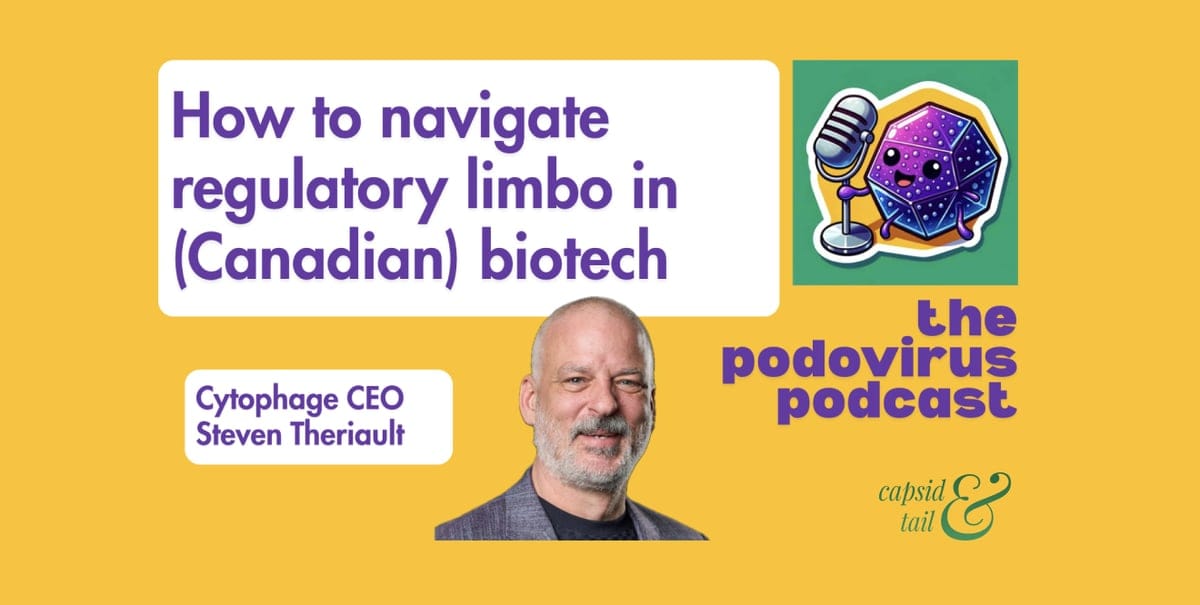
When your health innovation doesn't fit existing regulatory boxes, how do you build a business? Steven Theriault, CEO of Cytophage, has spent 9 years learning to navigate Canada's regulatory maze for phage therapy. From being told "we don't know" by government officials to raising $24M and treating patients, Steven shares his hard-won playbook for building in uncharted regulatory territory.
In this episode of the Podovirus Podcast, we talk to Steven Theriault about what he's tried, accomplished and learned in the last ~decade building a phage biotech company in Canada:
Highlights from our conversation:
- The "not a drug" dilemma: Traditional GMP guidelines don't account for the inherent variability of biologics – if Steven's phage grows to 10^12 instead of 10^10, that may be better for treatment, but regulatory frameworks would see it as "out of spec"
- Regulatory geography matters: Cytophage has more traction with U.S. and international regulators than in Canada, despite being a Canadian company, because other countries are adapting their frameworks for phages
- The emergence of new regulatory hurdles: Mid-treatment, a new government organization emerged requiring four months to review phage preparations – potentially fatal delays for dying patients
- Commercial viability through reduced cost per dose: By achieving 10^15 phage titers with treatment doses of only 10^3, Steven's team can achieve a treatment dose [for chickens] for something like 0.00006 cents — well below the pennies-per-dose that antibiotics go for
A few snippets from the episode...
On leaving government to pursue phage innovation:
"I realized that the government's not necessarily the best place for out of the box thinking. So for myself, I stepped out of the government, again, very secure job, worked there for about 15 years, had a great career, stepped out because I really saw a need as well as something that we could do with phages."
On the reality of treating patients in Canada:
"For human, we've always looked at human sides. The biggest thing for us though is we can only do about four patients a year. And the reason we only do four patients a year is because of cost restrictions. If this was a funded program, I could do a hundred patients a year."
On the disconnect between science and regulation:
"Listen, we all know toxicity is not an issue. When I put in my first application in the Canadian government, of which I have four currently, applications have been sitting there for 18 months, they asked us to come back and show toxicity. So I went ahead and I paid for a study, and this is like the most boring study you'd ever read in your life. Nothing happened."
On the funding momentum shift:
"I haven't been this excited about phage research and the success of phages since I started this company. It's just this new year that sort of really showed that people are starting to flip the switch and really understand."
What's next for regulatory reform:
Steven is working on developing guidance documents for phage research in Canada and expects significant policy changes with the new government. His vision includes coordinated phage treatment protocols across Canadian research centers and potentially a dedicated phage research facility to streamline patient access.
Listen to the full episode:
Learn more:
- Cytophage website: Learn about their agricultural and therapeutic phage applications
- Steven's TEDx talk on the future of phage therapy
- CBC story on Thea, Cytophage (and Canada’s) first PJI patient treated with phages
This episode is part of our ongoing series exploring the practical challenges of bringing phage therapy to market.

Jessica Sacher, PhD
I'm a co-founder of Phage Directory and have a PhD in Microbiology from the University of Alberta (I studied Campylobacter phage biology). For Phage Directory, I help physicians find phages for their patients, and I'm always trying to find new ways to help the phage field grow (especially through connecting people and highlighting awesome stuff I see happening in the field).
I spent 2022-2024 as a postdoc in Jon Iredell's group at Westmead Institute for Medical Research in Sydney, Australia, helping get Phage Australia off the ground. I helped set up workflows for phage sourcing, biobanking, diagnostics, production, purification and QC of therapeutic phage batches, and helped build data collection systems to track everything we did. We treated more than a dozen patients in our first year, and I'm so proud of that!
As of 2024, I joined the Bollyky lab at Stanford University as a Staff Scientist, where I'm focused on phage engineering and delivery (to both microbial and human cells) and hydrogel-embedded phage cocktail development for wounds!