

Issue 230
C&T Round Up for June 2023!

This month, we really put the CAPS lock in Capsid: from ORACLE to a CARB-X article on SNIPR, to AKTA and DBs, we really capitalized on many deep topics.
Sponsor
Sponsor
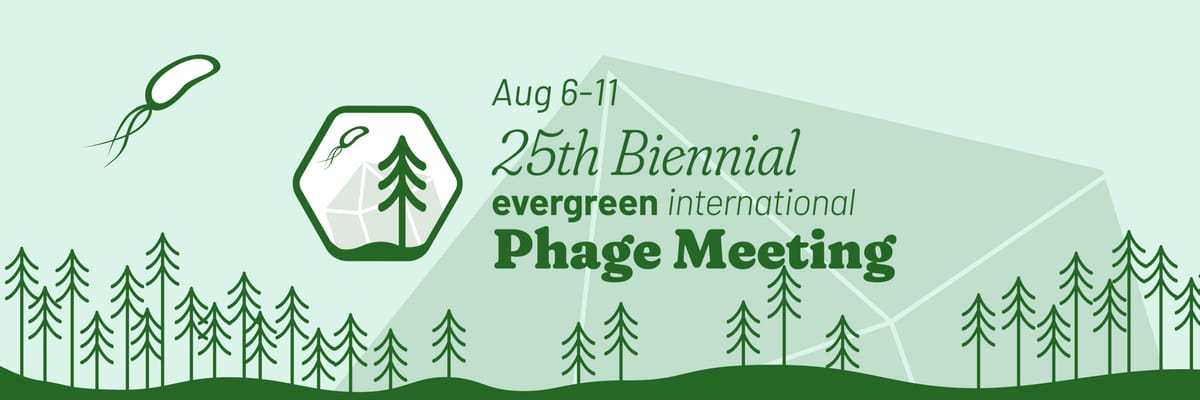
The Evergreen International Phage Meeting is happening Aug 6-11, 2023, live in Olympia, Washington, USA! This is an in-person meeting, better known as Phage Camp! Come present your phage work, climb mountains with other phage scientists, play phage-related board games, see a special showing of the Salt in My Soul documentary, and much more! This is the 50th anniversary meeting, hosted by Betty Kutter, Queen of Phage.
Community digest5updates7jobs5posts
Updates
Mariam Taha (Ottawa Hospital Research Institute) and colleagues have published a study on the efficacy of lytic phages combined with vancomycin against S. aureus biofilm-like aggregates in synovial fluid, offering a promising strategy against periprosthetic joint infections.
Anisha Thanki (University of Leicester, UK) and colleagues have shown that a phage cocktail delivered in chicken feed significantly reduced Salmonella colonization in experimentally-challenged broiler chickens.
Ming Hu (Qingdao University, China) and colleagues have isolated and characterized two novel, highly pH- and temperature-stable jumbo phages and found they have strong potential to eliminate Klebsiella pneumoniae in sewage water.
David Helekal (University of Warwick, UK) and colleagues have published a new model to estimate AMR fitness cost and benefit. They found that two unrelated Neisseria gonorrhoeae lineages resistant to fluoroquinolones shared similar epidemic dynamics and resistance parameters.
Naomi Haddock (Stanford University, USA) and colleagues have developed a pipeline to identify phages and their bacterial hosts in cell-free DNA from plasma samples, enabling identification of bacterial pathogens associated with sepsis.
Jobs
ADM (Cork, Ireland) is seeking a Cell Culture and Bacteriophage Research Scientist to work on various research projects revolving around the support of basic microbiological cell culture platform and the isolation, purification, characterization, design, and production scale-up of novel phages.
The Centre D'Immunologie et des Maladies Infectieuses (Paris, France) are hiring a postdoc to participate in pre-clinical development of a synergistic phage therapy/antibiotic treatment protocol against encapsulated bacteria.
Europe's EvoInHi (Evolution in the Gut in Health and Disease) project is hiring a postdoc to quantify the tempo and mode of evolution by mutation and horizontal gene transfer, emphasizing phage driven horizontal gene transfer and phage bacteria eco-evolutionary interactions.
TEAGASC (Ireland) is hiring a PhD researcher to develop and validate new library preparation methods to study phage communities in the rumen of dairy cows.
Jian Li (Monash University, Australia) has an honours project opening on comparative genomic analysis of phages against Gram-negative superbugs.
Gavin Knott (Monash University, Australia) has an honours project opening on the structure and function of nucleic acid sensors for microbial threat detection.
ARNA Laboratory (University of Bordeaux, France) is offering a bioinformatics internship studying Type I Toxin-Antitoxin systems, which are involved in phage defense.
Community board
ISVM General Assembly Meeting is taking place during the Viruses of Microbes conference in Tbilisi, Georgia from 17h30-18h30 on Tuesday, July 4th. This is a great opportunity to get to know the Executive Board, make suggestions and hear what ISVM has planned for the upcoming year!
The Sullivan lab is hosting the 2023 Viromics Workshop October 11-13, 2023, in-person at the Ohio State University in Columbus, OH. You can expect deep dives on virus identification, virus taxonomy/classification, databases, ecogenomics pipeline, auxiliary metabolic gene analysis, virus-host linkages, and genome annotation.
The journal 'PHAGE: Therapy, Applications, and Research' has achieved its first impact factor of 2.7. The journal offers immediate deposit to PubMed, a zero-embargo Green Open Access policy, and free 30-day access to share your research with networks and colleagues.
PhageLab's CTO, Pablo Cifuentes Palma, was interviewed by the BBC's Jane Chambers on "The Coolest Science in the World" segment of the Unexpected Elements podcast about PhageLab's work with phages (starts at the 29:55 minute mark).
Tom Ireland's new book The Good Virus explores the potential of phages as the future of medicine, including their ability to target tumours with cancer drugs and fight antibiotic-resistant infections.
Hi everyone, we’re sailing through 2023! These past few weeks has seen Jessica spending most of her time producing phages and learning and using AKTA Flux (and soon the AKTA Pure!). As for me, I’m writing about and building database tooling and prototypes for Phage Australia, which I’m excited to share with and open up to the rest of the world (once it’s ready…). We also had a couple of excellent guest posts this month.
If you’re excited to write about your phage research, project, or journey: here’s how to do it!
Working with data in biology
by Jan Zheng
In this blog post, I discussed the challenges of working with data in biology, and suggested using small SOPs to collect structured data and aggregating entries over time to better describe what was being measured. I also explored the benefits and drawbacks of using the Entity-attribute-value model for biobank items, and identified the need for a tool that could mix data from different sources for ease of analysis and reporting.
Getting our AKTA-gether: Using the AKTA Flux to purify phages for patients
by Jessica Sacher
In this article, Jessica Sacher shares her journey in learning about the AKTA Flux system for purifying phages for patients. She discusses the challenges of phage purification and the need for a system like the AKTA Flux for the production of pure phages. The AKTA Flux system is used for tangential flow filtration and helps to clean and concentrate phage lysate while ensuring reproducibility and predictability. The author provides a primer on the AKTA Flux system for those who are new to it and highlights the benefits of using it for phage work. They also discuss the importance of understanding the parameters and how to monitor them. The author concludes that the AKTA Flux system can be part of a GMP process and is a useful tool for phage research.
ORACLE: A great tool for generating many variants of phages
by Dylan Woolsey
In this article, Dylan Woolsey discusses the ORACLE method, which creates different RBP variants in bacteriophages to understand the sequence-function relationship. This method involves creating T7 acceptor phages with modified tail fiber locus. These phages replicate on E. coli, creating a library of variants that can be sequenced to study the important variants of RBP on the tail fiber. ORACLE helps to better understand the structure of phage variants and the efficacy of bacteriophages for phage therapy.
CRISPR phages target E. coli with sharpshooter precision
by Robin Berghaus
In this CARB-X Spotlight article, Robin Berghaus discusses SNIPR Biome's CRISPR-based phage therapy for preventing bloodstream infections in cancer patients. The article describes the development of SNIPR001, a cocktail of phages with a CRISPR-Cas system that specifically targets genes unique to E. coli in the gut before they can enter the bloodstream. The article also explains how the company engineered phage tail fibers to recognize both highly-conserved receptors and sugars that protect bacteria from the environment. The company hopes to develop a range of applications for its CRISPR-Cas platform, including products that target bacteria known to be correlated with colorectal cancer and live bacteria and phages that produce therapeutic compounds.
C&T Throwback!
In preparation for my data-centric topics for both Capsid & Tail, Phage Australia, and other talks, here’s a throwback to a C&T post about the Viral Host Range Database. You can find the full VHRdb here: https://viralhostrangedb.pasteur.cloud. Looks like their tool has been going strong!
Jan Zheng, MHCI
I'm Jan, the other half of Phage Directory, and co-write Capsid & Tail.
Previously, I did data work at Phage Australia / Westmead Institute, where I built the biobank databases, data systems, and bioinformatics workflows for the clinical trial
I have a background in computer science and human-computer interaction, and I'm currently full-time at building the agentic layer for science at Nvidia.