

Issue 288
C&T Round Up for October 2024!

Roundup time! This month we explored phage-based gene editing in the microbiome, high schooler Kate Kelly shared her jam-packed 30 days in Stanford’s Bollyky lab, and Ritah Nakayinga from Kyambogo University discussed her phage cocktail to fight Banana Bacterial Wilt. We also released our 7th edition of Phage Picks!

Sponsor
Sponsor

Why don't we have phage therapy yet? We want to understand why.
Come join the fun, with the new Podovirus podcast!
🎙️ Most recent episode: Jesus Fernandez-Rodriguez, PhD, VP of Technology at Eligo Bioscience, shares how their team is editing live microbes in the mouse gut with engineered phages!
🎧 Listen: Podovirus on Spotify
🎥 Watch: Podovirus on YouTube
Subscribe to get the next episodes!
🩺 Up next: Joe Campbell joined as a co-host for an interview with Dr. Gina Suh, Mayo Clinic ID physician, about what makes the best phage therapy patients, getting phage therapy up and running at her institution, and her current hopes and challenges.
🍅 On deck: Joe and I interviewed Alexander (Sandro) Sulakvelidze, CEO of Intralytix, about his 26-year (!) journey toward getting phage cocktails on the market in the food industry, the 3 clinical trials they've got running, and the efficacy data (hopefully) around the corner!
Community digest5updates3jobs2posts
Updates
Jyot Antani (Yale University) and colleagues developed a microscopy-based technique to measure phage attachment to bacterial cells. This method provides an attractive alternative to the (literally) century-old Phage Adsorption Assay because it...
- is fast
- consumes less media
- provides single-virus readouts
- does not rely on a theoretical model to estimate adsorption rate
Feel free to reach out with any questions: jyot.antani@yale.edu. Requests for advice or collaborations are welcome!
François Rousset (Weizmann Institute of Science) and colleagues discovered a new immune signaling molecule: N7-cADPR, which is produced by phage-stimulated TIR proteins. It activates a bacterial caspase, which then degrades essential proteins to curb infection.
Tong Zhang (Massachusetts Institute of Technology) and colleagues discovered a bacterial immunity protein that senses two unrelated phage proteins, showing that CapRelSJ46 in E. coli can directly bind two structurally different phage proteins using the same sensory domain. This versatility may help bacterial defenses keep pace with rapidly evolving phages.
Peter Erdmann Dougherty (University of Copenhagen) and colleagues isolated and sequenced 8 novel phages targeting wheat phyllosphere bacteria, characterizing their genomic, phylogenetic, and morphological traits. They identified DNA modifications, including 13 motif-associated single-stranded DNA breaks in Pseudomonas phage Rembedalsseter, and found related phages in various metagenomes.
PHIOGEN is seeking to explore patient experiences with recurrent UTIs and attitudes toward phage therapeutics: the study involves a brief screening questionnaire followed by a survey for qualified participants who experience ongoing UTI symptoms.
Jobs
A UK-based laboratory is hiring a Microbiology Laboratory Scientist to perform microbiological testing, maintain quality standards, and contribute to method development and validation for pharmaceutical products.
The Sorek lab at LMU Munich's Gene Center is hiring a Postdoctoral Researcher to study innate immune responses against phages using biochemistry, immunology, and computational approaches.
The University of Liverpool is hiring a PhD student to optimize phage therapy for cystic fibrosis lung infections by studying biofilms and phage-host dynamics.
Community board
Atif Khan (phage scientist at the Bhabha Atomic Research Center in Chennai, India and longtime Phage Directory volunteer) was interviewed on the "You Make Me Sick!" podcast about his work. They talk phages, biofilms, biofouling, multidrug-resistant organisms, and phage therapy applications.
The Phage Collection Project, led by early career researchers at the University of Southampton, is pioneering a citizen science initiative to tackle AMR.
The project combines public education, clinical biobanking, and policy advocacy to advance development and implementation of phage therapeutics in the UK healthcare system.
They’ve just launched a new blog — check it out!
Hi everyone,
It’s getting darker and colder outside! Being in California (like Sydney) means it’s easy to forget what it’s like in many parts of the world — cold and wintery! Though we’re now sometimes wearing sweaters, it’s still about 15-20°C ish most days. It’s also easy to forget what’s going on when you’re heads down in work!
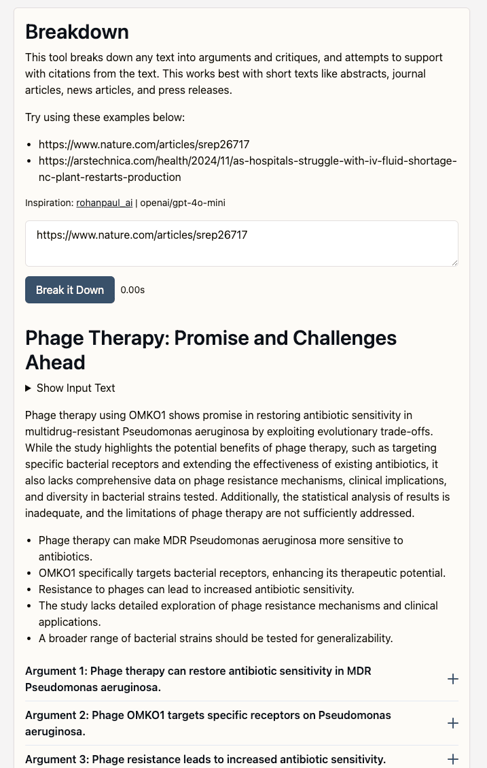
Jess is working hard in the lab, and I’ve been building prototypes of various data and research tools in prep for Phage Option 2024, the phage conference in Colombia coming up soon. We’re polishing these up and fixing bugs along the way, but here’s a sneak preview of one of our tools — Breakdown.
Breakdown uses OpenAI’s GPT-4o to break any news article or research paper down into its base arguments and critiques. It does its best to cite its sources from the articles itself. It does a decent job, and can make some papers (e.g. Machine Learning and bioinformatics) papers much easier to read and understand.
We’re still squashing bugs and adding features like multiple languages, but you can try it out here (https://breakdown.labspace.ai/).
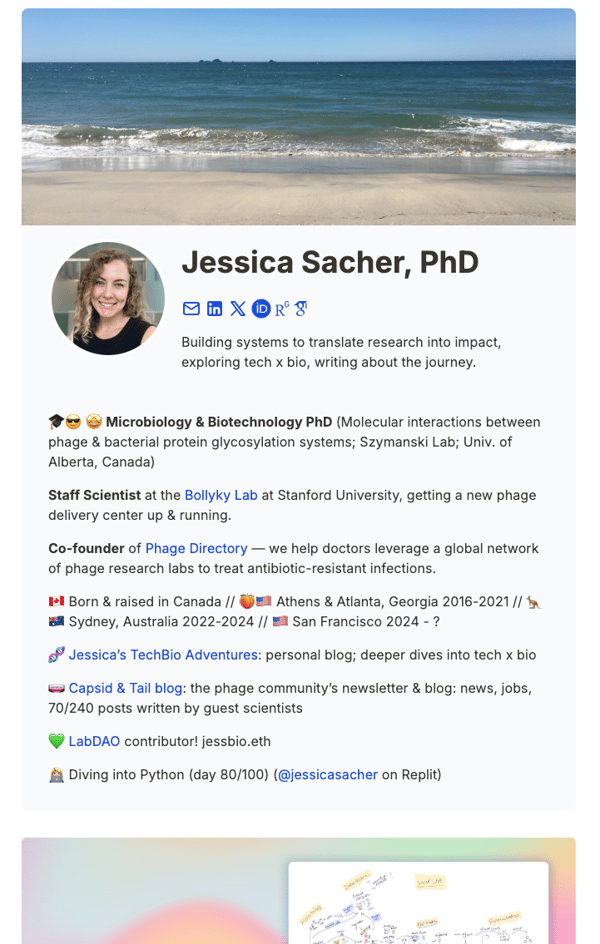
We’re also making progress on our profile page system, which is a cross between a personal blog, Linkedin page, CV/resume, and link in bio.
Eventually we want everyone to have their own professional websites, based on their CV and Linkedin, that they can share with others at conferences or when looking for their next position.
Check out Jessica’s personal CV page (https://jess.bio) and Atif Khan’s personal CV page (https://atif.phage.directory/). We’re currently making it easier for people to set up their own accounts, and (finally) be able to edit their own accounts!
Here’s what we published this past month:
How Eligo Bioscience edits gut bacteria with phages
by Jessica Sacher
In this interview between Jessica and Jesus Fernandez from Eligo Bio in France, they talk about how Eligo figured out how to use modified phages to perform base editing of E. coli and Klebsiella — within the mouse gut — without killing the bacteria! Very very cool, and something they deserved a Nature paper for.
Nature: https://www.nature.com/articles/s41586-024-07681-w
Spotify Podcast: https://open.spotify.com/episode/5ybZX5A8bAYGsrkyt9iZrK?si=eUvuoiNDSoaXTg56vKnMRg
Fluorescence, FRAP and flow: 30 days in a phage lab
by Kate Kelly
Last month, Kate Kelly, a high school senior, spent 30 days interning at the Bollyky Lab at Stanford (where Jessica currently works). At the lab, she learned various techniques like bacterial inoculation, plaque assays, flow cytometry, and fluorescence recovery after photobleaching (FRAP), and her main project involved dyeing phages to observe diffusion in biofilms. In this article, she reflects on her experience in the lab.
Our Phage Picks for October 2024!
by Jan Zheng
In this month’s Phage Picks, we highlighted a very well-written post-mortem on Achaogen’s (a former biotech that made antibiotics) demise, and how expensive and difficult putting a new drug on the market is. I also found a neat review paper on atypical (non-dsDNA phages), and a preprint describing a new method for designing phage-based biosensors with novel protein systems on PDMS surfaces. That last one was a doozy.
Protecting Uganda’s banana crops with phages
by Ritah Nakayinga
In this guest article by Dr. Nakayinga, she describes how Banana Xanthomonas Wilt (BXW), a disease caused by Xanthomonas vasicola pv. musacearum, is ravaging banana crops across Uganda. Current management practices are expensive and ineffective, and at this rate could lead to 100% crop loss. Dr. Nakayinga is leading a project at Kyambogo University to develop phage-based biocontrol methods against BXW, where they’ve already isolated phages showing 70-100% efficacy. They’re now working on formulating a phage cocktail and testing effectives in the field!
C&T Throwback!
ChatGPT tips for lab work
C&T Throwback!
I honestly can’t believe it’s been almost exactly a year we’ve been using ChatGPT for work. Where’s the time flown? Seriously. We have so many thoughts on how to use AI for research, and they might not be what you think. We barely use AI to write any text for us!
Mostly we use AI as a partner for thought — from understanding research papers, to searching for information, to formatting data, to writing and refactoring code. We also build it into tools that we use daily (like Breakdown, which I shared above!). If we use it for writing, mostly for those what’s that word again…? moments, or for spell checking. If you’ve noticed, we’ve chose to write more casually, and in our own voices. That’s one of the few ways left to tell that you didn’t just ask ChatGPT or Claude to write everything for… might even leave in a typo ro two. AI after all rarely makes typo mistakes!
We’ll try to get another AI for Work article to you before the end of the year. The year’s almost up, but there’s still so much left to do! Here’s looking forward to November!
~ Jan & Jessica
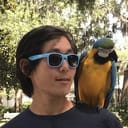
Jan Zheng, MHCI
I'm Jan, the other half of Phage Directory, and co-write Capsid & Tail.
Previously, I did data work at Phage Australia / Westmead Institute, where I built the biobank databases, data systems, and bioinformatics workflows for the clinical trial
I have a background in computer science and human-computer interaction, and I'm currently full-time at building the agentic layer for science at Nvidia.