

Issue 304
C&T Round Up for March 2025!


Roundup time! This month, we heard from Aaryan's experience as an undergrad researcher at Paul Bollyky's lab. We picked papers across topics like T4-AAV viral vectors, cell-free synthesis of phages, and taxMyPhage, a new tool for classifying dsDNA phage genomes, and we have a podcast episode between Jessica and Phiogen about the business case for phage therapy.
Sponsor
Sponsor
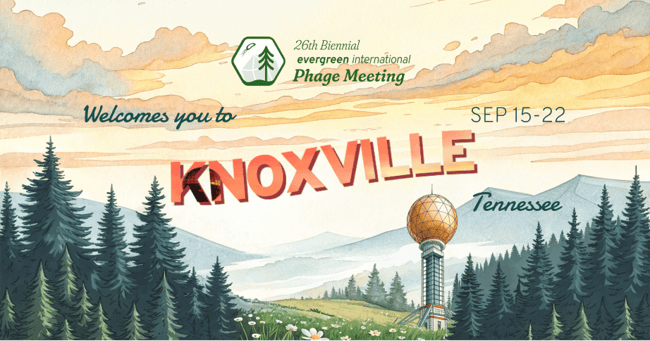
Evergreen 2025 is happening, and for the first time in its 50-year history, we're taking it on the road!
Register for the 26th Biennial Evergreen International Phage Meeting, which will be held August 3-8, 2025, at the University of Tennessee, Knoxville!
Hosted by the Phagebiotics Research Foundation, the Denes Lab, and UTK colleagues, this event aims to bring the magic of Evergreen to a new location.
Follow @Evergreen_Phage on X for updates, or stay tuned here — Jan and Jess are excited to help out again this year!
Community digest5updates1job1post
Updates
Li Yuping (University of California, San Francisco) and colleagues published a new paper on a bacterial immune system targeting jumbo phages, showing it disrupts an early phage infection compartment to block replication.
Brittany Supina (University of Alberta) and colleagues published a new paper on isolation and characterization of a novel Burkholderia jumbo phage, showing it uses flagella as a receptor, controls rice seedling rot, and steers B. glumae toward reduced virulence in rice seedlings.
Himanshu Batra (Catholic University of America) and colleagues published a new preprint on targeted phage T4-based nanoparticles, showing these nanoparticles can reactivate latent HIV-1 in CD4+ T cells without causing global T cell activation or cytokine storm.
Tamsin Redgwell (Copenhagen University Hospital) and colleagues published a new paper on prophage induction in infant gut microbiomes, showing most prophages were actively induced and may modulate host bacterial functionality through accessory genes.
Arne Echterhof (Stanford University School of Medicine) and colleagues published a new preprint on modeling whole-body phage distribution in mice, using Physiologically-based Pharmacokinetic Modeling. They show rapid elimination of phage and the need for multi-dose regimens to maintain detectable phage concentrations.
Jobs
PhD position: Phage pharmacokinetics at UiT The Arctic University of Tromsø, Vascular Biology Research Group in Tromsø, Norway
This PhD project aims to explore the pharmacokinetics and biodistribution of phages using clinically relevant mouse models and primary human cell cultures. Specifically, the study will investigate the role of the liver's scavenger system, including Kupffer cells (KCs) and liver sinusoidal endothelial cells (LSECs), which are known to play a significant role in the clearance of bloodborne pathogens and nanoparticles.
For more info, please contact: anett.k.larsen@uit.no
Community board
Dear Phage Protein enthusiast,
We are pleased to invite you to The Phage Protein Meeting, September 10-11, 2025 in Ghent, Belgium.
The Phage Protein Meeting is an interdisciplinary conference organized by academics and dedicated to advancing the field of phage proteins for biocontrol. This event will bring together academic researchers and professionals who are actively working with phage proteins such as phage lysins, tail fibers, tailspikes, depolymerases, and tailocins.
Sincerely, Daniel Nelson on behalf of the Organizing Committee
Hi Phans!
We hope you’ve had a great March! Jessica and I just moved to Palo Alto, to be much closer to her Stanford lab. We’re now just five minutes away!
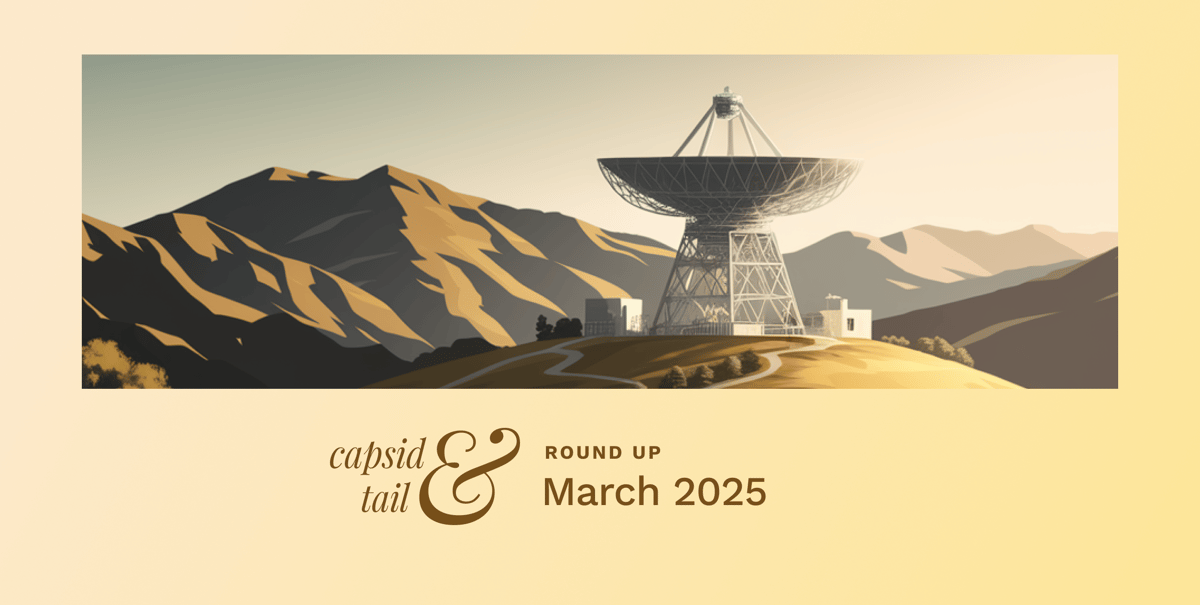
The Cover image pictured above is of the Stanford Dish, a radio telescope built in 1961 by the Stanford Research Institute, and is on Stanford campus. They still do research there, but nowadays it’s a popular hiking trail called “The Dish!”
Meanwhile, here’s what we covered this month in Capsid.
Best,
~ Jan & Jessica
A tale of three viruses (and how I discovered them)
by Aaryan Harshith
In this article, Aaryan Harshith recounts his year-long journey as an undergraduate researcher at Stanford's Bollyky Lab, where he successfully isolated and characterized three novel bacteriophages. Starting with wastewater samples from Stanford's Resource Recovery Center, Aaryan details his process of phage isolation, purification through multiple rounds of plaque assays, genome sequencing, and finally electron microscopy visualization. After months of trial and error, his persistence paid off when VIRIDIC analysis confirmed his phages (named Cardinal, Vanta, and Luminis) were indeed new species, with two showing activity against clinical antibiotic-resistant Pseudomonas strains.
Our Phage Picks for March 2025
by Jessica and Jan Zheng
In this article, Jess and I continue to pick our favorite papers from the phage field. Jess picked two papers: one about a hybrid T4-AAV viral vector that can deliver massive DNA payloads (up to 170kb) into human cells, and another on cell-free synthesis of bacteriophages including complex ones like T4. I picked taxMyPhage — a new automated tool from Andy Millard’s lab for classifying dsDNA phage genomes with over 96% accuracy that syncs with ICTV's database.
If antibiotics companies fail, why won’t phage companies?
by Jessica Sacher
In this article / podcast, Jessica interviews Amanda and Mayukh of Phiogen, a company spun off from TAILOR Labs’ efforts to scale up personalized phage therapy. They explore how Phiogen is differentiating itself with their rapid phage evolution tech (the “Directed Evolution Machine”). They also consider new business and pricing model precedents like the recent Live Biologic Products approvals for C. diff infections — which could open the door to $10k per treatment for phage therapy!
Getting phage research funded: Joe Campbell reflects on a career at NIAID
by Jessica Sacher
C&T Throwback: Here’s a fairly recent article covering how to get funding from NIAID, and how to work with Program Officers. With all the funding cuts, this almost feels like a throwback to a previous era.
Jan Zheng, MHCI
I'm Jan, the other half of Phage Directory, and co-write Capsid & Tail.
Previously, I did data work at Phage Australia / Westmead Institute, where I built the biobank databases, data systems, and bioinformatics workflows for the clinical trial
I have a background in computer science and human-computer interaction, and I'm currently full-time at building the agentic layer for science at Nvidia.

Jessica Sacher, PhD
I'm a co-founder of Phage Directory and have a PhD in Microbiology from the University of Alberta (I studied Campylobacter phage biology). For Phage Directory, I help physicians find phages for their patients, and I'm always trying to find new ways to help the phage field grow (especially through connecting people and highlighting awesome stuff I see happening in the field).
I spent 2022-2024 as a postdoc in Jon Iredell's group at Westmead Institute for Medical Research in Sydney, Australia, helping get Phage Australia off the ground. I helped set up workflows for phage sourcing, biobanking, diagnostics, production, purification and QC of therapeutic phage batches, and helped build data collection systems to track everything we did. We treated more than a dozen patients in our first year, and I'm so proud of that!
As of 2024, I joined the Bollyky lab at Stanford University as a Staff Scientist, where I'm focused on phage engineering and delivery (to both microbial and human cells) and hydrogel-embedded phage cocktail development for wounds!