

Issue 45
Optimizing phage amplification

Are you a company or lab that needs to produce phages in high quantities? This week, Craig Loftus of Cellexus tells us about how their CellMaker system can help you get higher phage titres in less time and with less cleaning.
Community digest6updates2jobs4posts
Updates
Next week (Wed-Thurs; Sept 25-26), we'll be at the Phage Futures EU conference in Brussels, and we won't release a Capsid & Tail issue. Instead, we'll be hosting Phage Futures Live on our site. Tune in to keep up to date with the conference, which will cover progress toward phage therapy commercialization around the world.
Thanks in advance to our two social media assistants who'll be accompanying us to the event: Aël Hardy (@ael_hardy) and Francesca Hodges (@fhodges_)!
At the end of 2018, Phage Directory helped coordinate a phage sourcing effort on behalf of a patient in Helsinki. More than 10 labs around the world sent or tested around 200 phages. As of today, some of the results of this effort have been published! The paper describes the genomic characterization of two of the phages isolated for their ability to lyse the patient's isolate. The paper was coauthored by Ortal Yerushalmy and colleagues in Ronen Hazan's group at the Hebrew University of Jerusalem and by members of Mikael Skurnik's group at the University of Helsinki.
Kevin Forsberg (Fred Hutchinson Cancer Research Center) and colleagues have published a new paper in eLife on a high-throughput method to find new phage-encoded anti-CRISPR proteins. The method involves expressing gene fragments from human oral and fecal metagenomes in E. coli and screening for Cas9-inhibitory activity. Excitingly, they found a new anti-CRISPR protein that inhibits Cas9 by a new mechanism, and works on divergent Cas9s.
Armata Pharmaceuticals has developed a new synthetic phage candidate targeting P. aeruginosa to treat serious respiratory infections, with an emphasis on cystic fibrosis patients. The cocktail, a mixture of synthetic and natural phages, has been elevated to the lead clinical candidate in their pipeline, and clinical trials to test its efficacy are being planned in both the US and Europe.
The Vellore Institute of Technology School of Bio Sciences and Technology and the Society for Bacteriophage Research and Therapy Ganga is hosting an International Conference on Bacteriophage Research and Antimicrobial Resistance (ICBRAMR-19) in Vellore, India from Dec. 12-13, 2019. Submit abstracts by Oct. 15, and register by Nov. 30 (Oct. 10 for early bird!).
Bloomberg has done a podcast on phage therapy. In it, a patient who got a heart transplant thanks to phage therapy is interviewed, Steffanie Strathdee speaks about phage therapy-antibiotic synergy, and Martha Clokie talks about finding phages. [25 min]
Jobs
4 Full Professorships: Microbiome Dynamics, Viral Ecology and Theoretical Microbial Ecology
The Cluster of Excellence Balance of the Microverse at the Friedrich Schiller University combines expertises in life, optical, material and computational sciences to elucidate the role of microbiomes in different habitats in order to identify overarching regulatory principles that can be harnessed to address societal needs in healthcare and environmental stewardship.
We encourage applications from researchers with a broad experience in viral ecology, including aquatic ecosystems or other habitats.
We are looking for an individual experienced in theoretical ecology with focus on microbiology, systems biology theory development, bioinformatics and/or modelling.
Faculty position in CryoEM
The Department of Biochemistry and Molecular Biology at Michigan State University seeks outstanding applicants for a tenure-track position at the Assistant/Associate level with expertise in cryo-electron microscopy (Cryo-EM) and the ability to develop a vigorous, externally funded research program that will complement existing strengths in the areas of structural, membrane protein, computational, biomedical, microbial, and plant biochemistry. Michigan State University is building and committed to expand a state-of-the-art Cryo-EM facility. We are currently operational with a Talos Arctica outfitted with a phase plate and Falcon 3 camera to support this research area.
Community board
Seeking graduate research position
I am Ritam Das, a third year undergraduate student studying Life Sciences at Acharya Narendra Dev College, University of Delhi. I’ve been actively working at the Anti-Mycobacterial Drug Discovery Lab of our college under the guidance of Dr. Urmi Bajpai since December 2018, wherein I am trying to isolate, purify and characterize Mycobacteriophages and phage-derived proteins. Currently, I’m looking for graduate programs (Masters/Masters-PhD integrated) at institutes working on bacteriophages. I wish to apply as a full-time student and to associate myself with a lab to explore phages and phage-derived enzybiotics as credible alternatives to antibiotics. Please contact me at ritamdas007@gmail.com if you know of possible opportunities.
Seeking graduate research position
I am Uchenna Precious Nnadi, a graduate of Veterinary Medicine from the University of Nigeria, Nsukka. I am looking for a graduate mentor that will accept to supervise me to develop into a fantastic phage researcher and to provide impactful research and skill to my local community and country, thereby enabling me to grow into a great scientist that will meet local and global issues that relates to health. Please contact me at nnadi.ucheprecious@gmail.com if you know of possible opportunities.
Seeking tips on imaging phage infection
Hoping to get some really cool #TEM images of cool #phages infecting #bacteria really soon. Anyone have any advice on imaging a phage infection? — @MotherOfPhage | Tweet thread
Seeking community input on using multiple hosts to isolate phages
Anyone inoculate their samples for enriched isolation of phage with multiple hosts to save resources? —@BryanGibb2 | Tweet thread
Optimizing phage amplification
The issue of low PFU/ml results when amplifying phages is a common problem facing researchers worldwide. With a focus on quality over quantity at the early development stage, this is often found to be an issue when scaling up for product trials and for full scale manufacturing. Increasing PFU/ml at this stage provides more phage product for use in trials or for selling to clients.
Using flasks for phage amplification
At the research level, amplification of phages in laboratories is commonly carried out in Erlenmeyer flasks, with air being pumped into the media using a pipette as shown in the diagram below. The flask is then transferred to an incubator for temperature control.
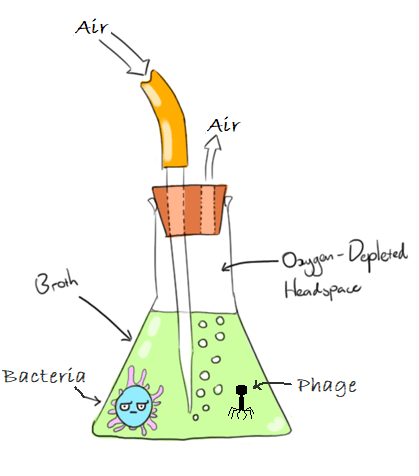
While this technique produces phage product, there are inherent drawbacks to the method which contribute to low and inconsistent PFU/ml results.
Difficulties of working with flasks
- Lack of control due to empiric nature of the flask
- Inability to control temperature effectively in the incubator
- Inability to control gas flow at optimum rate
- Risk of contamination
- Labour-intensive
- Significant downtime between each experiment with cleaning and sterilization required
- Difficult to scale up
Important parameters to control
Working with client trials, we discovered that the following parameters are crucial in optimizing phage amplification:
- Temperature control
- Gas Flow rate
- OD measurements
- Contamination reduction
Using the CellMaker to optimize phage amplification
Having identified these issues and key parameters, we have developed a new solution to improve phage manufacturing. The CellMaker uses a patented, revolutionary airlift technology which provides optimal aeration, and our single-use technology reduces downtime and eliminates the need for cleaning.
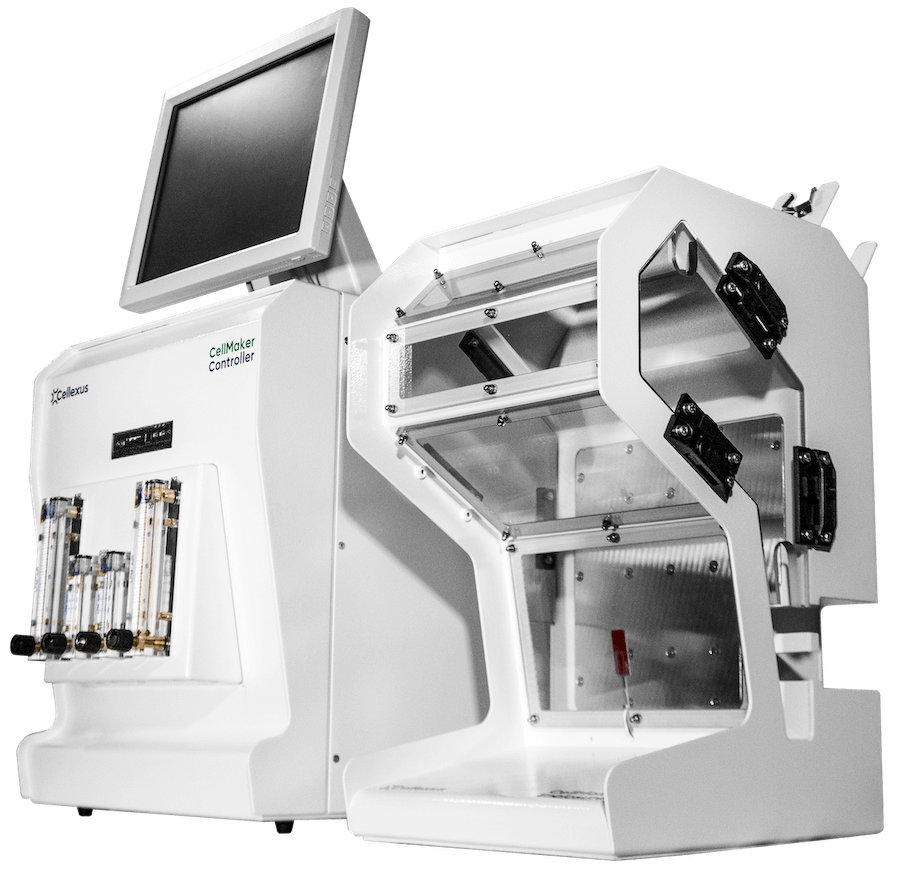
The CellMaker has several key benefits to optimize phage amplification:
- Accurate temperature control to +/- 0.1C provided by a Peltier plate situated within the enclosure unit
- Gas flow rate measured by mass flow controllers, with a tolerance of 0.005L/min, providing the accuracy required for phage amplification
- Real-time optical density measurements from in-situ sensors
- Reduction in contamination due to sterile bioreactors fitted with tubing and connections for “plug and play” convenience
- Reduced downtime due to single use technology, eliminating the need for cleaning and sterilization
- Flexible solution, with working volumes from 3L to 50L
- Further downstream processing can be achieved; a discussion with Cellexus would facilitate this
- Ready to use in a GMP facility with CFR chapter 11-compliant software
Results from the CellMaker
Our technology is flexible and can be used across industries. The CellMaker is currently in use in the animal health, food safety, crop protection and drug discovery industries. Our technology has successfully amplified phages from E. coli, Salmonella, Listeria, Pseudomonas aeruginosa, Pseudomonas syringae, Staphylococcus aureus and Yersinia ruckeri, all producing exciting results. A selection of these results are seen below:
| Bacteria Used | Starting PFU/ml | Final PFU/ml | Amplification Factor |
|---|---|---|---|
| Salmonella | 5 × 10⁷ | 1 × 10¹⁰ | ×200 |
| E. coli | 1 × 10⁵ | 1 × 10⁸ | ×1000 |
| E. coli | 1 × 10⁹ | 3 × 10¹⁰ | ×30 |
| Pseudomonas syringae | 1 x 10⁹ | 3 × 10¹⁰ | ×30 |
Reduced manufacturing costs
Manufacturing cost is key to the success or failure of a product, and the significance of choosing the best technology for scaling up your process cannot be underestimated.
Summary
The CellMaker is producing exciting phage amplification results due to the ability to control process parameters, the speed and ease of single-use technology, and the efficiency of the airlift process. This results in optimized PFU/ml results and a faster route to market.

Craig Loftus
[Craig retired from Cellexus in 2019 and his email address is no longer monitored — if you need to reach Cellexus, visit https://cellexus.com/contact/]
Craig T Loftus is the former Director of Sales and Marketing at Cellexus International Ltd, based in Dundee, Scotland. Craig has over 34 years’ experience in the biotechnology industry. He has worked for many key players within the industry, including Merck, GE, Millipore’s bioprocessing group and Stedim Industries where he was a product manager in the implementation of single use technologies.